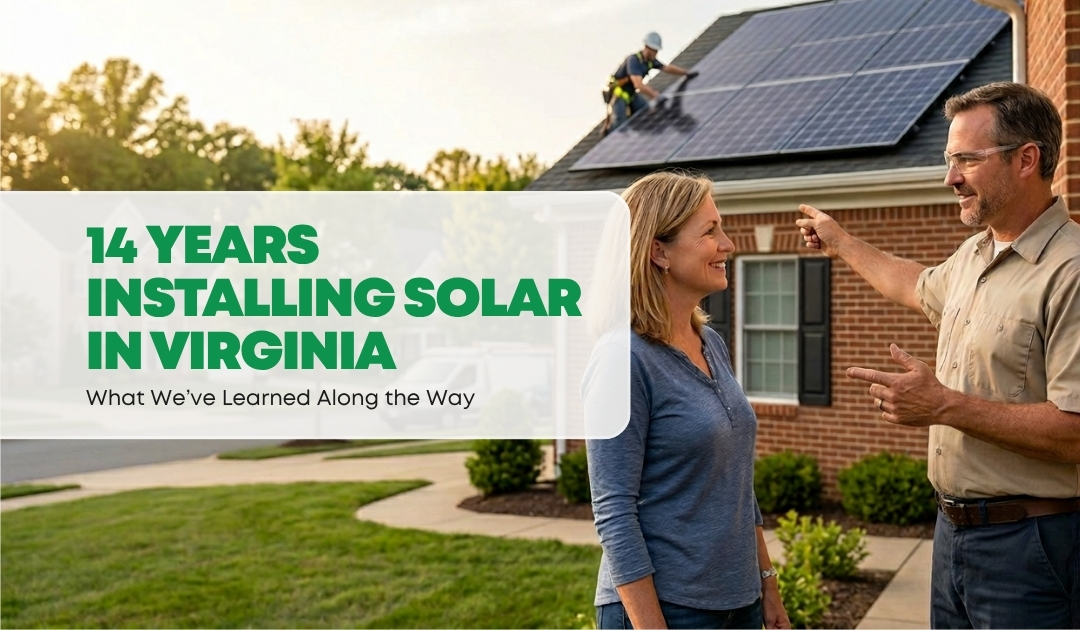
After more than 14 years and over 7,000 completed installations, our solar installer Virginia experience has taught us that the biggest factors behind a successful solar project are rarely the ones homeowners expect.
While many people focus on panel brands, incentives, and equipment specifications, long-term solar performance often comes down to system design, local expertise, installation quality, and the ability to navigate Virginia’s unique permitting requirements, utility programs, weather patterns, and homeowner concerns.
When we installed our first systems in Virginia, the residential solar industry looked very different. Equipment was less efficient, battery storage was uncommon, and many homeowners were still unsure whether it made sense in Virginia.
Since then, we have worked with thousands of homeowners across Virginia Beach, Chesapeake, Norfolk, Hampton, Suffolk, Richmond, and Northern Virginia, and we have seen firsthand what consistently leads to successful outcomes.
The lessons below come directly from projects completed throughout Virginia over the last 14 years. If you are evaluating solar companies and looking for the best combination of expertise, reliability, and long-term support, these are the lessons we believe every homeowner should know.
Quick Summary
- After more than 14 years and 7,000+ Virginia installations, Convert Solar has learned that successful solar projects are driven by thoughtful system design, local expertise, and long-term support.
- Virginia homeowners often underestimate how much a properly designed solar panel system can produce over a full year. Real-world performance depends on roof conditions, system design, and annual energy production.
- One of the biggest lessons from Convert Solar’s solar installer Virginia experience is that rising utility costs can make long-term energy savings just as important as lowering today’s monthly bill.
- Homeowner priorities have evolved over the past decade, with growing interest in battery storage, energy resilience, electric vehicle charging, and future-proof system designs that can adapt to changing household energy needs.
- Convert Solar’s experience navigating Virginia permitting requirements, HOA processes, utility programs, and regional considerations across Virginia Beach, Hampton Roads, Richmond, and Northern Virginia helps homeowners reduce risk and make more confident solar decisions.
How Our Solar Installer Virginia Experience Changed the Way We Design Systems
One of the first lessons we learned is that every home is different.
Homeowners often ask how many panels they need, but after thousands of installations, we have found that panel count is rarely the most important factor. The question is whether the system is designed around the home’s energy needs, roof characteristics, future plans, and long-term goals.
Two homes with identical panel counts can produce very different results depending on roof orientation, shading, roof pitch, and energy consumption patterns.
Over the years, our solar installer Virginia experience has shown us that homeowners achieve the best results when the system is customized to their specific situation rather than built around a generic formula. This approach is especially important when designing solar panels for residential home applications, where factors such as energy usage, roof layout, budget, and long-term savings goals can significantly influence overall performance and return on investment.
The most successful projects begin with understanding what the homeowner wants to accomplish. Some prioritize maximizing savings. Others want energy independence. Some are preparing for future electric vehicle charging, while others are interested in battery storage. A properly designed system takes all of these factors into account.
Virginia Produces More Solar Energy Than Most Homeowners Expect
One of the most common misconceptions we hear is that Virginia’s cloudy weather limits the effectiveness of solar panels.
Many homeowners compare Virginia to states such as Arizona and assume solar performance must be significantly lower. While Virginia certainly experiences cloudy weather, annual production is what matters most.
Solar systems are designed around yearly energy generation. A typical Virginia solar system experiences seasonal fluctuations. Production tends to be highest during spring and summer months and lower during winter. However, what matters is how the system performs across an entire year.
Many homeowners are surprised to discover that Virginia receives enough annual sunlight to support strong residential solar production. In fact, some of the highest-performing solar panel systems we have installed are in areas where homeowners initially doubted they would produce enough energy.
This is one reason solar panels are often worth it in Virginia for homeowners with a suitable roof and long-term ownership plans.
Utility Rate Increases Matter More Than Most People Realize
When we first began installing residential solar systems in Virginia, most homeowners focused on one thing: their current utility bill. Today, homeowners are increasingly concerned about future electricity costs.
One thing our solar installer Virginia experience has consistently shown us is that many homeowners underestimate how much utility rates can change over the lifespan of a solar system.
A solar investment is measured over decades. As utility rates increase, the value of every kilowatt-hour your solar system produces also increases. While no one can predict future electricity costs with certainty, many homeowners find that the long-term savings become more significant over time.
This shift in perspective often changes how homeowners think about the long-term value of a solar panel system. Instead of focusing solely on today’s bill, they begin considering what energy costs may look like 10, 20, or even 25 years from now.
The Best Solar Systems Are Designed for the Future
A common mistake homeowners make is designing a solar system around their current electricity usage without considering future changes. Over the years, we have seen many households significantly increase their electricity consumption after installing a solar panel system.
Common examples include:
- Purchasing an electric vehicle
- Installing a heat pump
- Expanding living space
- Adding a home office
- Growing family energy needs
The most effective solar systems account for these future possibilities. Planning ahead often prevents homeowners from outgrowing their system only a few years after installation.
Thinking long term is one of the most valuable lessons we have learned through thousands of residential solar projects.
Battery Storage Has Changed the Conversation
In 2012, most homeowners wanted to discuss solar panels. In 2026, many homeowners want to discuss batteries. Our solar installer Virginia experience reflects a significant shift in homeowner priorities. While savings remain important, resilience has become equally important for many families.
Questions we hear today include:
- What happens during a power outage?
- Can I keep critical appliances running?
- How much backup power do I need?
- Should I install a battery now or later?
Battery storage has become one of the fastest-growing parts of residential solar panel systems because homeowners increasingly want more than monthly savings. They want greater control over how their home uses, stores, and relies on energy.
Equipment Matters Less Than Installation Quality
Homeowners often spend considerable time comparing panel brands and equipment specifications. While quality equipment is important, installation quality often plays a larger role in long-term system performance.
A premium solar panel installed incorrectly will not perform as well as a properly designed and professionally installed system using quality components. When evaluating companies, homeowners should look beyond product specifications and consider the depth of a company’s solar installer Virginia experience.
Questions worth asking include:
- How long has the company been in business?
- How many systems have they installed?
- Do they handle installation in-house?
- Will they provide support after installation?
- What do customer reviews say about long-term service?
The answers often reveal more about future satisfaction than the equipment list itself.
The Most Important Day Is Not Installation Day
Many homeowners view installation day as the finish line. It is the beginning of a relationship that may last decades. Solar systems are long-term investments, and homeowners should consider what happens years after the installation is complete.
Monitoring, service, warranty support, troubleshooting, and future upgrades all play an important role in ownership satisfaction. One lesson we have learned repeatedly is that long-term support matters far more than most homeowners initially realize.
The best solar companies remain available throughout the life of the system.
Every Region of Virginia Has Different Solar Considerations
Regional knowledge is another area where solar installer Virginia experience can make a meaningful difference. Virginia is a geographically diverse state, and the conditions that shape a solar project vary significantly depending on where a homeowner lives.
Virginia Beach and Hampton Roads
Coastal conditions, salt-air exposure, and hurricane season preparedness are often part of project planning in this region. Systems need to be designed for wind load and corrosion resistance alongside the standard performance considerations. Virginia Beach averages approximately 213 sunny days per year, making it one of the stronger solar markets in the mid-Atlantic.
Richmond Metro Area
Many homeowners in Richmond focus on balancing energy savings with long-term property value improvements. The region sits in the middle of Virginia’s solar production range and benefits from a relatively straightforward permitting environment compared to more complex jurisdictions.
Northern Virginia
Larger homes, higher energy consumption, and complex HOA environments frequently influence system design decisions in Northern Virginia. Homeowners here often have higher electricity usage, which can make solar economics particularly compelling when systems are sized correctly.
Southwest Virginia and the Roanoke Metro
Southwest Virginia operates under a different utility territory which affects net metering terms and interconnection processes. The region averages slightly fewer peak sun hours than coastal Virginia at approximately 4.5 per day, and the seasonal production swing is more pronounced. Systems here are sized with that annual rhythm in mind. The fundamentals of good installation are the same. The regional variables simply require a different set of local decisions.
Whether homeowners are in Virginia Beach, Richmond, Northern Virginia, or the Roanoke corridor, local knowledge helps ensure the system is optimized for the specific conditions, utility environment, and permitting requirements of that region.
Experience Reduces Risk
Technology changes. Equipment evolves. Policies and incentives shift. What remains constant is the value of experience. Every solar project involves hundreds of decisions related to design, engineering, permitting, utility coordination, installation, and long-term service.
Most homeowners only go through this process once. Experienced installers go through it every day. After more than 7,000 installations, we have learned that experience helps identify potential issues before they become problems, improves project outcomes, and creates a smoother path from consultation to activation.
What We Have Learned After 14 Years and 7,000+ Virginia Installations
If there is one lesson that stands above all others, it is this: Successful solar projects are rarely defined by equipment alone.
They are defined by thoughtful design, local expertise, installation quality, and long-term support. Our solar installer Virginia experience continues to reinforce the same conclusion year after year: homeowners benefit when they work with a team that understands Virginia’s unique environment, regulations, utility landscape, and long-term solar performance considerations.
Many of the questions homeowners are asking today have already been solved hundreds of times through projects completed across the Commonwealth. That accumulated experience helps reduce uncertainty, improve outcomes, and provide greater confidence in one of the most important home improvements many homeowners will ever make.