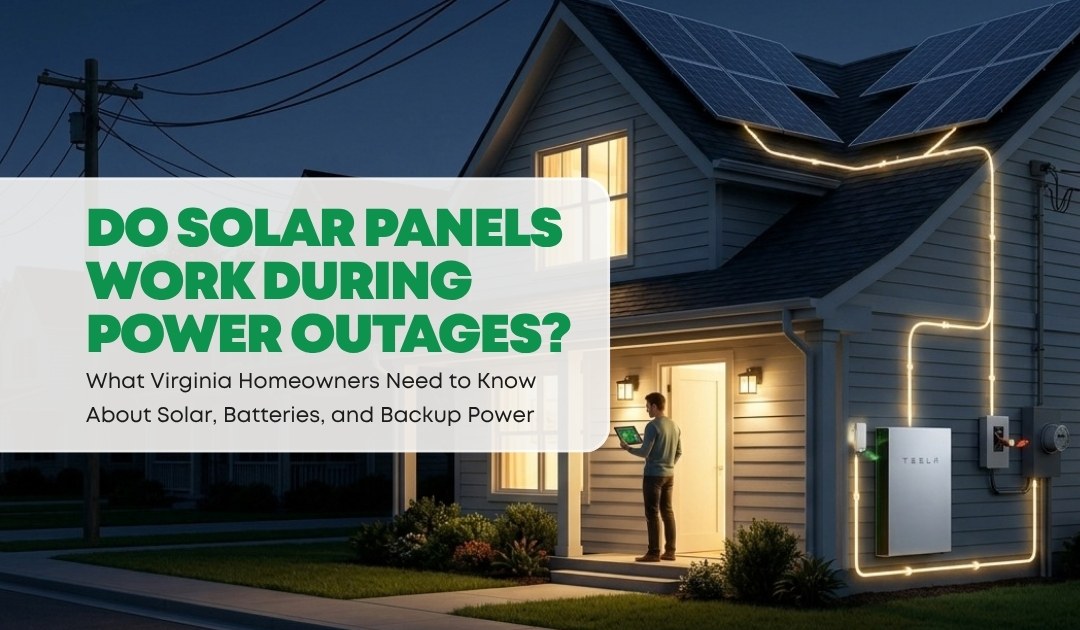
Quick Answer: For most Virginia homes, the answer to “do solar panels work during power outages” is no. A standard grid-tied solar system shuts off automatically when the utility grid goes down, even at noon on a clear day, because its inverter is required to stop sending electricity onto lines that crews may be repairing. Solar can keep your home running through an outage when it is paired with battery storage and equipment that safely separates your home from the grid.
Key Takeaways
- A standard grid-tied solar system without a battery shuts down during a grid outage, including in full sun.
- The shutdown comes from anti-islanding protection, a required inverter safety function. Certified inverters stop exporting power within about two seconds of losing the grid.
- Solar panels can power a home during an outage when the system includes battery storage, a backup-capable inverter, and a device that isolates the home from the grid.
- One battery is generally sufficient for critical-load backup. Whole-home backup typically requires at least two batteries.
- A fully charged 13.5 kWh battery running 0.75 kW of critical loads lasts about 18 hours with no sun, and daytime solar can recharge it.
- Virginia customers averaged about 7 hours without power in 2024 when major storms are included, according to the U.S. Energy Information Administration.
Why do solar panels shut off during a power outage?
Grid-tied solar panels shut off during a power outage because their inverters are required to stop producing power when the utility grid goes down. This safety feature, called anti-islanding protection, prevents a home solar system from sending electricity onto power lines that lineworkers believe are de-energized. When comparing solar installation companies in Virginia, homeowners should ask about battery backup options that can keep essential appliances running during an outage.
How a grid-tied solar system depends on the grid
Solar panels produce direct current (DC) electricity. Your home runs on alternating current (AC), so an inverter converts the power and matches it to the voltage and frequency of the utility grid. A standard grid-tied inverter treats the grid as its reference signal. For the basics, see how solar panels actually work.
When that signal disappears, the inverter has nothing to match. It stops converting power, and the panels on your roof sit idle until the grid returns.
What anti-islanding protection does
Anti-islanding protection is an inverter safety function that detects a grid outage and shuts the solar system down so it cannot energize utility lines. An “island” is a pocket of the grid that stays live from a local power source after the utility has cut power to it.
The risk is to the people restoring service. Virginia’s largest electric utility states that a home generation system is forced offline when electric service is out so it cannot feed electricity onto the grid and put line workers at risk during repairs.
Two national standards set the requirement. IEEE 1547 governs how solar and other distributed energy systems connect to the grid, and UL 1741 is the testing standard inverters must pass. Under IEEE 1547, an inverter must detect an unintentional island and disconnect within two seconds. Utilities in Virginia require certified equipment that meets these standards before a system can interconnect.
The shutdown is a designed safety response. Nothing is broken, and no reset is needed in normal operation.
What happens to your solar power while the grid is down
A grid-tied solar system without a battery produces no usable electricity during a power outage. Nothing is stored, nothing is exported, and no net metering credits accrue during those hours. When utility power returns and stabilizes, the inverter reconnects automatically and solar production resumes. If you’re researching a solar company in Richmond, ask about battery backup options to help keep essential appliances running during outages.
Do solar panels work during power outages if you have a battery?
Yes. Solar panels can work during a power outage when the system includes battery storage and equipment designed for backup. The same utility page that explains the shutdown also says the only way to supply your home from your own generation during an outage is an energy storage system and a transfer switch.
A backup-ready solar system needs three things:
- Battery storage. The battery holds energy and steadies the supply as clouds pass and appliances cycle on and off.
- A backup-capable inverter. This type of inverter can create its own stable AC power signal instead of relying on the grid for one.
- An isolation device. A transfer switch or gateway disconnects your home from the grid during an outage so no power flows back onto utility lines.
Together, these parts let your home operate as its own small, self-contained power system until the grid returns.
What happens when the grid goes down
With a properly configured solar and battery system, the switch to backup power is automatic:
- The system detects the loss of grid power.
- The isolation device opens and separates your home from the grid.
- The battery and inverter begin powering the circuits selected for backup.
- During daylight, the solar panels supply the home and recharge the battery.
- When grid power returns, the system reconnects without any action from you.
Backup power has limits. A battery holds a fixed amount of energy, and how long it lasts depends on what you run.
Is there any solar backup without a battery?
A few system designs can supply limited daytime power without a battery. Some microinverter systems, when installed with additional control equipment, can run a small number of circuits while the sun is shining. Output rises and falls with sunlight and stops at night, so this setup does not replace battery backup for storms or overnight outages.
Which solar batteries does Convert Solar install for outage backup?
Convert Solar installs three battery storage systems for home backup: Tesla Powerwall 3, Enphase IQ Battery 5P, and Enphase IQ Battery 10C. Tesla Powerwall 3 is generally Convert Solar’s preferred battery option, and the right choice depends on your existing equipment, your electricity use, and what you want to keep running.
| Battery | Usable energy | Continuous power |
| Tesla Powerwall 3 | 13.5 kWh | 11.5 kW |
| Enphase IQ Battery 10C | 10 kWh | 7.08 kW |
| Enphase IQ Battery 5P | 5 kWh | 3.84 kW |
Two numbers matter when comparing batteries. Usable energy, measured in kilowatt-hours (kWh), tells you how long a battery can run your loads. Continuous power, measured in kilowatts (kW), tells you how much it can run at the same moment. Specifications come from Tesla and Enphase product documentation.
Battery storage systems typically start around $18,000, with final pricing depending on equipment selection, system design, installation complexity, and homeowner energy needs. Battery warranties run approximately 10 to 15 years depending on the manufacturer and model.
What can a solar battery keep running during an outage in Virginia?
One battery is generally sufficient for critical-load backup, which covers the circuits you most need during an outage. Whole-home backup typically requires at least two batteries. The right size depends on your household electricity use, the loads you select, your system configuration, and your backup goals.
Critical-load backup usually covers:
- Refrigerator and freezer
- Lighting in main rooms
- Internet, phones, and device charging
- Medical devices
- Security system
- A sump pump or well pump, if the battery can handle its startup surge
Whole-home backup adds large loads such as central air conditioning or a heat pump, an electric water heater, an electric range, a dryer, and an EV charger. These appliances draw several kilowatts each and can drain a single battery in a few hours.
Consider a Norfolk homeowner who wants to get through a storm outage with food kept cold, lights on, phones charged, and a sump pump ready. That is a critical-load goal, and one battery is the usual starting point. A household on a well in a rural part of the state that also wants air conditioning during a summer outage has a whole-home goal and should plan for at least two.
How long will a solar battery last during a power outage?
A solar battery lasts as long as its usable energy divided by the power your home draws. The formula is: runtime in hours = usable battery capacity in kWh ÷ average load in kW.
The table below applies that formula to the three batteries Convert Solar installs. It assumes the battery starts full and receives no solar recharge. Actual runtime will be somewhat shorter because of conversion losses and any reserve setting.
| Battery | Usable energy | Runtime at 0.75 kW (light critical loads) | Runtime at 1.5 kW (heavier critical loads) |
| Tesla Powerwall 3 | 13.5 kWh | About 18 hours | About 9 hours |
| Enphase IQ Battery 10C | 10 kWh | About 13 hours | About 6.7 hours |
| Enphase IQ Battery 5P | 5 kWh | About 6.7 hours | About 3.3 hours |
The main takeaway: with careful use, a single mid-size battery can carry critical loads through an overnight outage. The 0.75 kW and 1.5 kW figures are illustrative averages, and your home’s draw will differ.
Solar changes the picture after sunrise. Virginia receives approximately 4.0 to 4.7 peak sun hours per day, a measure of equivalent full-strength sunlight and not the number of daylight hours. A 9 kW solar array would produce roughly 36 to 42 kWh on an average day before system losses (9 kW × 4.0 to 4.7 hours). Critical loads averaging 0.75 kW use 18 kWh over 24 hours.
On an average day, that array can cover the day’s critical loads and refill the battery. Heavy cloud cover after a storm and short winter days reduce production, so plan around the battery alone for the first night.
How often does the power go out in Virginia?
The average Virginia electric customer went without power for about 7 hours in 2024 when major storms are included, according to the U.S. Energy Information Administration. Excluding major events, the figure was about 2.8 hours. Storms account for most of the time Virginians spend in the dark.
| Virginia reliability measure (EIA) | 2024 | 2023 |
| Average outage time per customer, major events included | 418.3 minutes (about 7.0 hours) | 221.1 minutes (about 3.7 hours) |
| Average outage time per customer, major events excluded | 166.4 minutes (about 2.8 hours) | 159.3 minutes (about 2.7 hours) |
| Average number of outages per customer, major events included | 1.6 | 1.5 |
| Average time to restore power per outage, major events included | 257.1 minutes (about 4.3 hours) | 151.3 minutes (about 2.5 hours) |
The year-to-year swing tells the story. Routine outages stayed nearly flat between 2023 and 2024, while total outage time almost doubled because of major weather events. Hurricanes and nor’easters along the coast, summer thunderstorms in central Virginia, and ice in the western part of the state all bring down lines.
Those averages also hide wide differences between households. A home at the end of a rural line can wait far longer for restoration than a home near a hospital or substation.
This is why homeowners asking “do solar panels work during power outages” should think about their own outage history first. If your power rarely goes out and returns within a couple of hours, solar without a battery may suit you well. If you rely on a well pump, a medical device, a sump pump, or a home office, battery backup is worth pricing alongside your solar system.
Do you need a battery to benefit from net metering in Virginia?
No. A battery is not required for net metering in Virginia. Net metering is a utility billing arrangement that credits eligible solar customers for electricity their systems send to the grid, and it works with a standard grid-tied system.
On April 30, 2026, the Virginia State Corporation Commission issued a final order in Case No. PUR-2025-00079 that kept annual, energy-based netting in place for customers of Virginia’s largest electric utility. A May 20, 2026 clarification order confirmed that approach and noted a $1.00 monthly administrative charge. Appalachian Power and electric cooperatives operate under their own terms.
For most Virginia homeowners, the reason to add a battery is backup power during outages. Solar savings come mainly from the panels and net metering. See how net metering works in Virginia for the billing details.
Solar incentives, utility programs, eligibility requirements, and program deadlines can change. Confirm current requirements with the relevant agency or utility before making a financial decision.
Can you add a battery to an existing solar system?
Yes, in most cases, a battery can be added to an existing solar system. The installation may involve adding a battery, a backup-capable inverter or gateway if the current equipment lacks one, and an isolation device that separates your home from the grid during an outage. Professional solar panel maintenance services can also help assess your existing system’s condition and compatibility before adding battery backup.
An installer will review four things before recommending a retrofit:
- The inverters you already have and whether they can work with the battery
- The capacity and condition of your main electrical panel
- Where the battery can be mounted
- Which circuits you want backed up
Compatibility has improved. Enphase announced that its IQ Battery 10C can be added to existing solar systems that use other manufacturers’ inverters.
If outage backup matters to you and you have not installed solar yet, plan the battery with the solar system. Designing both together avoids reworking electrical equipment later. If your budget only covers panels now, ask for a design that leaves room for a battery. See is solar battery storage worth it in Virginia for a fuller look at cost and value.
Is solar battery backup better than a generator for Virginia outages?
Solar battery backup is the better fit for most short and medium outages, and a standby generator is the better fit for long outages with heavy electrical loads. The two differ mainly in fuel, noise, and how they behave when nothing is wrong.
| Factor | Solar plus battery | Standby generator |
| Energy source | Sunlight and stored electricity | Natural gas, propane, or diesel |
| Runtime limit | Battery capacity and available sun | Fuel supply |
| Noise and exhaust | Silent, no exhaust | Engine noise and exhaust outdoors |
| Upkeep | Minimal | Regular engine service and test runs |
| Value between outages | Works with your solar system every day | Sits idle |
A battery paired with solar refuels itself each morning and needs no fuel delivery during a regional storm. A generator can run large loads for days as long as fuel is available. Homeowners with long outage histories and whole-home needs sometimes use both.
What should you ask an installer about solar backup power?
Ask an installer exactly what will happen at your home when the grid goes down, in writing if possible. Solar and battery systems can be configured in several ways, and a battery installed only for bill management may not be wired for backup.
Bring these questions to any solar or battery consultation:
- Can my solar panels recharge the battery while the grid is down?
- Which circuits will be backed up, and can I change them later?
- How long will the battery run those circuits on a typical night?
- Can the battery start my well pump, sump pump, or air conditioner?
- Does the switch to backup happen automatically?
- What does the battery warranty cover, and for how long?
The first question matters most. A system that cannot recharge from solar during an outage is limited to whatever energy the battery held when the power went out.
Frequently asked questions about solar panels and power outages
Can solar panels power a house during an outage without a battery?
Not with a standard grid-tied solar system. The inverter shuts down when the grid fails, so the panels produce no usable power. A small number of specialized setups can supply limited daytime power to a few circuits without a battery, but they stop at night and fluctuate with cloud cover. Reliable outage power requires battery storage.
Will solar panels recharge a battery during a multi-day outage?
Yes, when the system is designed to operate while disconnected from the grid. During daylight the panels power the home and send extra energy to the battery, which then carries the home overnight. Recharging is slower on overcast days and in winter, so reducing your electricity use during a long outage helps the battery last.
Does solar battery backup turn on automatically?
Yes. A solar battery system configured for backup detects the outage, disconnects the home from the grid, and begins powering the backed-up circuits without any action from the homeowner. When utility power returns, the system reconnects on its own. Confirm with your installer that your battery is set up for backup and not only for daily energy use.
Can a solar battery run an air conditioner or a well pump?
Often, yes, but it depends on the equipment. Motors in air conditioners and well pumps draw a brief surge of power at startup that can exceed what a small battery delivers. An installer should check the appliance’s startup demand against the battery’s power rating. Running central air conditioning for long periods generally calls for more than one battery.
Do solar panels work at night or on cloudy days?
Solar panels do not produce electricity at night, and they produce less under cloud cover, though cloudy weather does not stop production entirely. During normal operation the grid covers the difference. During an outage, a battery supplies stored energy at night and on dim days until the sun returns.
Find out what backup power would take at your home
The answer to “do solar panels work during power outages” at your address depends on the equipment installed there, and a short review of your home can tell you what backup would involve.
Convert Solar is a residential solar installer with 8,500 systems across Virginia and Maryland, and its current battery lineup includes Tesla Powerwall 3, Enphase IQ Battery 5P, and Enphase IQ Battery 10C. Bring your electric bill and your questions to a Convert Solar consultation. We can review which circuits you want to keep running, how many batteries that would take, and what your home’s roof and electrical panel can support.
Related reading: how solar panels hold up in Virginia hurricanes, how solar panels perform on cloudy days in Virginia, and the complete residential solar installation guide for Virginia homeowners.