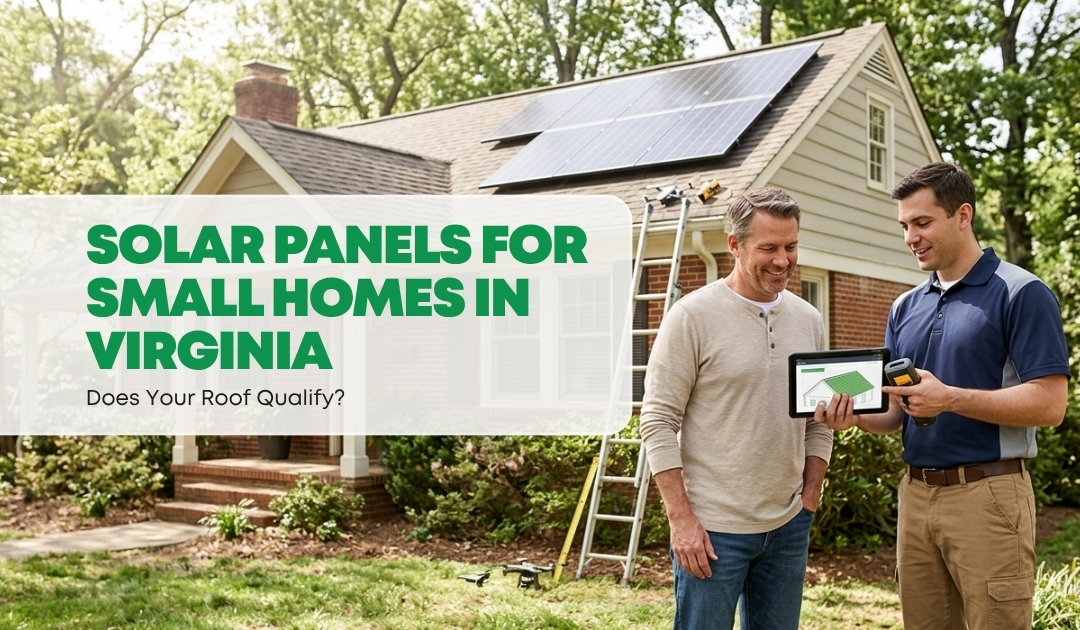
Solar panels on a small home in Virginia work, and the assumption that your roof is probably too small is the single most common reason Hampton Roads homeowners never find out whether their specific home qualifies.
A 5 kW system in Virginia costs approximately $13,262 to install. A 5 kW system on a Hampton Roads home using 600 kWh per month offsets approximately 80–100% of that home’s electricity consumption. A 1,200 sq ft Virginia Beach bungalow with a south-facing, unshaded 250 sq ft roof section qualifies for exactly that system, and the qualifying question has nothing to do with the home’s square footage.
This blog answers two versions of the same question:
- Is a small system actually worth the hassle, and will a solar company even bother with my roof?
- Does a small system make a real difference, or is it just symbolic?
Both answers are yes, with specifics, with numbers, and with the honest exceptions that tell you when the answer is actually no.
Quick Summary
- Small Virginia homes can qualify for solar when they have enough usable, unshaded roof space facing south, west, or east.
- Square footage is not the deciding factor; roof orientation, shading, condition, and electricity usage matter more.
- A 4–6 kW system can be enough for many small Hampton Roads homes and may offset 80–100% of annual usage when sized correctly.
- The biggest disqualifiers are heavy shade, aging roofs, weak structure, mostly north-facing roof planes, or very low electricity use.
- Convert Solar’s drone assessment checks the roof, shading, structure, and consumption data so homeowners know exactly whether their roof qualifies before committing.
The Right Question Is “Is My Roof Suitable?”
The qualifying factor for solar is not your home’s square footage. It is whether your roof has enough usable, unshaded south-, west-, or east-facing space to support a system that matches your electricity use.
Most homes have more roof space than they need. A typical 1,500 sq ft home can fit 50–60 panels, while most households only need 18–22. The real question is not how many panels fit, but how many are required.
For example, a 3,000 sq ft Virginia Beach home with heavy shading and poor roof orientation may not be a good candidate, while a 1,100 sq ft bungalow with a clean south-facing roof can be ideal. Roof suitability matters far more than home size.
Small homes often need only 10 panels, requiring approximately 170–200 sq ft of usable roof space. Most Hampton Roads homes have enough room to accommodate that on a single roof section. Homeowners evaluating options with a Solar Company in Lynchburg, VA may find that even smaller roof footprints can support meaningful energy production when properly designed.
Solar Panels Small Home Virginia: The Qualifying Criteria
Six factors determine whether a small Virginia home qualifies. Most small Hampton Roads homes meet at least four without any modifications.
Quick qualification guide:
| Criterion | Green flag | Yellow flag | Red flag |
| Roof orientation | South, west, or east facing | Mixed — some north sections | Primarily north facing only |
| Shading | Minimal — less than 20% of usable area | Moderate — some seasonal tree shade | Heavy — continuous shading on primary section |
| Roof condition | 15+ years of life remaining | 5–15 years remaining | Under 5 years — replace first |
| Structural integrity | Built after 1980, standard rafters | Older construction — needs assessment | Identified structural concerns |
| Roof material | Asphalt shingle, metal, tile | Flat or low-slope — workable | Condition-dependent |
| Minimum usable area | 200+ sq ft facing south/west/east | 150–200 sq ft — marginal | Under 150 sq ft — unlikely viable |
Orientation
South-facing roofs are ideal, but west-facing roofs are also strong because they capture afternoon sun during peak usage hours. East-facing roofs can work too. North-facing roof sections are typically excluded from system design.
For small roofs, a west-facing section can still be viable. On a simple north/south gable roof, about half the roof may be usable. A 1,000 sq ft home could still have around 500 sq ft of south-facing exposure before shading adjustments, enough for a meaningful 4–6 kW system.
Shading
Shading is often the bigger issue for small Virginia roofs. Trees, chimneys, dormers, nearby structures, and vents can reduce production. After setbacks, orientation, and obstructions, about 40–60% of a typical gable roof may be usable for solar.
Convert Solar uses module-level electronics, such as microinverters or optimizers, so shading on one panel helps small roofs with partial shade produce more than older string-inverter setups.
Roof Condition
Roofs within five to ten years of replacement should usually be addressed before solar. Removing and reinstalling panels during re-roofing adds cost, especially on smaller systems. Convert Solar’s drone assessment checks roof condition upfront. A sound roof is not an obstacle. An aging roof should be replaced first and included in the total investment decision.
Structural Integrity
Most Virginia homes built after 1980 can support solar. Older homes, especially pre-1950 builds with unusual rafter spacing, may need reinforcement. Convert Solar checks this during the site assessment before money changes hands.
Permitting
Virginia’s Solar Permit by Rule applies mainly to commercial and utility-scale projects. Home solar is handled through local building permits, such as Virginia Beach’s Accela portal. A 2026 update, Virginia HB590, established the Smart Solar Permitting Platform in law to automate plan review and issue permits faster for qualifying residential solar systems, the platform is currently in development and not yet operational statewide.
How Many Solar Panels Does a Small Virginia Home Actually Need?
The number of panels comes from electricity consumption.
The accurate formula: annual kWh ÷ 1,200 = approximate system size in kW. For a small Virginia home using 600 kWh per month: 7,200 kWh ÷ 1,200 = 6 kW. For a very energy-efficient small home using 500 kWh per month: 6,000 ÷ 1,200 = 5 kW.
System size vs roof space, small Virginia homes:
| Monthly usage | Annual kWh | System size | Panels (~400W) | Roof space needed |
| 500 kWh/month | 6,000 kWh | ~5 kW | 12–13 panels | ~210–230 sq ft |
| 600 kWh/month | 7,200 kWh | ~6 kW | 14–15 panels | ~245–265 sq ft |
| 700 kWh/month | 8,400 kWh | ~7 kW | 17–18 panels | ~300–315 sq ft |
| 800 kWh/month | 9,600 kWh | ~8 kW | 19–20 panels | ~330–350 sq ft |
Based on NREL PVWatts production estimates for Hampton Roads (4.6–4.7 peak sun hours/day); ~17.5 sq ft per 400W panel
The Hampton Roads Advantage for Small Systems
Virginia’s annual peak sun hours range from about 4.3 hours per day in the northern Shenandoah region to 4.7 hours per day in the coastal plain around Hampton Roads. Higher irradiance means each panel produces more annually, which means fewer panels are needed to reach the same offset target.
A small Hampton Roads home needs fewer panels per kWh of offset than the same home in Richmond or Northern Virginia, and while Southwest Virginia and the Roanoke metro average slightly fewer peak sun hours at around 4.5 per day, the same qualifying criteria and sizing formula apply. A small home in Roanoke or Christiansburg with a clean south-facing roof qualifies on exactly the same basis as one in Virginia Beach.
Is there a limit to how many panels a small roof can hold?
Yes, available usable area and structural capacity define the ceiling. But for most small Hampton Roads homes, the ceiling is higher than the minimum system size required. Modern 400W panels generate approximately 22–23 watts per square foot of nameplate capacity, meaning a small home installation typically needs about 200 sq ft of usable roof space. For a home using 600 kWh per month and requiring 14–15 panels, the math works on many roofs with at least 250 sq ft of clean south- or west-facing exposure. This is why residential solar panels Virginia homeowners choose today can often fit smaller properties more efficiently than expected.
The Financial Case for a Small System
A 4–6 kW system on a small Virginia home delivers a comparable ROI percentage to a larger system. The savings are smaller in absolute dollar terms, but the investment is proportionally smaller too.
Current Costs for Small Virginia Systems
As of June 2026, the average solar panel system costs $2.65/W including installation in Virginia. A 5 kW system costs approximately $13,262 in Virginia.
The Honest Cost-Per-Watt Note
Smaller systems run slightly higher cost per watt than large systems, fixed installation costs (permits, electrical work, equipment) are spread across fewer watts. A 4 kW system may run $2.80–$3.10/W while a 10 kW system runs $2.40–$2.65/W. This is real. The delta is worth factoring into any comparison with a larger system.
Small-System Cost Table for Virginia in 2026
| System size | Estimated installed cost | Virginia sales tax exemption (~$850–$1,050 saved) | Net cost |
| 4 kW | ~$11,200–$12,400 | ~$560–$620 | ~$10,640–$11,780 |
| 5 kW | ~$13,262–$14,750 | ~$663–$738 | ~$12,600–$14,010 |
| 6 kW | ~$15,900–$18,600 | ~$795–$930 | ~$15,100–$17,670 |
| 8 kW | ~$21,200–$22,400 | ~$1,060–$1,120 | ~$20,140–$21,280 |
The ROI for a Small Hampton Roads System
At $0.16/kWh current Virginia rate: approximately $1,248–$1,344 in annual electricity offset. At a $17,100 installed cost: simple payback approximately 12–14 years at today’s flat rate. At a 3% annual rate escalation, Virginia’s documented trajectory, payback shortens to approximately 9–11 years. Over 25 years: approximately $23,000–$34,000 in electricity cost avoided.
The Loan Path for a Small System
$0 down, monthly payments structured to match or undercut the current electricity bill. A 6 kW system at $17,100 over 20 years at 7%: approximately $132/month. For a small Virginia home currently paying $120–$145/month in electricity, this produces near-neutral to slightly positive monthly cash flow from day one, without the federal tax credit.
Charles Griffin’s 9.36 kW system in Hampton Roads reaches 100% offset because it was sized from his actual consumption data. The same principle applies to a 6 kW system: accurate sizing from real usage data is what produces 80–100% offset, regardless of how small the system is.
SREC Income
Virginia homeowners also earn Solar Renewable Energy Credits for the electricity their system generates, typically 5–8 SRECs per year for a small system, at approximately $22 per SREC. That adds $110–$180 in annual income on top of the bill savings above. With Virginia’s HB 628 expanding program demand, SREC values have room to grow. It is a modest but real line item that belongs in any honest payback calculation.
See Your Small System Numbers →
The Impact Case for a Small System
Not every homeowner researching solar is focused on payback periods. Some are asking a different question: does a small system actually make a real difference, or is it just symbolic?
The answer is yes, in specific, measurable terms.
A 6 kW system in Virginia Beach produces approximately 7,800–8,400 kWh per year. The EPA’s carbon equivalency calculator puts that at approximately 5.5–6 tonnes of CO2 offset annually, the equivalent of planting 130–140 trees per year, or removing one average passenger car from the road. This is a measurable, annual impact from a single home.
Energy Independence on a Small Footprint
The self-sufficient home many Virginia homeowners are imagining does not require a 14 kW system. A 6 kW system with battery backup keeps a small Virginia home powered during outages, offsets 80–100% of electricity consumption across the year, produces clean energy every day the sun shines, and earns net metering credits through the utility that banks in summer and pays down winter draws. The system is smaller, the principle is identical.
Can a small system run AC?
Yes. A 6 kW system can power a small central AC unit during peak production hours. On the hottest Hampton Roads summer days when air conditioning runs continuously, a small system may not fully offset every hour of consumption. However, on an annual net basis, most properly sized small Virginia systems achieve 80–100% energy offset, including summer cooling demand. Working with a Solar Company Chesapeake, VA helps ensure system sizing is based on actual energy usage data and seasonal load patterns for more accurate performance expectations.
Can I run two AC units on a small solar system?
A 5 kW system powering two AC units simultaneously is unlikely to provide full coverage on peak cooling days. Two-AC households typically need a larger system than 5–6 kW. The drone assessment and consumption analysis will identify this and size accordingly.
Can I expand later?
Yes. Convert Solar designs systems with future expansion in mind. Additional panels can be added with a revised interconnection application. Battery storage can be added as a separate upgrade after the initial installation. A small system today is a starting point.
What Actually Disqualifies a Small Virginia Roof?
Some small roofs genuinely do not qualify. Knowing the real disqualifiers is more useful than a blanket reassurance.
- North-facing primary slope with no viable secondary section. If the majority of the roof faces north and the south or west-facing portion is under 150 sq ft or heavily shaded, the drone assessment will say so. This is uncommon but real.
- Roof within two to three years of replacement. The cost of removing and reinstalling panels during a re-roof can erode the economics of a small system. Honest advice: re-roof first.
- Heavy continuous shading from mature tree canopy. If the primary south-facing section receives fewer than four hours of direct sun per day, annual production will not support a financially viable system. Strategic pruning can sometimes resolve this, the assessment identifies whether it is an option.
- Structural concerns on older construction. Pre-1950 homes with non-standard rafter spacing may require reinforcement before installation. This adds cost. The assessment identifies it upfront, before any commitment is made.
- Very low electricity consumption. A home using 300–400 kWh per month may not generate enough bill savings to make a rooftop system financially worthwhile, the system cost is too large relative to the electricity cost it offsets. Shared solar is a better fit for very low-usage households.
What About Balcony Solar, Plug-In Panels, or Portable Systems?
Balcony solar kits and plug-in systems are becoming more common, but they are supplemental solar. A 400–800W kit may produce about 400–700 kWh per year in Virginia, which is only a small fraction of what a full rooftop system can generate.
That makes balcony solar useful for renters, condo owners, or homeowners who cannot install rooftop panels. It is not the same investment, outcome, or financial return as a rooftop system.
For Virginia homeowners who own their roof, rooftop solar is still the better comparison. For those who cannot install panels because of condo rules, shared roofs, or structural limits, Virginia’s shared solar program may be the more practical alternative.
Your Roof Probably Qualifies. The Only Way to Know Is to Check.
Convert Solar has been installing solar in Virginia since 2012. In fourteen years across Hampton Roads, the most common thing we find is not that a small home’s roof fails to qualify, it is that the homeowner assumed it would without ever finding out.
The drone-based site assessment we provide at the start of every quote answers the qualifying question definitively: your roof’s orientation, shading profile, usable area, structural condition, and the system size your consumption requires. It takes about 15 minutes. It costs nothing. It carries no obligation. And it produces the only number that actually matters, the system-specific quote for your specific home.