Solar panels installed in Virginia Beach face hurricane risk, and if you are researching this question, you probably already know it. Hampton Roads has lived through Isabel (2003), Floyd (1999), Charley (1986), and Dorian (2019). These are part of the reason some Hampton Roads homeowners hesitate before committing to $20,000 or more of equipment on their roof.
According to the National Renewable Energy Laboratory, only 0.1% of 50,000 studied solar systems reported damage annually, data spanning installations from 2009 through 2013, covering multiple major hurricane seasons. Solar panels installed on properly engineered racking systems in Virginia Beach are rated to survive Category 3 hurricane winds. But there is one thing a standard solar system cannot do without additional equipment: keep your home powered when the grid goes down.
That is the honest picture. This guide covers both halves of it, the engineering answer for homeowners who want to know whether the panels will survive, and the practical answer for homeowners who want to know whether the house will stay lit when the storm passes.
Quick Summary
- Properly installed solar panels are built to withstand hurricane conditions, with systems like IronRidge XR racking rated for wind loads exceeding Category 3 hurricane strength and a very low historical damage rate of just 0.1% annually across 50,000 studied systems.
- The biggest misconception is that solar panels keep your home powered during an outage. Standard grid-tied solar systems automatically shut down when the grid goes down due to anti-islanding safety requirements.
- Battery storage is what provides backup power during storms. A solar-plus-battery system can keep essential appliances running through multi-day outages and recharge from sunlight while the grid remains offline.
- Hampton Roads homeowners should pay special attention to coastal installation standards, including hurricane-rated racking, roof-rafter attachments, and IEC 61701 salt-mist-certified equipment to protect against long-term corrosion.
- Solar remains a strong investment in Virginia Beach due to high solar production, proven storm resilience, potential home value increases, and the option to add battery backup for energy independence during hurricanes.
Do Solar Panels Survive Hurricanes? The Engineering Answer
Modern solar panels are built for exactly this environment, and the data supports it.
The top wind speed for a Category 3 hurricane is 129mph, and most solar panels are built to weather that and more. Solar panels are made from extremely durable components, including fully heat-tempered glass with the ability to withstand extreme wind and snow loads. The panels themselves are one part of the equation. The racking system, the hardware that secures them to your roof, is the other, and it is where coastal installation standards matter most.
How the Racking System Protects the Investment
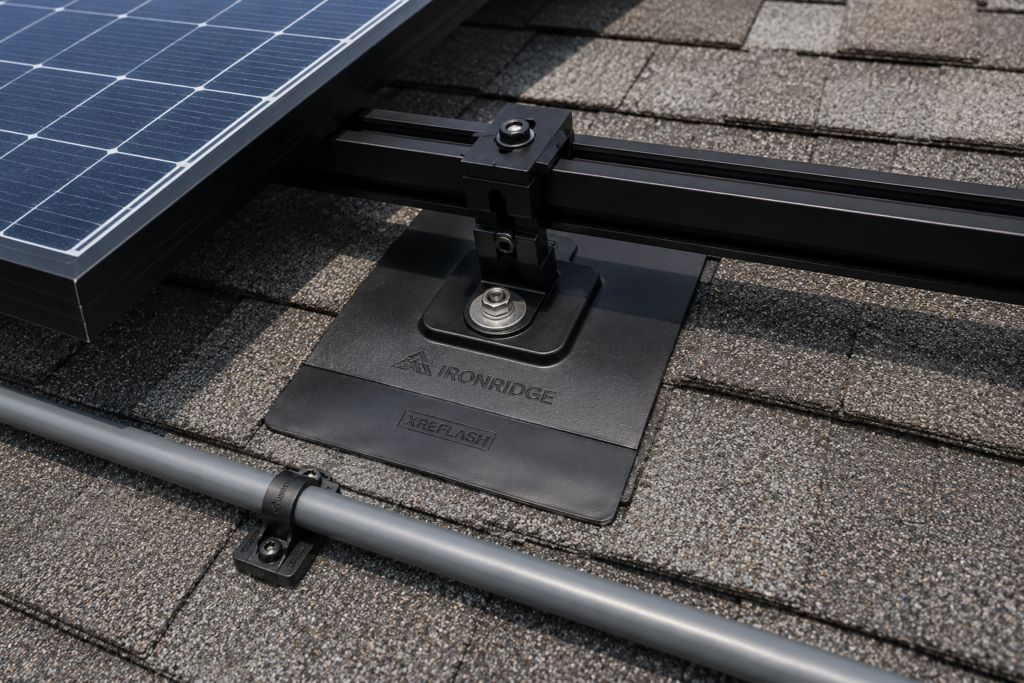
Properly installed solar mounting systems add structural strength to your roof. Racking systems are anchored directly into roof rafters, creating additional support that helps resist wind uplift during storms. The panels are through-bolted into structural framing members beneath the decking. Hurricane-rated mounting systems use through-bolting rather than clamping fasteners, creating a stronger connection that penetrates the roof surface and anchors directly to rafters.
Convert Solar installs IronRidge XR racking on every Hampton Roads installation. IronRidge holds Florida Product Approval (FL#41858) for High Velocity Hurricane Zones, the first solar racking approved in HVHZs, covering Flush Mount systems tested to wind pressures of up to 135 PSF.
That corresponds to wind speeds well above the Category 3 threshold. The CAMO design load rating covers 50 PSF downward, 50 PSF upward, and 15 PSF lateral loads. For Virginia Beach homeowners, this means racking engineered for the precise conditions the region experiences.
The Salt Mist Factor, Specific to Hampton Roads
Salt mist certification (IEC 61701) is critical for any solar installation within five miles of the coast. Salt in the air causes accelerated corrosion of aluminium frames and the silver paste used in solar cells. Virginia Beach homeowners should specifically confirm their installer uses IEC 61701-certified equipment. This is a coastal-specific requirement that matters over the 25-year system life, and one that installers without local coastal experience sometimes overlook.
What the Historical Record Shows
Hurricane Ian struck Babcock Ranch, Florida in 2022. Despite powering the community with 700,000+ solar panels, the installation suffered minimal damage while surrounding structures experienced significant destruction.
Hurricane Maria hit Puerto Rico in 2017 with sustained winds of 155mph at landfall (Category 4, with peak intensity of 175mph before reaching the island). A 645-kilowatt hospital solar array continued operating at full capacity throughout the storm. These are not isolated outcomes. Only 0.1% of 50,000 NREL-studied solar systems reported annual storm damage, and that figure spans multiple major hurricane seasons.
The panels survive when they are installed correctly. That means the right racking, bolted into rafters, with coastal-certified equipment, by a team that knows Hampton Roads building code.
Solar Panels Hurricane Virginia, What Happens When the Power Goes Out
A standard grid-tied solar system shuts off automatically during a power outage. Because the law requires it.
Grid-tied solar inverters are required by UL 1741 and IEEE 1547 standards to shut down during a grid outage. This is called anti-islanding protection, it prevents your solar system from feeding electricity into downed power lines, which could electrocute utility workers repairing the grid.
This shutdown happens whether the storm damages anything or not. A fully intact system, on a clear sunny morning the day after a storm passes, cannot power your home if the grid is still down. The panels are produced. The electricity has nowhere to go. The house is dark.
Why This Is a Specific Hampton Roads Concern
Hurricane Isabel in 2003 left some Hampton Roads residents without electricity for two weeks. Bertha in 1996 knocked out power to 115,000 customers in eastern Virginia. Floyd in 1999 brought 10–20 inches of rain across the region, overwhelming infrastructure for days. Dorian in 2019 brought Category 1 conditions to the coast. These are the regular rhythm of coastal Virginia weather, and they produce the kind of multi-day outages that make the anti-islanding shutdown a practical limitation rather than a theoretical one.
A solar system without battery backup is a system that goes dark during the exact events that motivated many Hampton Roads homeowners to want energy independence in the first place.
The solution is battery backup. And this is the point in the blog where the answer diverges slightly depending on what you are looking for.
Battery Backup: The Financial Case, the Resilience Case, and the Hampton Roads Case for Both
Battery backup is a resilience investment. Understanding that distinction matters.
Solar panels generate savings by replacing electricity you would otherwise buy from the utility. A battery stores electricity that would otherwise be exported to the grid under net metering. Its primary value is keeping your home powered when the grid is down.
In 2026, home battery systems typically cost $10,000–$16,000 installed. An Enphase IQ 5P (5 kWh, essential loads) starts around $6,500. A Tesla Powerwall 3 (13.5 kWh, whole-home backup) runs $13,000–$16,500 depending on location and configuration.
The federal residential tax credit (Section 25D) expired December 31, 2025, there is no federal credit on battery purchases in 2026 for homeowners who own their system outright. Homeowners who lease a battery system may still benefit from the federal 48E commercial investment tax credit through 2027, passed through by the installer, worth asking about when you request your quote.
A $22,000 solar system paired with a $13,000 battery becomes a $35,000 investment with an extended payback period compared to solar alone.
The honest trade-off: a system without storage is less expensive, still delivers strong ROI, and still eliminates most of your electricity bill. A system with storage costs more but keeps the home running when the grid goes down. In Hampton Roads, where multi-day outages are documented in history, that trade-off looks different than it does in inland Virginia. We will tell you honestly which option makes sense for your home and budget when we run your quote.
For Homeowners Focused on What the Home Becomes
The day after a storm passes, sky clearing, crew trucks working the next street over, generator noise two houses down, is the moment the value of a solar-plus-battery home becomes visceral rather than theoretical.
When the grid goes down, the battery system activates island mode automatically. An automatic transfer switch disconnects the home from the grid within milliseconds, and the battery takes over. If the sun is shining, panels continue charging the battery during the outage, extending backup power indefinitely on sunny days.
The fridge stays on. The lights work. The phones charge. The kids sleep in a house that is comfortable. The neighbourhood waits.
A 10 kWh battery paired with solar panels can fully meet backup needs over a 3-day outage in virtually all US locations, per Lawrence Berkeley National Laboratory research, when heating and cooling loads are managed. A single Tesla Powerwall provides approximately 11 hours of whole-home backup for average usage, with strategic load management extending this significantly. For essential loads, fridge, lights, Wi-Fi, phone charging, runtime extends to 24 hours or more from a single battery, with the panels recharging it each day.
This is not a hypothetical future. Convert Solar installs Tesla Powerwall and Enphase IQ Battery as integrated upgrades alongside solar installations across Hampton Roads. The system that keeps the lights on during Isabel’s successor is available now.
Request a Quote and See Solar With and Without Battery Storage for Your Home →
We’ll model both options based on your energy data.
What Does Homeowners Insurance Cover for Solar Panels After a Hurricane?
Most homeowners insurance policies cover roof-mounted solar panels, but Hampton Roads homeowners need to check one specific clause before assuming they are fully protected.
Standard homeowners insurance typically covers roof-mounted solar panels under dwelling coverage against perils including fire, theft, vandalism, and storm damage. Homeowners should notify their insurance provider before or immediately after installation to ensure adequate coverage limits.
The clause to check: wind exclusions. In coastal states, wind and flood damage may be excluded from standard homeowners insurance policies. In 19 coastal states, wind insurance is a separate policy with a percentage deductible of approximately 1–5% of the home’s value. Virginia is among the states where this separate windstorm coverage may apply depending on your insurer and policy. Check specifically whether your policy includes or excludes Named Storm wind damage.
The coverage limit issue: solar systems cost an average of $29,649. Homeowners should consider raising their coverage limit after installation to ensure full replacement cost coverage. If your home’s value with panels remains under your existing coverage limit, your premium may not change, but if it pushes past the limit, your claim could be underpaid.
Three actions before the storm season:
- Call your insurance provider and notify them of the solar installation if you haven’t already
- Confirm whether your policy includes Named Storm or wind damage coverage for roof-mounted solar equipment
- Confirm your dwelling coverage limit covers the replacement value of your home including the system
Convert Solar’s 25-year bumper-to-bumper warranty covers workmanship and equipment failure; it covers installation-related issues for the life of the system.
What to Do If Debris Damages Your Solar Panels After a Storm
If storm debris strikes your system, the steps are the same as for any home structural damage, document first, act second, do not attempt to access the system yourself.
| Step | Action | Who handles it |
| 1 | Visual inspection from the ground, note any visible panel cracks, displaced panels, or damaged conduit | Homeowner |
| 2 | Do not go on the roof, damaged panels may carry electrical charge | Homeowner |
| 3 | Check the monitoring app, production data shows whether the system is functioning | Homeowner |
| 4 | Call Convert Solar’s service team, we assess damage and coordinate repair | Convert Solar |
| 5 | Photograph all visible damage before any work begins | Homeowner |
| 6 | Contact your homeowners insurance provider to file a claim | Homeowner |
| 7 | Do not reconnect or restart a damaged system without a certified assessment | Homeowner |
Claims often stall when homeowners cannot show proof of maintenance, submit incomplete photos, or begin repairs before contacting their insurer. Document before you act. The monitoring app is the fastest first signal, if the system was producing normally before the storm and shows zero output after, that is your first piece of documentation.
On Roof Structural Integrity and Solar Installations
Convert Solar’s pre-installation drone assessment evaluates roof structural condition before any mounting work begins. A roof in poor structural condition is not cleared for installation, the assessment flags this specifically because a compromised roof structure affects both the installation’s wind performance and the homeowner’s safety. If your roof is within five to ten years of needing replacement, that conversation happens at the assessment stage.
Is Solar Still Worth It in Virginia Beach Given the Hurricane Risk?
The short answer is yes, and the hurricane environment is one of the reasons.
Virginia Beach averages 4.6–4.8 peak sun hours per day, the highest solar irradiance in Virginia and among the best on the East Coast. The financial case for solar is strongest in Hampton Roads. The hurricane risk is real, but the documented performance of properly installed solar systems through hurricanes, including the Babcock Ranch community in Florida where 700,000+ panels survived Hurricane Ian with minimal damage while surrounding structures were significantly damaged, shows that the risk is managed by installation quality.
The Convert Solar position: we have been installing solar in Virginia Beach since 2012. We use IronRidge racking engineered for this coastal environment, IEC 61701 salt mist-certified equipment, and through-bolt attachment into roof rafters, because that is what this environment requires. Our 25-year bumper-to-bumper warranty covers the workmanship for the life of the system. And we will tell you honestly when a roof is not ready for installation, when battery storage makes sense for your home, and when the numbers work, and when they don’t.
Do houses with solar panels sell for more?
Yes. Studies consistently show homes with solar sell faster and at a premium of approximately 6.9%. Virginia’s property tax exemption means that added value is not taxable. Hampton Roads buyers increasingly recognise the value of a solar-plus-battery home, the hurricane argument does not diminish resale value. In a coastal Virginia market, energy resilience is a feature.
The Home That Stays Powered Is Available Now
Convert Solar has been installing solar in Virginia Beach since 2012. Fourteen years of Hampton Roads installations, through hurricane seasons, tropical storms, and the kind of coastal weather that separates a well-installed system from one that was not. Our in-house crew handles every step from the drone roof assessment to the final Permission to Operate. The same team that designs your system installs it and answers the phone if you call in year twelve.
Every Hampton Roads installation uses IronRidge racking rated for this coastal environment, IEC 61701 salt mist-certified equipment, and through-bolt attachment into roof rafters. Our 25-year bumper-to-bumper warranty covers panels, parts, labour, and workmanship, $0 out of pocket for covered repairs for the life of the system.
The quote we produce is based on your energy consumption and a drone assessment of your specific roof. We show you both options, solar alone and solar with battery storage, so you can decide which version of this home you want. We will tell you honestly if solar is not the right fit, if your roof is not ready, or if the numbers don’t work for your situation.
Request a No-Obligation Quote and See Both Options for Your Home →