

The 30% federal Investment Tax Credit expired December 31, 2025. Any solar quote that buries that fact isn’t giving you a useful number, so let’s start there.
What remains is 25-year savings of $42,339–$52,138 depending on system size and location, with Hampton Roads payback periods of 7.8–9 years (financed) or 10–13 years (cash). No ITC. Virginia solar still pencils out for most homeowners because rising utility rates, protected net metering, and 25 years of locked-in energy costs still work in your favor, just more slowly than in 2024.
The difference between a system that delivers ROI and one that merely “works” is accurate sizing from real consumption data. Charles Griffin’s 9.36 kW Hampton Roads system hits 100% electricity offset because it was sized that way from the start.

Quick Summary
- Virginia homeowners can still save $42,000–$52,000+ over 25 years with solar, even after the federal tax credit expired.
- Most Hampton Roads homeowners see payback in 7.8–9 years with financing, turning rising utility bills into long-term savings.
- Every Dominion rate increase improves your solar ROI, making the cost of waiting higher each year.
- Proper system sizing is the difference between average savings and maximum ROI, which is why Convert Solar designs around your actual energy usage.
- Convert Solar has completed 7,000+ Virginia installations with in-house crews and a 25-year warranty, helping homeowners maximize long-term value and savings.
What Does “Solar Panel ROI” Actually Mean?
“Return on investment” compresses three different calculations into one number. Here’s what they actually mean.
Payback Period
Net system cost divided by annual electricity savings. For Virginia homeowners in 2026, that’s 7.8–13 years depending on location, system size, and financing. The ITC used to cut a $30,000 system to $21,000 net cost, shortening payback significantly. Without it, the honest Hampton Roads figures are 10–11 years (cash) or 7.8–9 years (financed).
Why do sources vary so widely? EnergySage says 12.7 years, Green Energy Calculators says 10.1, others say 15–16? Different electricity rate assumptions, system sizes, and escalation models. The range is real; the right response is to understand what drives it.
Lifetime Savings
Total electricity costs avoided over 25 years, net of system cost. Virginia average: $42,339–$52,138. Actual results vary with system size, a 9.9 kW Suffolk system projects $55,390; a 16.6 kW Hampton Roads system projects $117,436. The difference comes down to sizing from real consumption data.
Long-Term Value Beyond Savings
Two factors a simple payback calculation misses: homes with solar sell for roughly 6.9% more, and Virginia’s property tax exemption means that premium doesn’t raise your tax bill. Virginia SRECs currently trade at $22.25–$22.50, generating around $135–$180 per year for a 6 kW system, modest compared to DC’s market, but real, ongoing, and worth one to two years off your payback period.
Solar Panel ROI in Virginia: The 2026 Numbers
Virginia solar ROI is lower than 2024 due to ITC expiry, but remains positive over a 25-year system life, particularly in Hampton Roads, where irradiance, electricity rates, and protected net metering combine to produce the best payback in the state. Virginia isn’t a uniform solar market. Payback periods, rates, and peak sun hours vary meaningfully by region, as shown in the table below.
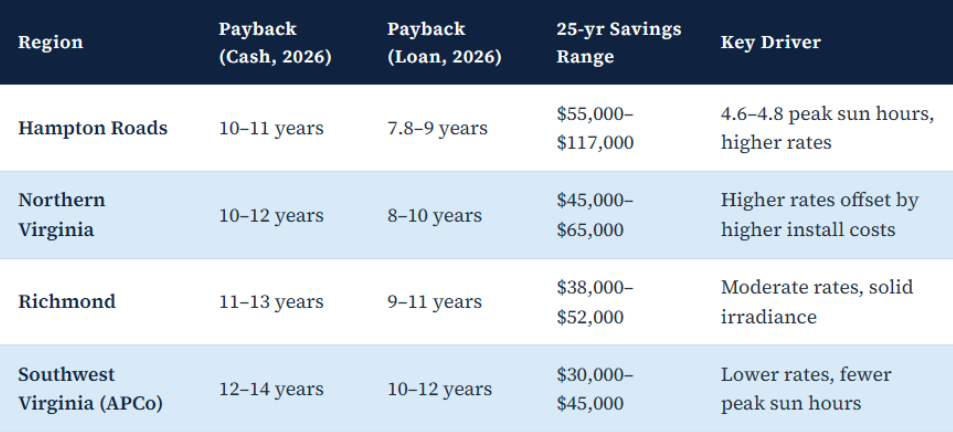
Hampton Roads leads at an estimated 7.8 years on a financed system, driven by two factors: 4.6-4.8 peak sun hours daily (among Virginia’s highest) and above-average electricity rates, reinforced by Dominion Energy’s April 30, 2026 net metering protection. Maryland has similar irradiance but shorter paybacks due to higher electricity rates, Virginia’s full retail net metering closes that gap.
The ITC Expiry in Concrete Numbers
EnergySage estimated the average Virginia payback period at 8.9 years with the ITC. Without it, that rises to 12.7 years on a cash purchase. On a $22,000 system, the credit was worth $6,600. On a $34,000 system, $10,200. That number sits at the center of every 2026 Virginia solar calculation.
How the ITC Expiry Changes the Virginia ROI Calculation
Without the 30% federal credit, cash purchase payback extends by two to four years. But the loan path, rising electricity rates, and Virginia’s remaining incentives mean the 25-year case stays compelling.
The Loan Path Changes the Equation
The ITC affected upfront cash purchase costs, it never changed the monthly cash flow comparison. A solar loan structured so payments match or undercut your current electricity bill produces positive net cash flow from month one. For a Hampton Roads homeowner paying $175/month, a well-structured loan at equivalent payments delivers an immediate saving. That’s why financed system payback is still 7.8–9 years.
Rising Electricity Rates Accelerate the Return
Virginia rates have risen roughly 18% since 2020. Two further increases are already approved: $11.24/month in January 2026 (in effect) and $2.36/month in January 2027. A RGGI reentry rider of $2–$5/month has a filing expected June 2026. Every approved increase raises the annual value of a system already installed, each subsequent year of ownership is worth more than the calculation at installation.
Virginia’s Remaining Incentive Stack
The sales tax exemption saves roughly $2,000–$2,500 upfront. The property tax exemption saves $75–$112 annually. Combined, these reduce effective system cost by $4,000–$5,500 over 25 years, partial, but real, offset to the lost ITC. The math is slower on a cash purchase. With accurate sizing and the right financing, it’s still positive from day one for most Hampton Roads homeowners.
How Rising Electricity Rates Accelerate Virginia Solar ROI
Most solar calculators hold today’s electricity rate flat across 25 years. That’s mathematically conservative, and it systematically understates the real return.
Virginia’s documented rate trajectory:
- Bills up roughly 30% since 2021 (SCC data)
- January 2026 base rate increase: +$11.24/month (already in effect)
- January 2027 increase: +$2.36/month (already approved)
- RGGI reentry rider: +$2–$5/month, filing expected June 2026
A solar system locks in its energy cost from day one. Every kilowatt-hour it produces is valued at whatever Dominion is charging when it’s consumed, so each rate increase silently raises the value of every panel on your roof. At a conservative 3% annual escalation (below Virginia’s actual recent average), the real 25-year savings run 30–40% higher than a flat-rate calculator would show.
The Cost of Waiting
For a Hampton Roads homeowner paying $175/month, a 3% annual escalation costs roughly $2,000 in additional utility bills over five years compared to locking in a solar payment today. The January 2027 increase is already approved. The cost of waiting is a scheduled charge.
Cash Purchase vs Loan vs Lease, ROI by Financing Method
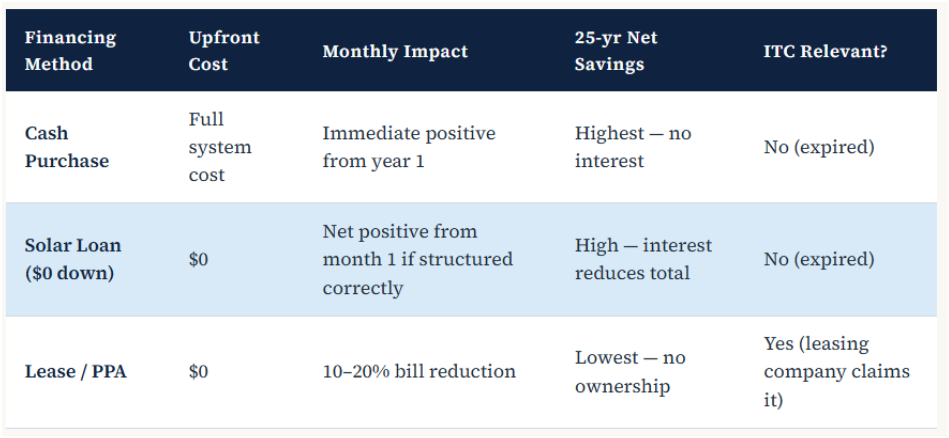
The financing method is the single biggest variable in the Virginia solar ROI calculation, more impactful than system size, region, or equipment tier.
Cash Purchase ROI in 2026
The best long-term outcome for homeowners with available capital: no interest, full ownership from day one, maximum 25-year savings. Payback runs 10–13 years without the ITC, lower in Hampton Roads, higher in Southwest Virginia. ZGlen Goodman’s 17.2 kW Virginia Beach system projects $104,924 in 30-year savings at 103% offset; Charles Griffin’s 9.36 kW Hampton Roads system projects $89,270 at 100% offset. Both results come from accurate sizing.
Solar Loan ROI in 2026
$0 down, full ownership, all SRECs retained, both Virginia tax exemptions apply. A loan typically adds $2,000–$5,000 in interest over the term, but preserves cash reserves while delivering immediate monthly cash flow benefit. For most Hampton Roads homeowners, payments structured to match current electricity bills produce positive net cash flow from month one, and effective payback of 8–10 years once cumulative savings exceed cumulative payments including interest. This is why financing closes much of the gap left by the ITC expiry.
Lease / PPA ROI in 2026
No ownership, no SRECs, no home value contribution. The leasing company claims the Section 48E commercial credit, which is why you’ll see leases marketed as “still tax credit eligible.” The credit is eligible, just not to you. Typical bill reduction: 10–20%, versus 80–100% offset for an owned system. A lease suits homeowners who can’t qualify for a loan or want zero maintenance responsibility. For everyone else, the 25-year financial gap between owning and leasing is significant.
What Affects Your Specific Virginia Solar ROI
Six variables determine whether a system lands at the top or bottom of the ROI range. One can be assessed before any money is committed.
The 20% Rule
The “20% rule” suggests a system should offset at least 20% of consumption to be financially viable, but that’s a floor. Most well-sized Virginia systems aim for 80–100% offset. A system sized to only 20% offset has a payback period three to four times longer. Charles Griffin’s 100% offset on a 9.36 kW system is what a properly designed system looks like.
Roof Orientation
South-facing captures the most direct sunlight. West-facing performs well too, afternoon sun aligns with peak consumption, which matters for net metering. East-facing is viable; north-facing is generally excluded from production calculations. In Virginia Beach, the production difference between south- and west-facing roofs of the same size is roughly 10–15%.
Equipment Tier
Monocrystalline panels degrade at 0.3–0.5% per year; thin-film at roughly 1%. Over 25 years, that gap represents around 8,000 kWh, worth $800–$2,400 at current Virginia rates. The equipment choice is a 25-year financial decision.
System Sizing Accuracy
The most underappreciated variable. A system sized to 85% of actual consumption versus 100% produces meaningfully different lifetime savings, and no generic calculator can tell you which one you’re getting. The difference between a system that pays off and one that merely functions is almost always this step.
Long-Term Maintenance Costs, What Virginia Solar Owners Actually Pay
Maintenance costs are low, predictable, and a small fraction of lifetime savings, but they belong in any honest ROI calculation.
The DOE estimates roughly $30 per kW per year for residential solar operations and maintenance. For an 8 kW system, that’s about $240 annually. In practice, most homeowners spend $150–$300/year on inspection and cleaning, largely discretionary, since Virginia rain handles most of it.
The one significant unplanned cost is inverter replacement: $1,000–$2,500 after 10–15 years for string inverters. Microinverters and power optimizers typically carry 25-year warranties, eliminating this cost entirely during the system’s primary production life.
The full picture: $240/year over 25 years equals roughly $6,000 in total maintenance. Against gross 25-year savings of $42,339–$52,138, that’s 11–14% of gross savings. Net ROI after maintenance remains strongly positive for every well-sized system in this market.
Real Virginia Solar ROI, Convert Solar Customer Results
The most reliable Virginia solar ROI data is from real systems on real Hampton Roads roofs.
National ROI calculators make assumptions about electricity rates, roof orientation, system performance, and consumption patterns. Four specific systems tell a more useful story than any calculator, because they are sized from actual consumption data on real Virginia roofs.
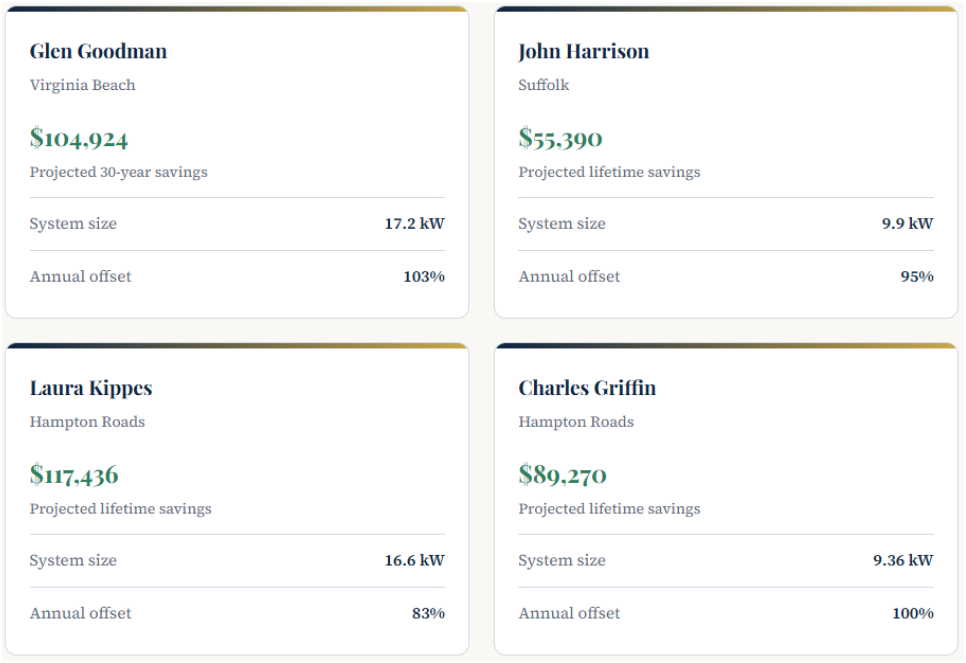
The range of outcomes reflects system size and offset percentage. Charles Griffin’s 9.36 kW system achieves 100% offset; Laura Kippes’ 16.6 kW system sits at 83%. Neither is miscalibrated, Laura’s system is larger because her consumption is higher, and her larger savings projection reflects that. The common factor across all four systems: every one was designed from actual consumption data.
John Harrison’s Suffolk result, $55,390 on a 9.9 kW system, illustrates the geographic point. Suffolk sits outside Hampton Roads’ peak irradiance zone with slightly lower electricity rates, and the more modest savings projection reflects exactly that.
The Only Number Missing Is Yours
You now have the framework: what Virginia solar ROI means, how 2026 numbers break down by region, what the ITC expiry actually costs, and what separates a system that pays off from one that underperforms. The specific numbers for your home depend on your consumption data and your roof.
Convert Solar has sized systems from real Virginia consumption data for 14 years across 7,000+ Hampton Roads installations. Our assessment uses drone roof mapping and your actual utility bills.
Request a No-Obligation Quote →
Based on your actual energy data and roof.