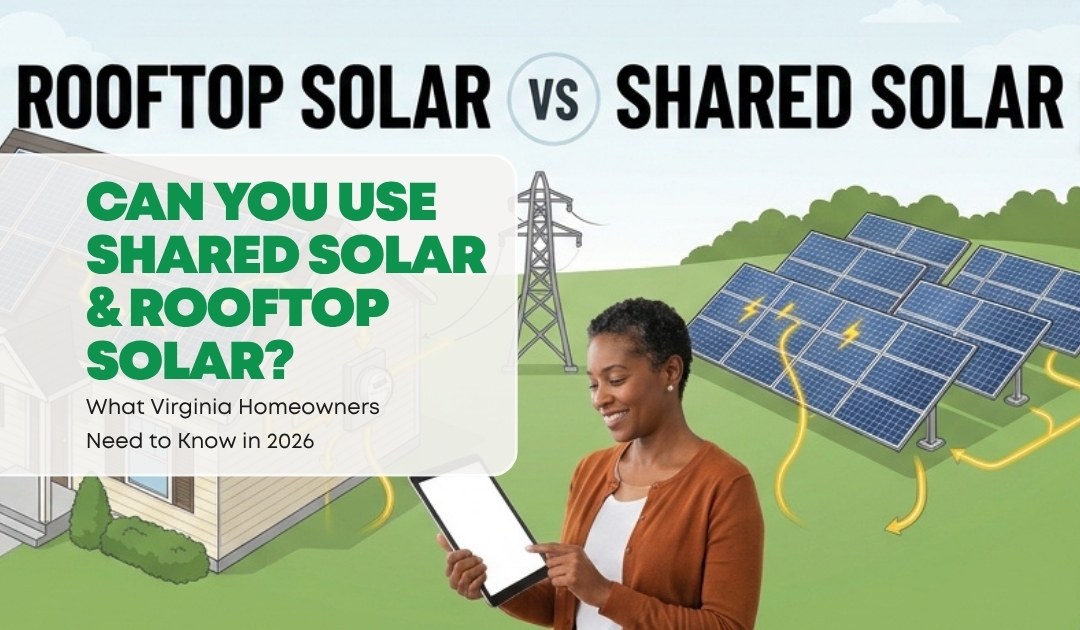
Virginia homeowners can use one solar credit program per utility account, so shared solar and rooftop solar work as an either/or choice on the same account. State rules keep shared solar subscribers off Net Metering, the program that credits rooftop panels. Both programs lower the same electric bill, so one path per account keeps credits balanced. Program rules are changing in 2026 and 2027, so confirm your eligibility with your electric utility before you sign anything.
This guide explains how each program works, who qualifies in 2026, and how to switch from a subscription to panels on your own roof. We also share an illustrative savings example with clear numbers. Use it as a starting point for conversations with your utility and your installer.
Key Takeaways
- Virginia allows one solar credit program per utility account: shared solar or rooftop solar with Net Metering.
- Shared solar suits renters, condo owners, and homes with heavy shade or unsuitable roofs.
- Shared solar subscribers save about 10% on monthly bills, roughly $175 a year, according to program advocates.
- A well-sized rooftop system can offset most or all of a home’s energy charges.
- Virginia law expanded Dominion Energy’s shared solar program by 525 MW and Appalachian Power’s by 50 MW in 2026.
- Homeowners can switch from shared solar to panels on their own roof by timing the cancellation around their contract.
- The federal 25D credit ended December 31, 2025, and Virginia’s property and sales tax exemptions remain for rooftop systems.
- Your utility has the final word on eligibility, so confirm it in writing before you sign.
Shared Solar and Rooftop Solar: How Each Program Works
Shared solar and rooftop solar differ based on where the panels sit. Shared solar is a subscription to an off-site solar farm. Rooftop solar is a system installed on your own home. Both lower your electric bill through credits.
What Shared Solar (Community Solar) Means In Virginia
Virginia’s Shared Solar Program lets you subscribe to a share of a solar facility built off-site, usually up to 5 MW in size. A licensed company, called a subscriber organization, owns and operates the facility. Each month, the power from your share becomes a credit on your utility bill.
You pay the subscriber organization a monthly subscription fee. Some providers send a separate bill. Others fold the fee into your utility bill through net crediting, where the utility may charge up to 1% of your credit value.
What Rooftop Solar With Virginia Net Metering Means
With rooftop solar, the panels sit on your roof, and your home uses their power first. Extra power flows to the grid and earns Net Metering credits. Those credits balance out once a year in an annual true-up.
After the State Corporation Commission’s 2026 ruling, Dominion Energy customers keep full retail 1:1 credit for exported power, with a $1 monthly administrative fee. Year-end surplus in Dominion Energy territory earns $0.05829/kWh. Appalachian Power customers also keep 1:1 credit and 12-month netting, with year-end surplus paid at $0.0566/kWh.
Shared Solar Vs. Rooftop Solar At A Glance
| Feature | Shared Solar | Rooftop Solar With Net Metering |
| Panel location | Off-site solar facility | Your roof or property |
| Panel owner | A subscriber organization | You (purchase or loan) or Convert Solar (lease) |
| Upfront cost | $0 for most subscriptions | About $2.65 per watt installed before incentives (EnergySage, July 2026), or $0 down with a lease or qualifying loan |
| Credit type | Bill credits for your share of the farm’s output | Net Metering credits at the full retail rate (1:1) |
| Estimated savings | About 10% off monthly bills (roughly $175 a year, per program advocates) | Most or all energy charges when sized to your usage |
| Size limit | Credits up to your average annual bill | Up to 150% of usage (Dominion Energy) or 100% (Appalachian Power), with a 25 kW residential cap |
| Minimum bill | Credits lower your bill to a set floor | Standard customer charges apply |
| Outage power | Grid credits only | Battery required for backup |
| Best fit | Renters, condo owners, and shaded roofs | Homeowners with a suitable roof who plan to stay |
Both programs pause during a grid outage, and a battery keeps power flowing. A home battery stores solar power for use when the grid goes down. Learn how panels behave during a power outage.
Why Shared Solar and Net Metering Stay On Separate Accounts
Virginia’s shared solar rules keep each subscriber on one credit program at a time. Both major utilities repeat that rule on their program pages. The goal is simple: one bill, one set of solar credits.
What The Rule Says
The State Corporation Commission’s Rules Governing Shared Solar Program keep subscribers in their current customer class and separate them from Net Metering for the duration of the subscription. Dominion Energy and Appalachian Power list the same rule on their program pages. Appalachian Power also keeps its shared solar program separate from its Percentage of Income Payment Plan.
The standard consumer disclosure form every subscriber receives states the rule plainly. Each customer joins one shared solar program, and Net Metering stays separate. Keep that form handy, since it also lists your contract terms.
Why The Rule Exists
Shared solar and rooftop solar do the same job. Each one applies credits to the same monthly bill to offset the power you buy. One program per account keeps total credits in line with your home’s use.
The regulations build in limits on both sides. A shared solar subscription is sized so its estimated credits stay at or below your average annual bill. Rooftop systems follow their own sizing caps under Net Metering.
Shared Solar Was Designed For Renters and Shaded Homes
Virginia created shared solar to widen access to clean power. It works for renters, condo owners, and homeowners with roofs that are too shaded or too small for panels. Homes with a suitable roof have a clear path to rooftop solar, and each account follows one path.
Virginia Shared Solar Eligibility In 2026
Your Virginia shared solar eligibility depends on the utility that serves your home. Each investor-owned utility runs its own program. The rule of one program per account applies in both territories.
Dominion Energy Territory
Dominion Energy’s original 200 MW program was fully awarded across 52 projects, with customers and developers waiting for openings. In 2026, the General Assembly passed SB 254 and HB 807, which call for 525 MW of new shared solar capacity. A portion of that capacity is set aside for low-income subscribers. Subscriber terms follow Dominion Energy’s Schedule SS tariff.
Appalachian Power Territory
Appalachian Power launched a 50 MW program in 2025, and it filled almost immediately. Under SB 255 and HB 809, the utility released another 50 MW on July 1, 2026, with a further 50 MW due by January 1, 2028. The 2026 law also requires net crediting, so subscribers see their fee and credits on one bill. Southwest Virginia is also home to new projects like Brightfields Solar on former coal mine land.
Electric Cooperative Members
The shared solar programs above serve Dominion Energy and Appalachian Power customers. Electric cooperatives set their own solar programs and Net Metering terms. If a co-op serves your home, check its rules first.
Why Availability Varies
New capacity opens the door, and each shared solar facility still needs to be built and connected to the grid. PJM delays can slow those connections across the region. The expansion supports Virginia’s clean energy goals for 2045.
Edge Cases Homeowners Ask About
Most questions about combining these programs come down to one detail. That detail is the Net Metering status of the account. Here is how common situations play out.
What If My Rooftop System Stays Off Net Metering?
The rule centers on Net Metering participation. Nearly every grid-tied home system in Virginia uses Net Metering, since that is how exported power earns credit. If your setup is unusual, ask your utility in writing before you subscribe to shared solar.
Can A Separate Meter Use Shared Solar?
Some homeowners have a second account for a detached workshop, a well pump, or a rental unit. The regulations leave the treatment of a second account held by the same person open to interpretation. Ask your utility whether that account qualifies before you sign.
What If My Panels Cover Only Part Of My Usage?
The answer for that same account is a properly sized rooftop system. Virginia allows rooftop systems up to 150% of expected annual usage in Dominion Energy territory and up to 100% in Appalachian Power territory. That leaves room to cover the full load in most homes.
Moving From An Apartment With Shared Solar Into A House
Virginia’s rules let your subscriber organization move your subscription to a new address in the same utility territory under your existing contract. That works well for a home that will rely solely on shared solar. If you plan to install panels and enroll in Net Metering, end the subscription under your contract terms first.
Switching From Shared Solar To Rooftop Solar
You can switch from a shared solar subscription to panels on your own roof at any point. Good timing helps you avoid early termination fees and gaps in credits. Follow these steps in order.
- Read your Consumer Disclosure Form. Every Virginia shared solar subscriber receives one, and it lists your contract length and any cancellation fees.
- Ask your subscriber organization about timing. Find out how much warning they need and when cancellation takes effect.
- Get a rooftop assessment and proposal. This shows the system size of your roof and usage support before you cancel anything.
- Line up the cancellation with your installation timeline. At Convert Solar, the average time from signed agreement to installation is 6 to 8 weeks, and installation takes one to three days on site.
- Enroll the new system in Net Metering. Your rooftop system earns credits once the utility grants Permission to Operate, so end the subscription ahead of that enrollment.
Switching in fall or winter? Learn how panels handle Virginia winters and what winter prep looks like for a new system. Both guides help you plan the first months of production.
Shared Solar Vs. Rooftop Solar: Which Saves More?
Savings from shared solar and rooftop solar depend on how much of your bill each one covers. A well-sized rooftop system can offset most or all of your energy charges. Shared solar trims a portion of your bill with $0 upfront, making it a good fit for renters and homes in the shade.
What Shared Solar Savings Look Like
Program advocates report that Virginia shared solar subscribers save about 10% or more on their monthly bills, or roughly $175 per year. However, actual savings depend on the program’s terms and the minimum bill, which sets a floor that bill credits cannot reduce further. In November 2025, the State Corporation Commission reset Dominion Energy’s minimum bill to function as a floor, without adding an extra charge on top. If you’re comparing shared solar with rooftop solar, a solar company in Chesapeake can help you understand your options and evaluate which approach best fits your home and energy needs.
What Rooftop Solar Savings Look Like
Rooftop solar replaces the power you would otherwise buy, with exports credited 1:1 at the retail rate under Net Metering. Convert Solar customers show what that looks like in practice:
- Charles Griffin, Hampton Roads: 9.36 kW system, 100% offset
- John Harrison, Suffolk: 9.9 kW system, 95% offset
- Glen Goodman, Virginia Beach: 17.2 kW system, 103% offset
Illustrative Example: One Household, Two Paths
| Scenario Detail | Shared Solar | 9 kW Rooftop System |
| Starting bill | 161/month(1,932/yr) | 161/month(1,932/yr) |
| Upfront cost | $0 | $23,850 before incentives, or $0 down with a lease or qualifying loan |
| Power source | Credits from an off-site farm | About 10,500 to 12,350 kWh produced each year |
| Share of energy use covered | About 10% of the bill | Roughly 87% to 100% or more |
| Approximate annual savings | About $190 | Most of the energy portion of the bill, with fixed customer charges remaining |
This example is for demonstration purposes only and is separate from any offer or quote. It assumes the confirmed Dominion Energy residential average of about $161/month, $0.16/kWh (about 12,000 kWh a year), $2.65/W installed cost (EnergySage Virginia, July 2026), 4.0 to 4.7 peak sun hours a day (NREL), and about 80% system efficiency. Shared solar savings use the 10% figure cited by program advocates, and your roof, usage, and rate shape your final results.
Incentives That Apply To Rooftop Solar
The federal Residential Clean Energy Credit (Section 25D) ended on December 31, 2025. Virginia exempts residential solar systems up to 25 kW from local property tax. Solar equipment is also exempt from state sales tax.
Rising utility costs add to the value of solar production. Virginia’s return to RGGI adds an estimated $10 to $13 a month to bills. Every kilowatt-hour your roof produces is one you don’t have to buy at future rates.
When Shared Solar Is The Better Choice
Choosing between shared solar and rooftop solar starts with how you live and what your home can support. Shared solar fits well when rooftop panels are impractical for your home or your plans. These situations point toward a subscription:
- You rent or live in a condo where the building owner controls the roof.
- Your roof is heavily shaded by trees or nearby buildings.
- Your roof needs replacement soon, and you prefer to handle one project at a time.
- You expect to move in the next few years and want savings with zero long-term equipment.
- Your community association limits panel placement in ways that make rooftop solar impractical. Virginia law limits how far associations can restrict solar, so check your declaration first.
Is Your Roof A Good Fit For Rooftop Solar?
Your roof is likely a good fit if it gets steady sun, has decades of life left, and has open space for panels. Every home is different, so whether shared solar or rooftop solar is right for you depends on your energy use and what your roof can support. A professional assessment looks at these factors:
- Orientation and shade: roof planes facing south, east, or west with light shading produce well.
- Roof condition: a roof near the end of its life is best replaced before installation.
- Storm resilience: properly mounted systems are built for Virginia’s storms, including hurricane season.
- Upkeep: rooftop systems need little care, and a few seasonal checks help, such as this winter maintenance list.
- Backup goals: for outage protection, compare solar with battery backup. One battery usually covers essential loads, while whole-home backup typically needs two or more batteries.
How Convert Solar Helps You Choose Between Shared Solar and Rooftop Solar
Convert Solar helps homeowners compare shared solar and rooftop solar using their own roof and energy use. The decision rests on clear numbers from your home. General usage information is enough for a first look, so a full year of bills is optional.
Here is what you can expect:
- Experience: 8,500 systems installed across Virginia and Maryland, with 14 years of continuous operation in Hampton Roads.
- Certified installers: NABCEP-certified professionals handle your installation.
- Independent recognition: Solar Power World has named Convert Solar a Top Solar Contractor for six consecutive years (2021 to 2026), including #22 Top Residential Solar Contractor in the U.S. for 2026. The rankings measure the previous year’s installed capacity, which reflects completed projects.
- Sizing from your usage: system size follows your home’s electricity use and your roof’s solar production.
- Quality equipment: panels from leading North American and European manufacturers, including Silfab, REC, and Mission Solar, paired with Enphase microinverters.
- Long-term coverage: a 25-year bumper-to-bumper warranty covering materials and workmanship, plus a separate 10-year roof penetration warranty.
- Flexible financing: purchase, $0 down loans for qualified homeowners, or a solar lease.
Our residential solar page explains each step for homeowners. It covers system design, financing, and installation. Use it to prepare questions for your assessment.
Before You Sign Either Contract: A Quick Checklist
A few quick checks protect your savings, whether you choose shared or rooftop solar. Each step takes only a few minutes. Work through them before you commit to either program.
- Confirm the utility that serves your address (Dominion Energy, Appalachian Power, or a cooperative).
- Check whether your account is already enrolled in Net Metering.
- Read the shared solar Consumer Disclosure Form for fees, contract length, and cancellation terms.
- Ask how the minimum bill affects your expected savings.
- Get a rooftop assessment to compare both options side by side.
- Confirm your eligibility with your utility, ideally in writing.
The Bottom Line On Shared Solar and Rooftop Solar
Choosing between shared solar and rooftop solar in Virginia comes down to selecting the option that best fits your home and utility account. Shared solar can be a strong choice for homes where rooftop panels are impractical, while rooftop solar with net metering can give homeowners more control over their electricity bills and potentially cover most or all of their energy use. A Virginia Solar Installation Company can help you compare these options, assess your property’s solar potential, and determine which solution aligns with your energy goals..
You’re already paying for power. Did you know that you could pay less? Bring your electric bill and your questions, and Convert Solar will help you see which option fits your home and what solar could save you.
Schedule Your Solar Assessment
Frequently Asked Questions
Can one Virginia utility account receive both Net Metering credits and shared solar credits?
Each Virginia utility account participates in one of these programs at a time. Virginia’s shared solar regulations keep subscribers off Net Metering for the length of their subscription. Dominion Energy and Appalachian Power both follow this rule.
Will installing rooftop solar end my shared solar subscription?
Enrolling a new rooftop system in Net Metering requires ending the shared solar subscription first. Plan the cancellation around your contract terms and your installation date. Check your Consumer Disclosure Form for any early termination fee.
Can shared solar cover the power my rooftop panels miss?
The best way to cover your full load on one account is a properly sized rooftop system. Virginia allows systems up to 150% of expected annual usage in Dominion Energy territory and up to 100% in Appalachian Power territory. Convert Solar sizes each system from your home’s electricity use and your roof’s solar production.
Can a homeowner use shared solar for a workshop or well pump on a separate meter?
A separate utility account may qualify, and your utility makes the final decision. The regulations leave this situation open to interpretation. Ask your utility to confirm eligibility for that account before you subscribe.
Can a renter keep an apartment’s shared solar subscription after buying a house?
You can move your subscription to a new address in the same utility territory under your existing contract. This works for a new home that will run on shared solar alone. If you plan to install rooftop solar, end the subscription under your contract terms before enrolling in Net Metering.
What does it cost to cancel shared solar and switch to rooftop solar?
Cancellation costs depend on your subscriber organization. Your contract length and any early termination fees are outlined in the Consumer Disclosure Form you received at sign-up. Review it before scheduling your rooftop installation, and compare these terms with other factors such as solar panel costs to make an informed decision about your solar investment.
How do savings per kWh work for each program in Virginia?
Rooftop solar credits exported power at the full retail rate of 1:1 under Net Metering. It also replaces the power your home would otherwise buy from the grid. Shared solar subscribers save about 10% on their bills after subscription fees, according to program advocates.
Do shared solar or rooftop solar qualify for the 30% federal tax credit in 2026?
The federal Residential Clean Energy Credit (Section 25D) ended on December 31, 2025. Rooftop systems up to 25 kW still qualify for Virginia’s local property tax exemption. Solar equipment also qualifies for a state sales tax exemption.
How do Appalachian Power’s shared solar rules compare with Dominion Energy’s?
Both utilities keep shared solar and Net Metering on separate tracks for each account. Program size, minimum bill calculations, and billing options vary between the two. Appalachian Power also keeps its shared solar program separate from its Percentage of Income Payment Plan.
How long does it take to switch from shared solar to rooftop solar with Convert Solar?
With Convert Solar, the average time from signed agreement to installation is 6 to 8 weeks. Installation takes one to three days on site with NABCEP-certified professionals. Net Metering credits begin after your utility grants Permission to Operate.