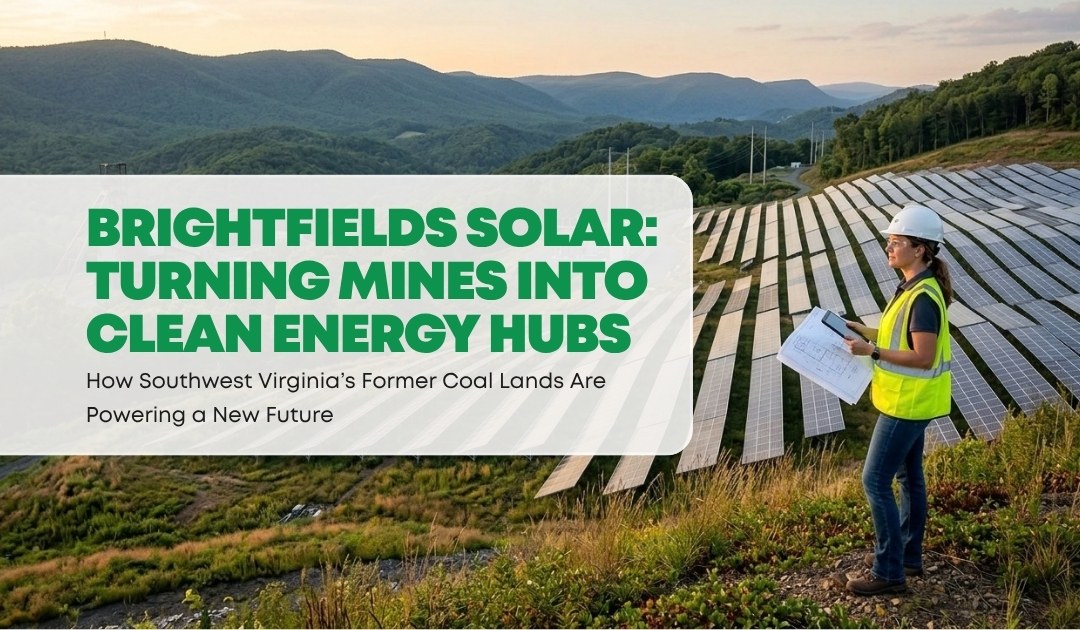
Brightfields solar on Virginia coal mines means building solar farms on reclaimed surface mine land instead of clearing forests or farmland, and Southwest Virginia is emerging as an early testing ground for the model. Wise County’s Mineral Gap array is the first commercial-scale solar development on abandoned mine land in Virginia. Larger projects are still in development: the 51.3MW Highlands project in Dickenson and Wise Counties is anticipated to begin operations in 2030.
What Is a Brightfield?
A brightfield is a solar project built on land that was already disturbed by past industrial use, such as a former coal mine, landfill, or contaminated industrial site. The underlying category is broad. A “brownfield” is property whose expansion, redevelopment, or reuse may be complicated by the presence or potential presence of a hazardous substance, pollutant, or contaminant. A brightfield is what happens when that land is put to work producing electricity. Homeowners researching solar options can also look at Convert Solar reviews to learn more about the company’s experience and customer feedback.
Brightfield vs. Standard Solar Farm
| Brightfield (former mine land) | Standard solar farm (greenfield) | |
| Prior land use | Surface mining, industrial, or landfill use | Farmland, pasture, or forest |
| Land-use conflict | Low; the land is already disturbed | Higher; can compete with agriculture and forestry |
| Site preparation | Geotechnical study, stabilization, sometimes remediation | Grading and clearing |
| Development cost | Advocates estimate 10–40% higher | Baseline |
| Liability considerations | Environmental due diligence required | Typically minimal |
Why Southwest Virginia’s Former Coal Mines Suit Solar
The case for brightfields solar on Virginia coal mines starts with geography: surface mining left behind something the mountains rarely offer.
- Flat, open land in steep country. Solar developers say mine sites have vast flat areas exposed to sunlight, that are a rarity in the mountains.
- Scale of available land. The Virginia Department of Energy has estimated that 100,000 acres of land formerly used for surface mining of coal alone is available for redevelopment in Virginia.
- Potential grid access. Many former industrial sites already have infrastructure in place to connect with the electric grid. This varies by site, as the challenges section below explains.
- Protecting forests and farmland. Siting solar on mined land can ease rising tensions over the significant land use requirements of large-scale solar installations. The Nature Conservancy has argued that directing development toward these sites will help conserve the region’s intact forests for wood products, carbon storage, wildlife habitats, outdoor recreation and tourism.
The Projects Behind Brightfields Solar: Virginia Coal Mines Leading the Way
Much of this activity sits inside the Cumberland Forest Project. That landholding encompasses nearly 253,000 acres of land in Southwest Virginia, Eastern Tennessee, and Eastern Kentucky. The vast majority of the property is designated for the protection and restoration of native forests. However, there are several thousand acres of non-forested, former surface coal mines that can support solar energy projects.
| Project | Location | Size | Partners | Status (Sept 2026) |
| Mineral Gap Solar | Wise County | 3.46MW on 20 acres | Wise County, Sun Tribe, Mineral Gap Data Center | Operating; first on Virginia abandoned mine land |
| Highlands Solar | Wise & Dickenson Counties (former Red Onion mine) | 51.3MW on ~1,200 acres | The Nature Conservancy, Virginia’s largest electric utility, Antares Group | In development; operations targeted for 2030 |
| Sun Tribe / Sol Systems sites | Wise & Dickenson Counties (plus one in Tennessee) | Up to 75MW across six sites | The Nature Conservancy, Sun Tribe, Sol Systems | Announced 2021 |
| Sun Tribe / ENGIE portfolio | Virginia, Tennessee, Kentucky | ~49MW solar + 320MW storage | The Nature Conservancy, Sun Tribe, ENGIE | Announced February 2025 |
Mineral Gap: The Proof of Concept
The Mineral Gap array provides behind-the-meter power to the Mineral Gap Data Center, a 65,000 sq ft Tier III colocation facility in Wise County’s Lonesome Pine Regional Business & Technology Park. The project got off the ground with a pilot grant of $500,000 from the $10 million in federal grant money Virginia received to develop AML sites. That makes it an early example of federal mine-reclamation dollars paying off as clean energy.
Highlands Solar: The Utility-Scale Test
Highlands Solar will repurpose roughly 1,200 acres of the former Red Onion surface mine and surrounding properties in Wise and Dickenson Counties. When announced in 2021, it was expected to generate approximately 50 megawatts of solar energy, enough to power 12,500 homes at peak output. The original plan was to begin construction in 2024 or 2025, subject to review and approval by the Virginia State Corporation Commission. The timeline has since moved to a 2030 operations target, a reminder that mine-land projects take time.
The Next Wave: Community-Scale Solar and Storage
In 2025, The Nature Conservancy announced agreements with Sun Tribe Development and ENGIE to develop 14 solar energy and three battery storage projects on 360 acres of former coal mines in the Appalachians. ENGIE’s share is smaller, distributed-scale solar, with projects ranging from 1 to 6 MW in size. Earlier work continues alongside it: since 2021, Sun Tribe and Dominion Energy have been conducting pre-development work with the goal of generating 140 MW of renewable energy on eight existing sites within the Cumberland Forest.
How Brightfields Solar on Virginia Coal Mines Supports Local Economies
For counties that built their tax base on coal, brightfield projects offer a new source of revenue.
Local Tax Revenue
Virginia lets localities collect a revenue share from larger solar projects.The original statutory maximum of $1,400 per MW increased by 10% on July 1, 2026, making the adjusted maximum $1,540 per MW for eligible projects under Virginia Code § 58.1-2636.
Basis note: A 10% increase on the $1,400 cap works out to a new maximum of about $1,540 per MW per year. Actual payments depend on each county’s ordinance and project eligibility.
Coalfield counties are already using this tool. Russell County, for example, has adopted a solar revenue-share ordinance under this statute. Local leaders have framed the benefit in plain terms. When Highlands Solar was announced, Dickenson County’s board chairman said the project offered a way to diversify our tax base and provide increased revenues for our schools and law enforcement.
Jobs and Community Funds
The most visible employment comes during construction. The 2025 Sun Tribe/ENGIE agreements are expected to generate increased local tax revenue, short-term construction job opportunities, and a dedicated fund to finance additional community benefits.
Solar farms need far fewer permanent workers than mines did, so expectations should be realistic. For context, nationwide coal mining jobs dropped from more than 175,000 in 1985 to about 40,000 in 2020. Brightfields won’t reverse that decline. They can help replace some lost tax revenue and give idle land a productive use.
The Engineering Challenges of Building Solar on Former Surface Mines
Building brightfields solar on Virginia coal mines is harder than building on open farmland, and the challenges explain why projects move slowly.
- Unstable ground. Reclaimed mine soils create significant uncertainties for load-bearing capacity, long-term settlement behavior, and corrosion potential. Engineers often use earth screws, ballasted foundations, and concrete piers because they adapt to variable soils.
- Settling fill. Much reclaimed land will consist of filled land in the form of deep deposits of mining spoil, and such fills undergo long-term settlement under their own heavy weight.
- Incomplete reclamation. Sites must be stable before any building starts. Some operators never finished the job: many coal companies still own the bonds to the land, and some don’t finish – or even begin – reclamation projects.
- Transmission distance. Grid access helps on some sites and blocks others. Transmission has been the biggest hurdle for developers because of how remote these former mine sites are, particularly in Appalachia.
Incentives, Grants, and Liability Protections for Brightfield Development
Because brightfields solar on Virginia coal mines costs more to develop, incentives and liability protections often decide whether a project gets built.
| Program | What it offers | Current status (Sept 2026) |
| Virginia Brownfield and Coal Mine Renewable Energy Grant Fund | $500/kW for mined-land projects, $100/kW for brownfields | Law updated in 2024 to allow state funding; no appropriation confirmed |
| Federal clean electricity credits (48E/45Y) | Business investment and production credits, with energy community bonus | Construction-start deadline passed July 4, 2026; later-start projects must be in service by Dec 31, 2027 |
| Federal Abandoned Mine Land funding | Reclamation and economic revitalization grants | $11.3 billion added under the 2021 infrastructure law |
| Virginia Voluntary Remediation Program | Liability certificate after DEQ-approved cleanup | Active |
Virginia’s Brightfields Grant Program
The program was designed so that grants are awarded on a basis of $500 per kilowatt of nameplate capacity from renewable energy sources located on previously coal mined lands and $100 per kilowatt of nameplate capacity from renewable energy sources located on brownfields. Caps apply: no more than $10 million shall be awarded to any previously coal mined lands project, and of the $35 million, $20 million shall be reserved for previously coal mined lands projects.
For years the program couldn’t pay out. The original law said no money could be allocated unless federal funds are available to cover the entire cost of such allocation. In 2024, lawmakers approved a bill that removes the prohibition on the allocation of funds, effective 7/1/24. State funding is now legally possible, but the General Assembly still has to appropriate it. Advocates said lawmakers missed a critical opportunity to do so in 2025.
Federal Tax Credits After the 2025 Law Changes
Federal credits for businesses and utility-scale developers changed sharply in 2025. Projects that did not begin construction by July 4, 2026 must now be placed in service by December 31, 2027 to qualify for the 48E commercial solar tax credit. Some bonuses survived: the labor bonus structure, domestic content bonus, and energy community bonus largely survived. Battery storage remains eligible for tax credits through a planned phase-out in 2032.
These are business credits. The federal residential solar credit for homeowners (Section 25D) expired on December 31, 2025.
Liability Protections for Buyers of Contaminated Land
Virginia’s Brownfield Restoration and Land Renewal Act mirrors federal protections. Categories of parties to whom liability protection is made available include bona fide prospective purchasers, contiguous property owners, innocent purchasers, and those who obtain property through inheritance. To qualify, a buyer must perform “all appropriate inquiry,” which generally means conducting a Phase I Environmental Site Assessment and, if warranted, a Phase II. For homeowners evaluating properties for a solar project, the Virginia Homeowner’s Complete Guide to Going Solar can provide additional context on the considerations involved when assessing a property before making a solar investment.
Developers who want stronger assurance can enroll in DEQ’s Voluntary Remediation Program. Once cleanup is complete, DEQ may issue a certification of satisfactory completion that provides liability protections subject to statutory conditions and exceptions.
Battery Storage and the Grid Role of Former Coal Sites
Brightfields are increasingly pairing solar with storage. ENGIE says the storage projects on former Cumberland Forest mine sites will enhance grid reliability in the immediate region and reduce the need for future grid upgrades, costs that are typically passed through to utility customers.
Are Brightfields a Replacement for Coal, or Mostly Symbolic?
Both sides have a case.
Why brightfields matter:
- They put abandoned, often degraded land back to productive use.
- They create new local tax revenue in counties that lost their coal base.
- They protect forests and farmland from being cleared for solar.
- Projects like Mineral Gap show the model works.
Why caution is fair:
- Total announced capacity, in the tens to low hundreds of megawatts, is modest compared with the region’s historic coal output.
- Timelines have slipped. Highlands moved from a 2024–2025 construction target to a 2030 operations date.
- Virginia’s dedicated grant program has never been funded.
- Permanent jobs are few.
The fairest reading is that brightfields solar on Virginia coal mines gives damaged land a practical second use and coalfield counties a revenue source.
What Happens When Brightfield Solar Panels Reach End of Life?
Virginia law requires localities to plan for this before a project is approved. Under Va. Code § 15.2-2241.2, a locality shall require an owner, lessee, or developer of property subject to this section to enter into a written agreement to decommission solar energy equipment. Decommissioning covers more than removing panels. It includes reasonable restoration of the property, including (i) soil stabilization and (ii) revegetation of the ground cover. Understanding requirements like these is an important part of Virginia Solar Consumer Protection, helping homeowners understand the responsibilities and considerations associated with solar projects.
What the Solar Transition Means for Virginia Homeowners
Brightfields solar on Virginia coal mines and rooftop solar work toward the same goal: generating power from space that already exists, whether that’s a reclaimed mine or your roof. Utility-scale projects in the coalfields add clean power to the grid. Rooftop solar lets individual homeowners produce their own electricity and rely less on the grid.
Every home is different. Whether solar makes sense depends on how you use energy, what your roof can support, and your goals. Convert Solar has installed 8,500 systems across Virginia and Maryland. It has also been named a Top Solar Contractor by Solar Power World for six consecutive years (2021–2026), rankings based on the previous year’s installed capacity. Homeowners can choose between purchase, loan, and lease options, and the right fit depends on individual needs.
You’re already paying for power. Did you know that you could pay less? Bring your electric bill and your questions, and we’ll help you understand what option may fit your home and what solar could potentially save you.
Building a New Energy Legacy Beyond Coal
Southwest Virginia powered the country for more than a century. Brightfields solar on Virginia coal mines gives that same land a role in what comes next. The milestones to watch are whether the General Assembly funds the brightfields grant program, how many projects meet the federal credit deadlines, and whether Highlands Solar reaches its 2030 target. Whatever happens, former mine sites are no longer being written off.
Frequently Asked Questions
What is a brightfield?
A brightfield is a solar or other renewable energy project built on previously disturbed land, such as a former coal mine, landfill, or industrial site. In Southwest Virginia, the term mostly refers to solar farms on reclaimed surface mines in counties like Wise and Dickenson.
Where is brightfields solar on Virginia coal mines being built?
Most activity is in Wise and Dickenson Counties in Southwest Virginia. Mineral Gap Solar in Wise County is already operating, while Highlands Solar, located on the former Red Onion mine, is in development. The Nature Conservancy has also announced additional sites with Sun Tribe, Sol Systems, and ENGIE across Virginia, Tennessee, and Kentucky. For homeowners and developers following these projects, understanding Virginia solar incentives can help provide context on the policies and financial factors shaping solar development across the state.
Are there solar farms on former coal mines in Virginia right now?
Yes. Mineral Gap Solar in Wise County is a 3.46MW array on reclaimed mine land powering a local data center. It is the first commercial-scale solar project on abandoned mine land in Virginia. Larger projects, including Highlands Solar, are still in development.
How much electricity will Highlands Solar produce?
Highlands Solar is currently listed at 51.3MW, with operations anticipated in 2030. At its 2021 announcement, the roughly 50MW design was estimated to power about 12,500 homes at peak output.
What happens to mine pollution before solar is built?
Developers conduct environmental site assessments and geotechnical studies first. Contaminated sites can go through Virginia DEQ’s Voluntary Remediation Program, which ends with a certificate once cleanup meets state standards. Unstable or incompletely reclaimed land may need stabilization before construction.
Is Virginia funding brightfield projects?
Virginia created a Brownfield and Coal Mine Renewable Energy Grant Fund in 2021 and removed its federal-funding requirement in 2024. The General Assembly still has to appropriate money before grants can be awarded. As of September 2026, no appropriation has been confirmed.
Do brightfield projects lower my electric bill?
Not directly. Brightfields add clean generation to the regional grid, and storage paired with them may reduce future grid upgrade costs. For a direct effect on your own bill, rooftop solar is the more immediate option.
Can Virginia homeowners still get a federal solar tax credit?
No. The federal residential clean energy credit (Section 25D) expired on December 31, 2025. The federal credits discussed in this article apply to business and utility-scale projects.