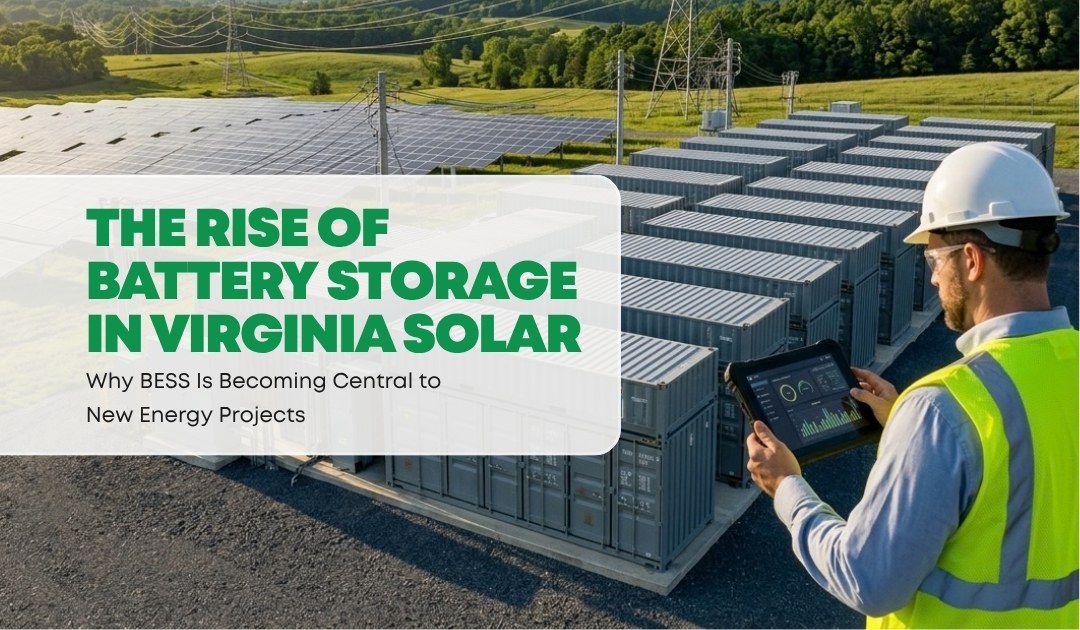
Quick Answer: Battery storage (BESS) in Virginia solar projects is growing fast for two reasons: state law now requires Virginia’s two largest investor-owned utilities to expand energy storage to a combined 21,000 MW, and a 2026 law lets batteries be added to parcels with approved solar projects without starting a new land-use process.
Batteries fix solar’s timing problem by storing midday power for the evening peak, when demand is highest. Most of this growth is utility-scale. A home battery is a separate decision, covered at the end of this guide.
Key takeaways
- Virginia’s 2026 storage law sets a combined target of about 21,000 MW for its two largest investor-owned utilities.
- Batteries can now be added to land with an approved solar project without starting a new land-use process.
- The U.S. installed a record 20.2 GWh of storage in Q2 2026, bringing the first-half total to 30.8 GWh.
- Virginia’s largest standalone battery, Prospect Power in Rockingham County, began operating in June 2026.
- Grid-scale batteries strengthen the whole grid, but they won’t keep your home powered during an outage. A home battery does that.
What Is Battery Storage (BESS), and How Does It Work With Virginia Solar?
A battery energy storage system (BESS) charges when electricity is plentiful, for example at midday when solar output peaks. It sends that power back to the grid when demand rises. Paired with solar, it turns daytime-only generation into power that’s available after sunset.
Every battery is described by two numbers, and their ratio gives its duration:
| Term | What it measures | Example: Prospect Power |
| MW (megawatts) | How fast the battery can deliver power | 150 MW |
| MWh (megawatt-hours) | How much energy it can store in total | 600 MWh |
| Duration | How long it can deliver full power (MWh ÷ MW) | 4 hours |
How many hours of electricity can a utility-scale battery store?
Most stores are two to four hours, and new projects are getting longer. The average duration of projects commissioned in 2025 rose to about three hours, up from roughly two hours in 2023, and a growing share now offer four hours or more.
Does storing solar energy waste electricity?
Some energy is lost in each charge-and-discharge cycle, but most of it comes back:
- EIA data showed the U.S. utility-scale battery fleet averaged 82% round-trip efficiency in 2019.
- NREL’s 2023 Annual Technology Baseline assumes 85%.
Losing 15 to 18% of stored energy is usually better than losing all of it. That’s what happens when surplus midday solar has nowhere to go.
Why Battery Storage (BESS) Is Taking Over Virginia Solar Projects
Five forces are driving the shift. Together they explain why developers are adding batteries instead of simply building more solar panels.
1. Electricity demand is climbing fast
Northern Virginia’s data center growth is reshaping the grid. Virginia’s largest utility reports in its own SCC filings that roughly 70 GW of new data-center interconnection has been requested in its territory, about three times its all-time peak demand. More solar panels add supply during the day. Batteries add supply in the evening, when the grid is under the most strain.
2. State law now requires storage
In the 2026 session, the General Assembly passed House Bill 895 and Senate Bill 448, which substantially expand the energy storage the state’s two largest utilities must procure. Governor Spanberger signed the bills in April 2026. Under the law:
- The smaller utility must seek approval for at least 780 MW of short-duration storage by 2040 and 520 MW of long-duration storage by 2045.
- The largest utility must seek approval for at least 16,000 MW of short-duration storage by 2045, plus a separate long-duration requirement.
- Half of the long-duration target must be 10–24 hour storage, and half must be 24+ hour storage.
- The law took effect on July 1.
3. A 2026 permitting change makes pairing easier
This is the most direct reason batteries are showing up on solar sites. HB891 and SB443 changed the rules in three ways:
- Batteries can now be added to parcels with approved solar projects without a new land-use process.
- Localities keep authority over safety standards, emergency response planning, and voluntary siting agreements.
- Under the governor’s amendments, the added battery system can’t exceed the solar facility’s capacity.
Counties are already updating their codes to match. Fluvanna County, for example, approved a comprehensive rewrite of its solar and battery storage rules to conform with the new state laws.
4. Midday surplus has to go somewhere
When solar output exceeds demand, grid operators can curtail it. That means switching panels off and losing the energy. A co-located battery captures that surplus and releases it in the evening instead. California shows how far this can go: on the evening of March 29, 2026, battery storage covered more than 40% of the state’s power load.
5. Better economics and safer chemistry
Two changes have made storage projects easier to finance and build:
- Tax credit: the One Big Beautiful Bill Act kept the federal energy storage investment tax credit, even as it sped up the phase-out of wind and solar credits. This credit applies to utility-scale and commercial projects.
- Chemistry: lithium iron phosphate (LFP) became the primary chemistry for stationary storage starting in 2021. It is generally considered less prone to thermal runaway than older chemistries.
Standalone BESS vs. co-located solar + storage
| Standalone BESS | Co-located solar + storage | |
| Where it sits | Its own site, usually near a substation or transmission line | On the same parcel as a solar farm |
| Charges from | The grid | Mainly the on-site solar |
| Virginia permitting | Needs its own local land-use approval | Can be added as an accessory use to approved solar, capped at the solar facility’s capacity |
| Main job | Peak shaving, grid balancing, fast response | Moving midday solar to the evening peak |
| Virginia example | Prospect Power, Rockingham County (150 MW / 600 MWh) | Scott Storage and Solar, Powhatan County (12 MW of storage) |
Nationally, the split is nearly even: 48% of installed utility-scale storage capacity is co-located with solar, and 51% is standalone.
2026 Is a Record Year for U.S. Battery Storage
Virginia’s shift toward battery storage (BESS) in solar projects is part of a national surge:
- The U.S. installed a record 3.3 GW / 8.4 GWh of battery storage in Q1 2026, 54% above the previous Q1 record.
- Q2 2026 set another record at 20.2 GWh.
- Solar and storage made up 91% of new generating capacity added in Q1 2026.
- The U.S. is on track to add 71 GWh of storage in 2026.
Which state has the largest battery energy storage system?
The answer depends on how you measure:
| Measure | Leader | Figure |
| Power capacity (MW) | Texas | 14,984 MW vs. California’s 14,365 MW, as of February 2026 |
| Stored energy (GWh), utility-scale | California | 62 GWh vs. Texas’s 33.1 GWh at the end of H1 2026 |
| Single strongest quarter on record | Arizona | 6.2 GWh installed in Q2 2026 |
In short, Texas has more batteries that can deliver power quickly. California’s batteries hold more total energy because they tend to run for longer durations.
Battery Storage Projects in Virginia to Know
These projects show what battery storage (BESS) in Virginia solar and grid planning looks like today, and where local debates are heading.
| Project | Location | Type | Status |
| Prospect Power | Rockingham County | Standalone, 150 MW / 600 MWh | Operating since June 2026 |
| Scott Storage and Solar | Powhatan County | Solar + storage, 12 MW | Operating since 2022 |
| Darbytown Storage Pilot | Henrico County | Iron-air and zinc-hybrid batteries | Iron-air portion slated for completion in late 2026 |
| Mill Stone Energy Center | Chesapeake | Standalone, 150 MW (proposed) | Application withdrawn |
- Prospect Power. It is the largest standalone battery storage asset in Virginia and in the PJM Interconnection. PJM said the project increases battery storage capacity in its region by more than 50%. The project is fully contracted to Virginia’s largest utility under a 15-year agreement.
- Mill Stone (Hampton Roads). Chesapeake shows how local debates can go. City planners recommended approval, but the Planning Commission rejected the lithium iron phosphate project 7–1 on June 10. On the day the City Council was scheduled to vote, East Point Energy withdrew its application, saying it needed to do more community outreach.
Which battery company was backed by Bill Gates?
Form Energy, whose investors include Bill Gates’ Breakthrough Energy Ventures. It has a Virginia connection through the Darbytown pilot in Henrico County. Form’s iron-air battery works by “reverse rusting”:
- To charge, it turns rust back into iron.
- To discharge, it lets the iron rust again, which releases electricity.
- It can discharge for up to 100 hours, far longer than the two to four hours typical of lithium-ion.
Are Battery Storage Facilities Safe?
Safety is the most common question about battery storage (BESS) in Virginia solar projects. Modern facilities are built to much stricter standards than early ones, and failure rates have dropped sharply.
What happened at Moss Landing?
The January 2025 fire at Moss Landing in California is the incident residents cite most often. It was not a typical design:
- The first phase was built indoors as one large 300 MW battery, with minimal fire barriers between cells and modules.
- It used NMC chemistry, which is generally considered more prone to thermal runaway.
- It was built before NFPA 855 set standards for battery storage design and installation.
How are developers preventing thermal runaway?
- Stricter codes: the 2026 edition of NFPA 855 expands hazard mitigation analysis and adds new requirements for large-scale fire testing, emergency response planning, fire protection, and explosion hazards.
- Better track record: according to EPRI, the failure rate for utility-scale battery storage fell about 99% between 2018 and 2025, as lessons from earlier incidents were built into newer designs.
- Safer chemistry: new projects, including the proposed Chesapeake facility, typically use LFP rather than NMC.
Can firefighters respond safely?
Emergency response planning is now a core requirement:
- NFPA 855 sets requirements for siting, spacing, ventilation, and coordination with fire authorities.
- Virginia’s Department of Energy, working with DEQ and the Department of Fire Programs, must develop model local ordinances for energy storage projects by December 1, 2026.
How close can BESS projects be built to homes?
Setbacks are set locally, and they vary. In Chesapeake, for example, the city requires a minimum 300-foot property setback, and the Mill Stone proposal would have sat 1,431 feet from the nearest home. The state’s model ordinances are expected to make these standards more consistent across localities.
How Virginia Communities Decide on Battery Storage Projects
Localities still have the final say on most projects, but the process is now more structured.
- Every application must be reviewed. Under HB711/SB347, localities must review applications for solar projects of 1 MW or more. They still don’t have to approve any project, but a denial now requires a written explanation.
- Siting agreements. Developers negotiate host siting agreements with localities, and these are the main way host communities receive direct payments. Battery storage was added to the siting agreement law in 2021, partly to offset revenue localities lose to the state’s machinery and tools tax exemption, which shrinks over time:
| Years of operation | Tax exemption |
| 1–5 | 80% |
| 6–10 | 70% |
| 11 and beyond | 60% |
- Denials still happen. Rocktown Power, a proposed twin to Prospect Power on the adjoining site, had its Special Use Permit denied.
Will Battery Storage Raise Virginia Electricity Bills?
Under Virginia’s New Solar Siting Laws, utility-owned or utility-contracted storage is paid for through rates approved by the State Corporation Commission, meaning ratepayers ultimately cover those costs. The industry argues that storage can save money over time by reducing reliance on costly peak power. The American Clean Power Association, a trade group, estimates that the average Virginian could spend an additional $5,200 over 10 years if no new clean power is built, although this should be treated as an industry projection rather than a guarantee.
How do developers make money from BESS projects? Mainly in three ways:
- Long-term contracts with utilities, like Prospect Power’s 15-year agreement
- Capacity payments for being available during peak demand
- Energy arbitrage: charging when power is cheap and selling when it’s expensive
How Long Do Utility-Scale Batteries Last?
NREL’s cost modeling assumes a 15-year life for a 4-hour utility-scale lithium-ion system. Actual lifespan depends on how hard the battery is cycled and how well it’s maintained. End of life is also part of the safety framework: NFPA 855 covers the full lifecycle, from design through decommissioning.
The Future of Battery Storage: Replacing Peaker Plants?
Batteries increasingly take on the job of gas “peaker” plants, which run only during the few highest-demand hours. Multi-day gaps in wind and solar output still require other resources. Virginia’s long-duration mandate targets that gap, with half of it requiring 24+ hour storage.
The forecasts point up:
- Wood Mackenzie and ACP project cumulative U.S. storage will reach 200 GW / 655 GWh by 2031, four times today’s level.
- EIA separately expects U.S. storage capacity to double by the end of 2027.
For battery storage (BESS) in Virginia solar, the long-duration mandate means the next wave of projects may look very different from today’s 4-hour lithium-ion systems.
What Virginia’s Storage Boom Means for Homeowners
The rise of battery storage (BESS) in Virginia solar projects is helping make the grid more reliable overall. However, it cannot keep your lights on during a local outage. If a storm takes down the power line to your street, a battery at a substation miles away cannot provide electricity directly to your home. A home battery paired with rooftop solar can. Working with a qualified solar installation company in Virginia can help homeowners determine whether a solar-plus-storage system is right for their energy needs.
| Grid-scale BESS | Home battery | |
| Who it serves | The whole grid | Your household |
| Backup during a local outage | No | Yes, for the circuits it’s designed to cover |
| Who pays | Ratepayers, through SCC-approved rates | The homeowner |
| Federal tax credit in 2026 | Storage ITC still available to utility/commercial projects | The residential credit (Section 25D) expired December 31, 2025 |
If you’re considering a home battery, here’s what to know:
- Approved systems: Convert Solar installs the Tesla Powerwall 3, generally the preferred recommendation, as well as the Enphase IQ Battery 5P and Enphase IQ Battery 10C.
- Backup coverage: one battery is generally enough to power critical loads during an outage. Whole-home backup typically requires at least two batteries, depending on your usage and backup goals.
- Cost: battery storage systems typically start around $18,000. Final pricing depends on equipment selection, system design, installation complexity, and your energy needs.
- Warranty: battery warranties generally range from 10 to 15 years, depending on the manufacturer and product.
Every home is different. Convert Solar has installed 8,500 systems across Virginia and Maryland. Bring your electric bill and your questions to a no-obligation assessment. We’ll help you figure out whether solar, a battery, or both fits how your home actually uses energy.
Frequently Asked Questions
What is driving battery storage (BESS) in Virginia solar projects?
Three factors are shaping Virginia’s battery storage landscape: a 2026 state law targeting about 21,000 MW of storage, a permitting change that allows batteries to be added to approved solar sites, and rising evening electricity demand, much of it associated with data center growth. For homeowners researching Virginia solar consumer protection laws, these changes are also worth considering when evaluating solar-plus-storage options.
What is a BESS system in solar energy?
A BESS stores electricity for later use. In a solar project, it captures power produced during the day and releases it in the evening, when panels stop producing and demand peaks. Homeowners exploring Virginia solar incentives can also consider how battery storage may complement their solar system and overall energy strategy.
Are lithium-ion batteries the best option for large-scale storage?
For two-to-four-hour storage, lithium-ion, especially LFP, is the current standard. For multi-day storage, alternatives such as iron-air batteries are being tested, including at the Darbytown pilot in Henrico County, as Data Center Power Demand Solar Virginia continues to influence discussions around grid-scale energy storage.
Do battery storage systems reduce blackouts?
They help prevent grid-wide shortfalls during peak demand by supplying power quickly. They don’t prevent local outages caused by downed lines. That’s what a home battery is for.
Can battery storage help during extreme weather?
Yes, at the grid level. Heat waves and cold snaps push demand to its peak, and batteries can discharge stored energy during those hours. At home, a battery provides backup for the circuits it’s designed to cover.
Who is responsible for safety at a battery storage facility?
The owner and operator, under local permit conditions and the fire code. The 2026 edition of NFPA 855 adds requirements for hazard analysis and emergency response planning.
How long do utility-scale batteries last?
NREL models a 15-year life for a typical 4-hour lithium-ion system. Actual lifespan depends on how often the battery is cycled and how it’s maintained.
Can I still get a federal tax credit for a home battery?
No. The residential clean energy credit (Section 25D), which covered solar and batteries, expired on December 31, 2025. The storage credit that remains applies to utility-scale and commercial projects.