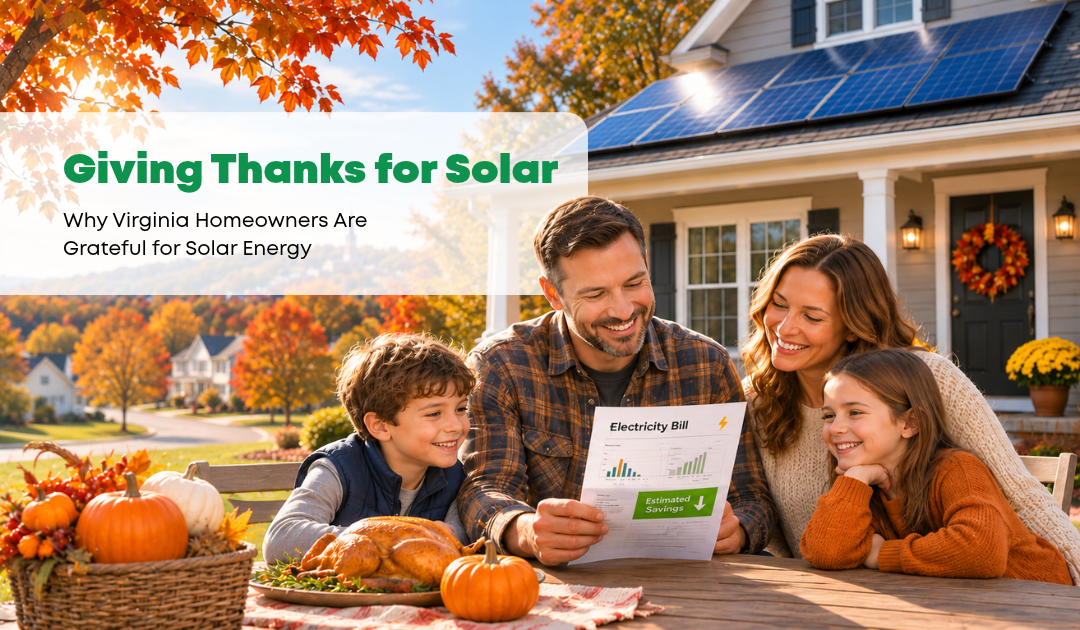
Homeowners have plenty to be thankful for with solar energy in Virginia this year. It trims the power you buy from the utility, keeps key circuits running during outages when paired with a battery, and makes electricity from sunlight alone. Household electric bills in Virginia have climbed nearly 30% since 2021, according to U.S. Energy Information Administration data. Savings vary by home, so a personalized assessment shows your own numbers.
Thanksgiving is when most families take stock of what’s going right at home. For a growing number of households from Virginia Beach to Richmond, that list now includes the panels on the roof. Thomas Edison is often quoted as saying he’d put his money on the sun, and in 2026 plenty of Virginians agree with him.
Below are five reasons Virginia homeowners say they’re grateful they went solar. Each one comes with practical details worth knowing first. We’ve kept the numbers simple so you can apply them to your own home.
Key Takeaways
- Rooftop solar offsets electricity you’d otherwise buy from the utility, and net metering credits your daytime surplus.
- Standard grid connected panels pause during an outage for crew safety, and a battery with the right inverter keeps chosen circuits powered.
- The 30% federal residential solar tax credit ended on December 31, 2025, so 2026 installs rely on Virginia incentives.
- Virginia’s property tax exemption covers qualifying residential systems of up to 25 kW.
- Panels commonly carry 25-year performance warranties and keep producing through cloudy days and winter at a reduced level.
- Homes get the most from solar energy in Virginia when the system is sized from actual electricity usage.
- Virginia’s Solar Consumer Protection Act adds written contracts and a 3-day right to cancel starting January 1, 2027.
- Convert Solar backs every install with a 25-year bumper-to-bumper warranty covering materials and workmanship.
1. Greater Control Over Household Electricity Costs
Solar panels turn sunlight into electricity right on your roof. Every kilowatt-hour your home makes is one you skip buying from the grid. That’s why the first thing most owners notice is a lower bill.
Control matters in a state where rates keep climbing. Virginia’s largest utility raised base rates in 2026 for the first time since 1992, on top of rider and fuel charges that have grown for years. Sunlight has zero fuel cost, so the share of power coming from your roof stays shielded from those increases.
Savings vary from one roof to the next. Your results with solar energy in Virginia come down to a handful of factors. Here are the main ones:
- How much electricity your household uses each month
- Your utility’s rates and net metering rules
- System size, roof direction, and shading
- Installed cost and how you finance it
Two local examples show the range. In Suffolk, Convert Solar customer John Harrison’s 9.9 kW system covers about 95% of his home’s electricity use, with an estimated $55,390 in savings over 30 years. Habitat for Humanity Virginia, which celebrated its 100th solar home in July 2026, reports that most of its families save $75 to $90 a month. You can compare solar financing options to see how the math looks for your home.
How Virginia Net Metering Works
On sunny afternoons, your panels often produce extra power. That surplus flows to the grid, and under Virginia net metering, you earn credits for power you pull at night or on cloudy days. Credits are reconciled once a year, and residential systems are capped at 25 kW.
| Virginia’s Largest Utility (Richmond, Hampton Roads, Northern Virginia) | Appalachian Power (Southwest Virginia) | |
| Monthly credit for surplus | 1:1 retail credit, kept in the 2026 SCC order | 1:1 credit with 12-month netting |
| Leftover credit at the end of the year | Paid at a reduced wholesale rate | Credited at a reduced rate |
| Fees to know about | $1 monthly administrative fee | Standard customer charge applies |
Electric cooperatives set their own terms. Cooperative members should check their program before estimating savings. A quick call to the cooperative usually clears it up.
2. More Energy Independence for Your Family
Making your own electricity means relying on your own roof and feeling calm about next year’s grid prices. For many families, that independence is the part they talk about at the dinner table. It’s a big reason solar energy in Virginia keeps growing.
One safety detail surprises a lot of homeowners. Standard grid connected panels switch off when the grid goes down, and the U.S. Department of Energy explains that this protects line crews working on nearby lines. A battery is what keeps the lights on during a storm.
Battery backup stores extra power from the middle of the day for evening use. With a compatible inverter, it can run your home’s critical loads during an outage. One battery generally covers circuits like the refrigerator, lights, and Wi-Fi, and whole house backup usually takes two or more. Convert Solar installs the Tesla Powerwall 3 and the Enphase IQ Battery 5P and 10C.
Solar Only vs. Solar Plus Battery During an Outage
| Solar Panels Only | Solar Plus Battery | |
| Power during a grid outage | Pauses for crew safety | Runs the circuits the battery backs up |
| Evening power | Draws from the grid at night | Uses stored daytime power |
| Lowers what you buy from the utility | Yes | Yes |
| Upfront cost | Panel system price only | Battery priced in your quote |
In Hampton Roads, hurricane season and nor’easters regularly knock out power. That makes backup a practical choice for local families. Learn more about solar vs. battery, power outages, and hurricane season to plan ahead, and keep the turkey carving under bright lights.
3. A Cleaner Energy Choice for Future Generations
Solar panels make electricity with zero combustion and zero emissions during operation. Each kilowatt-hour from your roof is one a power plant somewhere gets to skip. Renewable energy in Virginia is growing one roof at a time.
The impact adds up. Convert Solar customer Bill Harris has avoided an estimated 68,800 pounds of CO2 since his system went live in March 2023. Home systems also support the state’s bigger plan, since the Virginia Clean Economy Act sets a path to 100% clean electricity for the largest utilities by 2045.
Legislation passed in 2026 raised the share of that target set aside for small, distributed solar like home systems. That gives solar energy in Virginia a clear role in the state’s future. For many parents and grandparents, this is the reason that lands, since the kids at this year’s table will be paying electric bills and breathing the air for decades.
Options for Shaded Roofs, Older Roofs, and Renters
Shade, roof age, and renting all call for a different path to solar. Virginia offers good alternatives for these homes. Here are two worth knowing.
- Shared or community solar lets you subscribe to a nearby solar project and receive bill credits. See how shared solar compares with rooftop panels.
- Plug-in solar became legal statewide on January 1, 2027, for small systems up to 1,200 watts, which helps renters and apartment dwellers cover a slice of their usage.
4. Long-Term Benefits for Your Home
Quality panels commonly carry performance warranties of about 25 years. A system installed this fall could still be trimming bills at Thanksgiving in 2050. That long service life is where much of the value of solar energy in Virginia comes from.
A few things shape that picture for your house. Each one is easy to check during an assessment. Here’s what to look at:
- Roof condition. Replacing an aging roof first saves the cost of removing and reinstalling panels later.
- System size. A system matched to your usage puts every panel to work.
- Utility policy. Net metering rules set the value of your surplus power.
What a Home Solar System Costs in 2026
Prices vary with equipment, roof complexity, and battery storage, so your quote is the number that counts. As a reference point, here’s what common sizes cost at Virginia’s average of $2.65 per watt (EnergySage, July 2026). Battery storage is priced separately.
| System Size | Estimated Price Before Incentives | Good Fit For |
| 6 kW | $15,900 | Smaller homes or lower usage |
| 9 kW | $23,850 | Many average Virginia households |
| 12 kW | $31,800 | Larger homes, EV owners, and fully electric homes |
The federal residential tax credit ended on December 31, 2025, according to the IRS. Virginia helps through Va. Code §58.1-3661, which exempts qualifying residential systems of up to 25 kW from state and local property tax. Our page on the property tax exemption covers the details.
Many buyers value a home with lower electric bills, and resale impact varies by market. Day to day, panels need little care and keep producing in winter. Simple maintenance checks from the ground are usually all a homeowner needs.
5. Peace of Mind Through Professional Solar Installation
Panels perform as well as the people who design and install them. Roof penetrations, wiring, permits, and utility paperwork all need to be done right. You’ll also want the same company answering the phone in year 12.
A good installer starts with your electricity usage, then checks what your roof can produce. That’s how system size gets set. It’s also why two neighbors can get very different recommendations.
Convert Solar has served Virginia homeowners since 2012, when Chad Wilkins founded the company in Virginia Beach. The company has grown steadily across the state since then. Here’s what homeowners get:
- 8,500 systems installed across Virginia and Maryland
- Installs handled entirely by in-house, NABCEP certified crews
- A 25-year bumper-to-bumper warranty covering materials and workmanship, plus a separate 10-year roof penetration warranty
- Permits and utility interconnection handled in-house
- A usual timeline of 6 to 8 weeks from signing to installation, with one to three days of work on site
- Residential solar and battery backup from one team
As a Virginia Beach installer with offices around the state, Convert Solar serves Hampton Roads, Richmond, Lynchburg, and surrounding communities. Timing matters, too. Our post on installing in fall explains how the calendar affects permits and production.
What to Ask Any Solar Installer
Virginia’s new Solar Consumer Protection Act takes effect January 1, 2027. It requires written contracts and gives buyers a 3-day right to cancel. Whoever you talk to, ask these questions:
- Who will be working on the roof, employees or subcontractors?
- What do the equipment, workmanship, and roof warranties cover, and for how long?
- How was this system sized, and what usage data went into it?
- Who handles permits, interconnection, and service after installation?
A company that answers those clearly and in writing has earned your trust. Keep every answer with your contract. It makes future service calls simple.
This Thanksgiving, Be Thankful for a Brighter Energy Future
The reasons Virginia families are grateful for solar stack up over time. Steadier bills, backup when storms hit, cleaner power, and a home that keeps working for you all grow year after year. A clear look at your home, your usage, and your utility’s rules shows whether solar energy in Virginia fits your household.
This Thanksgiving, take the first step toward a brighter energy future. Contact Convert Solar to schedule your Zero-risk Analysis and discover whether residential solar panels or battery backup are right for your Virginia home. Bring a recent electric bill and your questions, and request a quote today.
Frequently Asked Questions About Solar Energy in Virginia
Is solar worth it for Virginia homeowners?
For many households, yes. Homes with steady electricity use, good sun exposure, and full retail net metering credits get the most from solar energy in Virginia. A personalized assessment using your own bills shows how the numbers work for your home.
How much does a home solar system cost in Virginia?
At Virginia’s July 2026 average of $2.65 per watt, a 6 kW system costs about $15,900 and a 9 kW system about $23,850 before incentives. Your price depends on system size, equipment, roof complexity, and battery storage. A customized estimate gives you the most accurate figure.
How does net metering work in Virginia?
Your panels send surplus daytime power to the grid, and you earn bill credits for it. Credits are reconciled once a year, and residential systems are capped at 25 kW. Virginia’s largest utility, Appalachian Power, and electric cooperatives each set their own fees and end of year credit rates.
Can solar panels power a home during an outage?
Standard grid connected systems pause during an outage to protect line crews. A compatible battery and a properly configured inverter keep power flowing to your chosen circuits. One battery covers critical circuits, and whole house backup usually takes two or more.
Do solar panels work in winter and on cloudy days?
Yes, panels keep producing in winter and on cloudy days at a reduced level. Shorter daylight hours and low sun angles trim output from November through February. Systems are sized on yearly production, and net metering credits banked in sunny months help cover the slower season.
What solar incentives are available in Virginia?
Qualifying residential systems of up to 25 kW are exempt from state and local property tax under Va. Code §58.1-3661. Net metering adds value throughout the year. The federal 30% residential tax credit ended on December 31, 2025, and you can see how solar savings still add up for 2026 installs.
Should homeowners replace an older roof before going solar?
Replacing an aging roof first is a smart move, since panels stay in place for about 25 years. Convert Roofing, Convert Solar’s sister company, can handle the roof so the whole project stays with one trusted local team. Both companies share the same focus on quality workmanship, honest guidance, and lasting service.
What warranties come with a Convert Solar installation?
Every Convert Solar system includes a 25-year bumper-to-bumper warranty covering materials and workmanship. A separate 10-year roof penetration warranty covers the points where the system attaches to your roof. Paired with a roof from Convert Roofing, homeowners get a clear, documented plan for the whole rooftop.
How long do solar panels last?
Solar panels are built for decades of use, and most come with performance warranties of around 25 years. Many keep producing well past that point at a gradually reduced level. Lifespan depends on equipment quality, installation workmanship, local weather, and basic upkeep.