
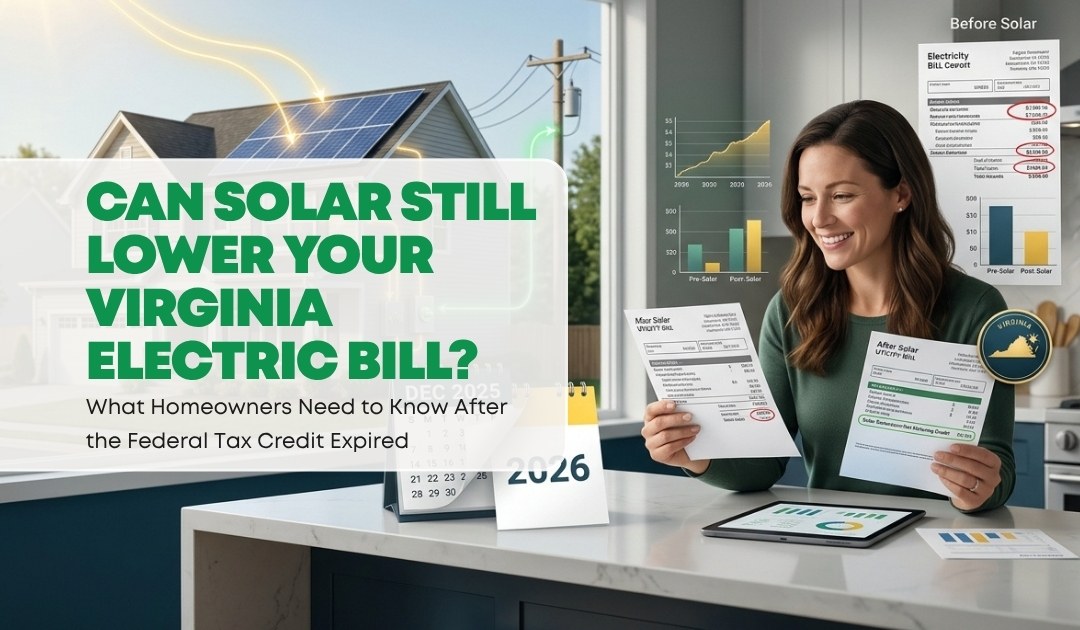
Yes, solar savings after tax credit are still within reach for Virginia homeowners. Your panels keep offsetting the power you would otherwise buy from your utility. Virginia net metering also credits the power you send to the grid at the retail rate, one for one.
The upfront math is what changed. The 30% federal Residential Clean Energy Credit ended for systems placed in service after December 31, 2025. Payback now runs about 11 years in our illustrative example below.
Key Takeaways
- The federal solar tax credit expired for systems homeowners own on December 31, 2025.
- Virginia regulators kept one-for-one retail net metering for the state’s two largest investor-owned utilities in 2025 and 2026.
- Residential systems up to 25 kW are exempt from local property tax, and solar equipment is exempt from Virginia sales tax.
- Base rate increases, data center demand, and returning RGGI costs keep pushing Virginia bills upward.
- In our illustrative 9 kW example, a cash purchase pays for itself in about 11.4 years and keeps producing for 25 years or longer.
- Cash purchases, $0 down loans, and solar leases all give homeowners a path to Virginia solar savings.
- Shared solar and plug-in solar open smaller savings to renters and homes with shaded roofs.
What Happened To The Federal Solar Tax Credit?
The federal solar tax credit expired early. The One Big Beautiful Bill Act, signed July 4, 2025, ended the Section 25D Residential Clean Energy Credit for systems placed in service after December 31, 2025. Congress had originally scheduled the credit to run into the 2030s.
What The Credit Used To Cover (Historical)
Until the end of 2025, homeowners who bought a solar system could claim a 30% federal tax credit on the installed cost. The credit also covered qualifying home batteries. Both benefits have now ended for new systems that homeowners own.
What Still Exists At The Federal Level
The commercial investment credit, Section 48E, still applies to solar systems a business owns. That includes systems a company owns and leases to a homeowner. The system owner is the party that claims this credit. Under current law, new solar projects must be placed in service by December 31, 2027, to qualify.
If You Installed Before 2026
Nothing changes for you. Systems placed in service by December 31, 2025, were eligible for the credit on that year’s tax return. Your existing savings continue as planned.
How Solar Still Lowers Your Virginia Electricity Bill
The federal solar tax credit expired, and the way solar lowers a bill stayed the same. Solar reduces your Virginia electric bill in two ways. It powers your home, and it earns credits for the extra energy it sends to the grid.
Self-Consumption: Power You Stop Buying
Every kilowatt-hour (kWh) your panels produce while your home uses power is a kWh you skip buying from your utility. At Virginia’s average residential rate of about $0.16/kWh, those savings add up fast in sunny months. This is the simplest part of how solar pays you back.
Virginia Net Metering: Credits For What You Send Back
When your panels produce extra power, it flows to the grid. Under Virginia net metering, each exported kWh earns a credit that offsets a kWh you use later, such as at night or on cloudy days. Credits roll forward month to month across 12 months, then reset at an annual true-up.
Virginia’s two largest investor-owned utilities both asked regulators to cut those credits. The State Corporation Commission (SCC) kept them in place. The table below shows the key terms from each decision.
| Virginia’s Largest Utility (Dominion Energy General Schedule Net Metering) | Appalachian Power | |
| SCC Decision | Final order April 30, 2026 (Case PUR-2025-00079) | Order issued August 2025 |
| Credit Value | One for one at the retail rate | One for one at the retail rate |
| Netting Period | 12 months | 12 months |
| Year End Surplus | Paid at about $0.058/kWh | Paid at about $0.057/kWh |
| New Fees | $1/month admin fee for new net metering customers | Customer charge holds at $7.96/month |
| Existing Customers | Grandfathered | Grandfathered |
Electric cooperatives set their own net metering terms. Check with your cooperative before comparing options. Their rules may differ from the two utilities above.
What You’ll Still Pay
A well-sized system keeps your bill low, and a few charges remain. You will still see your utility’s basic customer charge and any applicable fees. You will also pay for any usage your system leaves uncovered over the year.
Why Rising Rates Strengthen Solar Savings After Tax Credit
Your solar savings after tax credit depend heavily on what you would otherwise pay for electricity. Virginia rates keep climbing, which makes each kWh your panels produce worth more over time. Here are the main forces behind the increases.
- Base rate increase: The SCC approved the first base rate increase for Virginia’s largest utility since 1992 (Case PUR-2025-00058). A typical residential bill rises about $11.24/month in 2026 and another $2.36/month in 2027.
- Data center demand: The utility’s own SCC filings show roughly 70 GW of data center interconnection requests in its territory. That’s about three times its all-time peak demand, and serving it will require new generation and transmission.
- RGGI costs returning: Virginia rejoined the Regional Greenhouse Gas Initiative effective July 1, 2026. Based on utility filings with the SCC, that adds roughly $10 to $13/month to residential bills. Read our RGGI breakdown for the full story.
- Grid bottlenecks: New power plants face long waits to connect to the regional grid, which slows new supply. See our coverage of PJM delays in Virginia.
Solar locks in part of your energy cost as rates rise. Each kWh your system produces is one you skip buying at tomorrow’s price. We track Virginia’s long-term clean energy targets in our VCEA progress report.
Virginia Solar Incentives That Still Apply In 2026
Virginia solar savings now come from state and local benefits. The federal homeowner credit has ended, but several Virginia programs remain. Here is what still applies.
| Incentive | What It Does | Who Qualifies |
| Net metering | One-for-one retail credit for exported power over 12 months | Customers of investor-owned utilities with residential systems up to 25 kW |
| Property tax exemption (Va. Code §58.1-3661) | Keeps solar from raising your home’s assessed value for local property tax | Residential systems up to 25 kW, in every locality |
| Sales tax exemption (Va. Code §58.1-609.10) | Removes Virginia sales tax from qualifying solar equipment | All qualifying purchases |
| Local extras | Some localities add perks, such as Fairfax County’s waived solar permit fees | Set by each locality, so check yours |
| Group buy programs | Programs such as Switch Together and Solarize Virginia periodically offer pooled pricing | Check current enrollment windows and eligible localities |
Is There A Virginia State Solar Tax Credit?
Virginia’s residential solar benefits come from net metering and the tax exemptions mentioned above. Although the state currently offers no residential solar income tax credit or statewide cash rebate, homeowners can still benefit from monthly utility bill credits and tax exemptions. Working with an experienced solar company in Richmond can also help homeowners understand these savings opportunities and make informed decisions about going solar.
How Long Does Solar Take To Pay For Itself Now?
With the credit gone, a cash purchase system in Virginia usually pays for itself in about 10 to 13 years. Your usage, roof, and utility all shape that number. Here is how it works in an illustrative example.
Installed cost at $2.65/watt (Virginia average, July 2026, before incentives):
| System Size | Installed Cost |
| 6 kW | $15,900 |
| 9 kW | $23,850 |
| 12 kW | $31,800 |
Illustrative 9 kW cash purchase:
| Metric | Estimate |
| Installed cost | $23,850 |
| Estimated annual production | About 11,430 kWh |
| First year bill savings | About $1,830 |
| Payback period | About 11.4 years |
| Estimated 25-year bill savings | About $62,300 (about $38,500 after system cost) |
Basis: This example is for demonstration only and stands separate from any quote or offer. It assumes 4.35 peak sun hours a day (the midpoint of the NREL range of 4.0 to 4.7 for Virginia), 80% system efficiency, and all production valued at $0.16/kWh under one-for-one net metering. It also assumes 3% annual electricity rate increases, 0.5% annual panel degradation, a system sized to annual usage, and zero financing costs. Your actual results depend on your roof, shading, usage, and utility.
The example home uses about 953 kWh per month, aligning with the roughly $161 average monthly residential bill for Virginia’s largest utility. These figures illustrate how solar savings can add up year after year, even without the federal tax credit. Working with a trusted solar installation company in Mechanicsville can help homeowners evaluate their energy usage and determine the potential long-term savings of going solar.
What Happens After Payback
Panels usually produce power for 25 years or longer. After payback, most of that output turns into savings. Convert Solar systems come with a 25-year bumper-to-bumper warranty covering materials and workmanship, plus a separate 10-year roof penetration warranty.
Simple seasonal checks help protect that output. Our maintenance checklist covers what to look for from the ground. A few minutes each season keeps your system on track.
What Shortens Or Lengthens Payback
- Higher electricity usage and higher rates shorten it.
- Shading, a north-facing roof, or a system sized past your usage lengthens it.
- Loan interest adds to the total cost.
Cash, Loan, Or Lease: Comparing Your Options For Solar Savings After Tax Credit
The right path depends on your budget, how long you plan to stay in your home, and how you want to pay. Convert Solar offers cash purchases, $0 down loan financing for qualified homeowners, and solar leases. Power purchase agreements (PPAs) are unavailable through Convert Solar in Virginia.
| Cash Purchase | Loan | Lease | |
| Upfront Cost | Full system cost | $0 down for qualified homeowners | $0 upfront system cost |
| Who Owns The System | You | You | Convert Solar |
| Monthly Cost | $0 after purchase | Loan payment | Fixed lease payment |
| How You Save | Lower utility bill | Lower utility bill, offset by loan payment | Lower utility bill, offset by lease payment |
| Maintenance and Warranty | 25-year bumper-to-bumper warranty | 25-year bumper-to-bumper warranty | Covered under the lease agreement |
| Good Fit If | You want to own the system and have cash available | You want to own the system with $0 down | You want predictable payments with $0 upfront |
Each path lowers your utility bill. Choose based on whether ownership or predictable monthly payments matter most to you. Our team walks you through each option side by side.
Questions To Ask Before You Sign Any Solar Agreement
- What is the total term and monthly payment?
- Does the payment increase over time, and by how much?
- What happens when you sell your home?
- Is there a buyout option, and how is it priced?
- What warranty and service coverage comes with it?
Virginia is also adding consumer protections. The Virginia Solar Consumer Protection Act takes effect January 1, 2027. It requires written contracts and gives buyers a three-day right to cancel.
What Affects How Much You’ll Save In Virginia
Every home is different. How much your solar electric bill in Virginia drops depends on how you use energy and what your roof can produce. A few factors matter most.
- Roof direction and pitch: South-facing roofs produce the most, and east and west-facing roofs still perform well.
- Shading: Trees and nearby buildings reduce output, especially in winter when the sun sits lower.
- Household usage: Your electricity use and your roof’s production drive system size. General usage information is enough for an initial assessment, so a full 12-month bill history is optional.
- Season: Panels produce less on short winter days, and credits banked in spring and summer carry into winter. Learn more about winter performance in Virginia.
- Upkeep: A little preparation before cold weather keeps production steady. Our winter prep guide covers the basics.
Should You Oversize Your System?
Sizing to your annual use usually delivers the best value in Virginia. Some advice suggests sizing a system 20% above your usage. Under Virginia net metering, extra production left at the annual true-up earns about 5.7 to 5.8 cents/kWh, roughly a third of the retail rate. A system matched to your yearly use keeps every credit working at full value.
Virginia Customer Results
Convert Solar customers in Hampton Roads show what a well-sized system can do. These two homeowners offset 100% of their annual usage.
- Charles Griffin, Hampton Roads: 9.36 kW system, 100% bill offset
- Glen Goodman, Virginia Beach: 17.2 kW system, 103% bill offset
Can Solar Eliminate Your Electric Bill?
Solar can offset most or all of your energy usage. Your utility’s customer charge and applicable fees stay on the bill. So most solar homes still receive a small monthly bill.
What Happens During An Outage
Grid-tied solar systems shut off during an outage to protect line workers. A battery keeps your power on when the grid goes down. Our outage guide explains how this works.
Convert Solar installs the Tesla Powerwall 3, which we generally recommend, along with the Enphase IQ Battery 5P and 10C. One battery generally covers essential loads, and whole-home backup usually needs at least two. Battery storage systems usually start around $18,000, with final pricing depending on equipment, system design, installation complexity, and your energy needs. Compare battery backup options for Virginia homes.
Built For Virginia Weather
Long-term value also depends on durability. Coastal Virginia faces hurricane season every year. See how panels hold up in a Virginia hurricane or severe storm.
Solar Options For Renters and Shaded Roofs
If your roof is shaded or small, or if you rent, two newer options can still trim your bill. Both offer smaller savings. Both also open solar to more Virginians.
- Shared solar: Subscribe to a community solar farm and receive credits on your bill. Recent legislation (SB 254 and HB 807) expands the program in the territory of Virginia’s largest utility by 525 MW and creates a program for Appalachian Power customers. Participants usually save about 10%, or around $175 a year, according to program advocates. Most subscribers of Virginia’s largest utility pay a monthly minimum bill of about $ 55.
- Plug-in (balcony) solar: A 2026 law (HB 395 and SB 250) lets Virginians plug small solar units of up to 1,200 watts into a standard outlet starting January 1, 2027. These units skip the interconnection agreement. Savings are modest, and the option opens solar to renters.
At the utility scale, Virginia is turning former coal mine land into solar sites. Read about brightfields solar in Southwest Virginia. These projects add clean power to the state’s grid.
Should You Go Solar Now Or Wait?
The credit stays expired, and waiting keeps you paying today’s rising rates. Weigh a few factors as you decide whether now is the right time.
- Net metering is settled for now. The SCC’s 2025 and 2026 rulings preserved one-for-one credits, and regulators noted the program may be revisited as adoption grows. Existing customers have been grandfathered in past changes.
- Rates rise again in 2027 under the approved base rate case.
- Installation prices show few signs of falling enough to replace the lost credit.
- Your home’s situation matters most. Plan any needed roof replacement first.
How Convert Solar Helps You Get The Most From Solar Savings After Tax Credit
Getting the most from solar savings after tax credit comes down to the right system size, quality equipment, and a contractor who stays with you for the life of the system. Convert Solar brings all three to Virginia homeowners. Here is what that looks like.
- Experience: 8,500 systems installed across Virginia and Maryland, with 14 years in Hampton Roads.
- Independent recognition: Solar Power World Top Solar Contractor for six consecutive years (2021 to 2026), plus #22 Top Residential Solar Contractor and #25 Top Solar Installer in the U.S. for 2026. Solar Power World bases these annual rankings on the previous year’s installed solar capacity, a measure of completed projects.
- Certified team: NABCEP-certified installers.
- Sizing based on your home: Systems are designed around your electricity use and your roof’s production.
- Quality equipment: Panels from leading North American and European manufacturers, including Silfab, REC, and Mission Solar, paired with Enphase microinverters.
- Warranty: 25-year bumper-to-bumper warranty covering materials and workmanship, plus a separate 10-year roof penetration warranty.
- Timeline: About 6 to 8 weeks from sale to installation, with one to three days on site.
- Flexible options: Cash, $0 down loans for qualified homeowners, and solar leases.
You’re already paying for power. Did you know that you could pay less? Bring your electric bill and your questions, and we’ll show you what residential solar could save your home. Every quote comes with zero obligation.
The Bottom Line
The federal solar tax credit expired, and solar still lowers bills for Virginia homeowners. Net metering survived, tax exemptions remain, and rates keep climbing. Your roof, your usage, and the financing path that fits your budget now drive the decision. Bring your electric bill to Convert Solar, and we’ll help you see what solar could save.
Frequently Asked Questions
Are solar panels still worth it in Virginia now that the federal tax credit expired?
For many homes, yes. Your solar savings after the tax credit come from net metering and the power you skip buying from your utility. In our illustrative 9 kW example, a cash system saves about $1,830 in year one and pays for itself in about 11.4 years. It then keeps producing for 25 years or longer.
How much can a Virginia home save on its monthly electric bill with solar?
Savings depend on system size and usage. In our illustrative 9 kW example, first-year savings come to about $1,830, or roughly $152 a month. The average residential bill for Virginia’s largest utility sits around $161 a month. Your customer charge and fees still apply.
Does Virginia offer a state solar tax credit or rebate?
The state currently offers zero income tax credit and zero statewide rebate for residential solar. Residential systems up to 25 kW are exempt from local property tax in every locality. Solar equipment is also exempt from Virginia sales tax.
How does Virginia net metering work, and is there a size cap?
Exported power earns a one-for-one retail credit that offsets future usage over 12 months. Leftover credits at the annual true-up are paid at a lower rate. Residential systems up to 25 kW qualify for net metering with Virginia’s investor-owned utilities.
Is it better to lease or finance solar right now?
Each option fits a different homeowner. A loan or cash purchase means you own the system, and a lease gives you $0 upfront cost and a predictable monthly payment. Convert Solar offers both paths and helps you match one to your budget and goals. PPAs are unavailable through Convert Solar in Virginia.
Can a homeowners association stop a homeowner from installing solar in Virginia?
Under Va. Code §55.1-1820.1, a community association may ban solar only when its recorded declaration explicitly prohibits it. Associations can set reasonable placement rules. Rules that raise installation cost by over 5% or cut production by over 10% count as unreasonable.
Can a home with an unsuitable roof still get solar savings?
Yes, on a smaller scale. Virginia’s expanded shared solar program lets you subscribe to a community solar farm for bill credits. Plug-in solar units up to 1,200 watts also became legal statewide on January 1, 2027.
Should homeowners wait for solar prices to drop?
Installation prices show few signs of falling enough to replace the expired 30% credit. Electricity rates are scheduled to rise again in 2027. Each year of waiting means another year of full utility bills.
What sets Convert Solar apart for Virginia homeowners?
Convert Solar has installed 8,500 systems across Virginia and Maryland over 14 years in Hampton Roads. NABCEP-certified installers design each system around your electricity use and roof production. Every system comes with a 25-year bumper-to-bumper warranty covering materials and workmanship, plus a separate 10-year roof penetration warranty.