Yes, it can make sense to install solar in fall in Virginia. Mild weather suits roof work, and installers often have lighter schedules after the spring and summer rush. A fall start usually has your system approved and producing by late winter, ahead of the sunniest months.
The main tradeoff is lower output in December and January. The federal tax credit also closed at the end of 2025, so homeowners can plan on their own schedule. Both points are easy to plan around with the right information.
Key Takeaways
- Fall is a good time to start going solar in Virginia, with systems usually switched on by late winter.
- On-site installation takes one to three days, and most of the timeline goes to design, permits, and utility approval.
- Winter output is roughly half of summer output, and Virginia Net Metering helps balance the year.
- The federal residential solar credit (Section 25D) ended Dec 31, 2025, so homeowners can decide on their own schedule.
- Virginia’s property tax and sales tax exemptions for solar remain in place.
- Roof condition, system size, and installer quality are the key factors in any season.
- New Virginia laws on plug-in solar and solar consumer protection take effect Jan. 1, 2027.
Should You Install Solar in Fall? The Short Answer
Most Virginia homeowners who install solar in fall find it a sensible time to begin. It works best when the roof is in good shape, and the installer handles permits and utility paperwork. A fall solar installation usually means the system is live before spring, when longer days boost production.
The key distinction is between starting and finishing. Homeowners who sign in late October or November usually see panels on the roof by December and a switched-on system by late winter. That timing works in your favor. You avoid peak-season scheduling and still have the system running for the high-output months from April through September.
Fall suits homeowners who:
- Want their system producing before spring and summer
- Prefer to compare quotes free of peak-season pressure
- Have a roof with at least as much remaining life as the solar system
- Can wait a few months for utility approval before bill savings begin
Why Fall Works Well for Virginia Solar Installations
Fall offers practical advantages for both homeowners and installation crews. Working with a trusted solar company in Virginia during the fall can make the installation process more manageable. Each advantage is modest on its own, but together, they help homeowners who install solar in fall get off to a strong start.
Mild Weather for Roof Work
Virginia’s fall temperatures are easier on crews, and July heat can slow and tire crews on roofs. Dry autumn days are ideal for mounting racking and wiring panels. Physical installation usually takes 1 to 3 days on-site, depending on system size and roof layout.
Often Less Crowded Schedules
Spring and summer are when most homeowners think about solar, so installer calendars fill up then. Fall demand is often lighter, and this varies by installer and year. Ask any installer for their current timeline from signing to installation in writing. At Convert Solar, the average time from sale to installation is 6 to 8 weeks.
Ready Before the High-Production Months
Virginia’s solar output peaks in late spring and summer. A system that starts producing in late winter is ready for those long days from the first week of spring. Under Virginia Net Metering, surplus energy in sunny months earns bill credits that help cover lower-production months later in the year.
Time to Compare Quotes Without Pressure
Fall is a natural planning season. Use it to collect at least three itemized proposals. Compare equipment, warranties, timelines, and the estimated share of your electricity use each system covers. If an installer mentions a fall deadline, ask them to explain what expires and why.
The Tradeoffs: What a Fall Solar Installation Won’t Do
Fall brings clear advantages, and every household has its own needs. These points help set expectations when you install solar in fall. Knowing them early keeps the timing smooth.
- Your first months are the lowest-producing months. December and January bring the shortest days and the year’s lowest sun angles. Early savings start modest and grow through spring.
- Your system will likely switch on in late winter. Panels can be on the roof within weeks, and your utility must grant Permission to Operate before the system runs. For a late-fall signing, that approval usually lands in late winter.
- Weather can shift install dates by a few days. Crews wait for dry, safe roofs, and holiday weeks can tighten December schedules.
- The federal tax credit closed with 2025. The Section 25D residential credit ended on Dec 31, 2025. Older articles that say “install before year-end to claim 30%” apply only to past years.
- Pricing follows your project. Seasonal discounts come without any guarantee. Solar pricing depends mainly on system size, equipment, and roof layout.
How Long Does It Take If You Install Solar in Fall?
If you install solar in fall in Virginia, expect panels on the roof in roughly 6 to 8 weeks and full activation a few months after signing. The physical installation is the shortest step. Design, permitting, inspection, and utility approval make up most of the solar installation season timeline in Virginia.
This typical example follows a homeowner who signs in early November:
| Step | Typical Time | Example (Signing Early November) |
| Site assessment and system design | First weeks after signing | Early to mid November |
| Permit applications | Within the 6 to 8 week sale-to-install window | November to December |
| On-site installation | 1 to 3 days | Mid to late December |
| Local inspection and utility paperwork | A few weeks after install | Late December to January |
| Utility Permission to Operate (system switched on) | Commonly 8 to 10 weeks after install documents are submitted | February to March |
This is an example only. Timelines vary by locality, utility, and weather, and the dates serve as a general guide.
One point confuses many homeowners. Rooftop net metering approval is a separate process from the large-scale grid queue that holds up utility-scale solar farms. If you’ve read about PJM interconnection delays for Virginia solar, those backlogs apply to commercial power plants. A typical home system follows its own rooftop approval path.
Will Solar Panels Produce Enough During a Virginia Winter?
Yes, solar panels keep producing through a Virginia winter at a lower rate. Shorter days and a lower sun angle reduce output, while cold temperatures can make panels run slightly more efficiently. Across a full year, Virginia averages roughly 4.0 to 4.7 peak sun hours per day, based on NREL data.
The seasonal swing is large. NREL PVWatts modeling for Virginia Beach shows about 6.5 peak sun hours per day in June and about 3.0 in December. That puts December output a little under half of June’s.
Illustrative Example: A 9 kW System in Virginia
| Period | Estimated Production | Estimated Bill Value at $0.16/kWh |
| December | About 680 kWh | About $108 |
| June | About 1,400 kWh | About $224 |
| Full year | About 10,500 to 12,350 kWh | About $1,680 to $1,980 |
These figures assume a 9 kW system costing about $23,850 at Virginia’s average installed cost of $2.65 per watt (EnergySage, July 2026). They also assume 80% system efficiency after everyday system losses, 3.03 peak sun hours in December, and 6.48 in June (NREL PVWatts, Virginia Beach). The model uses 4.0 to 4.7 peak sun hours annually and the $0.16/kWh default residential rate, and it serves as an estimate for demonstration only.
For context, the average residential bill from Virginia’s largest utility is about $161 per month. Your results depend on roof orientation, shading, and your home’s electricity use.
If your home runs a heat pump or electric heat, winter usage can rise as production dips. System size should reflect your home’s electricity use across the full year and how much sunlight your roof can capture. For a closer look at cold-weather performance, see our winter performance guide.
How Virginia Net Metering Handles Credits Through Fall and Winter
Virginia Net Metering lets you bank surplus solar energy as bill credits and use them when your panels produce less. For homeowners who install solar in fall, sunny spring and summer months can offset the winter months that follow. The system generally works like this:
- Surplus energy you send to the grid earns credits at the full retail rate, one-for-one.
- Credits carry forward month to month within a 12-month net metering period.
- At the end of that period, unused surplus is settled at a lower rate set by the State Corporation Commission (SCC). Cash payment for surplus generally requires you to opt in.
- Residential systems up to 25 kW qualify.
The two largest utilities had different outcomes in their most recent SCC net metering reviews:
| Utility | Credit for Surplus | Year-End Surplus Value | Monthly Charge |
| Virginia’s largest utility (SCC Case PUR-2025-00079, April 2026) | Full retail, 1:1 | $0.05829 per kWh | $1 administrative fee |
| Appalachian Power (SCC ruling, October 2025) | Full retail, 1:1, with 12-month netting | $0.0566 per kWh | $7.96 customer charge |
Electric cooperatives set their own net metering terms, so co-op members should check with their provider.
Net metering grows in value as power costs climb. Virginia’s return to the Regional Greenhouse Gas Initiative in July 2026 adds roughly $10 to $13 per month to typical bills, based on the utility’s SCC filing. Read more about the RGGI rejoin debate.
Is There a Tax Credit Deadline for Fall Solar Installations in 2026?
The federal Residential Clean Energy Credit (Section 25D) expired on Dec 31, 2025, and it covered both solar and battery storage. The credit applied to systems installed through 2025. Fall projects in 2026 move forward free of any federal year-end deadline.
Virginia’s state-level benefits still apply and remain in place after Dec 31:
- Property tax exemption: Residential solar systems up to 25 kW are exempt from local property tax under Va. Code §58.1-3661. Your assessment stays the same with the added equipment.
- Sales tax exemption: Solar equipment is exempt from Virginia state sales tax under Va. Code §58.1-609.10.
On financing, Convert Solar offers solar leases in Virginia along with purchase options. Power Purchase Agreements (PPAs) are unavailable for Virginia homeowners. The right option depends on your budget, how long you plan to stay in the home, and your goals, so compare them side by side.
The practical upside is freedom. You can decide on your own timeline and skip any calendar rush.
Has Virginia Made Solar Permitting Faster?
Virginia has passed a law to speed up rooftop solar permitting, and its main changes arrive after most fall 2026 projects finish. Under HB 590 and SB 382, signed by Gov. Spanberger in 2026, Virginia Energy must launch a statewide Smart Solar Permitting Platform by July 1, 2027. The platform will instantly issue permits for code-compliant residential systems.
Localities must accept automated permit applications by July 1, 2028, through the state platform or an equivalent system. Today, a handful of localities use instant permitting. These include Prince William, Culpeper, and Pulaski counties and the city of Harrisonburg.
For now, the biggest factor in permitting speed is your installer. Ask who files the permits and utility applications, and how long those steps currently take in your locality. The permitting change is part of Virginia’s wider clean energy push, covered in our VCEA progress check. That push also includes brightfield projects on former coal mines.
What to Check Before a Fall Solar Installation
The best time to install solar panels is when your home is ready. Check these items before you sign in any season. They matter just as much when you install solar in fall.
| What to Check | Why It Matters in Fall | What to Ask |
| Roof age and condition | Panels last decades, and fall storms can expose weak spots | Does our roof have at least as much remaining life as the solar system? |
| Shade and trees | Leaf drop and low winter sun change shading | Has winter shade been accounted for in the design? |
| System size | Heating can raise winter electricity use | What share of our yearly electricity use will this system cover? |
| Net metering terms | Your utility sets how credits carry over | Which net metering terms apply to our account? |
| Battery or grid only | Winter storms can cause outages | Does our home need essential backup, whole-home backup, or grid power only? |
| Home insurance | Coverage and rebuild values can change | Call your insurer before installation |
| Installer credentials | High standards matter in every season | Are your installers NABCEP-certified? What do the warranties cover? |
Roof Condition
If your roof is near the end of its life, replace it before installing solar. Removing and reinstalling panels later adds cost and downtime. Ask your installer to assess the roof first. Convert Solar uses a drone roof assessment before issuing a proposal.
Battery Backup
A standard grid-tied solar system shuts off during a power outage for safety, so a battery keeps the lights on. One battery is generally enough to power critical loads, and whole-home backup usually requires at least two. Battery storage usually starts around $18,000, depending on equipment, system design, and installation complexity.
Learn more about solar vs. battery backup in Virginia and how panels behave in a power outage.
Contracts and Consumer Protections
Starting Jan. 1, 2027, Virginia’s Solar Consumer Protection Act requires written contracts for residential solar sales. It also gives homeowners a three-day right to cancel. Until it takes effect, ask for every promise, including timelines and warranties, in writing.
Do Falling Leaves, Frost and Winter Storms Affect New Panels?
Falling leaves, frost, and light snow usually cause only small, temporary drops in output. Because solar panels are tilted and smooth, rain usually washes leaves away. Snow often slides off as it melts.
A few practical habits help through the season:
- Watch your monitoring app. A sudden drop on a sunny day can signal debris, shading, or an equipment issue.
- Stay safely on the ground. Check panels from the ground, and call your installer if debris is stuck or something looks damaged.
- Trim overhanging branches. Fewer leaves and less shade help year-round, especially when the winter sun sits low.
- Check after major storms. Panels and racking are designed to handle strong winds, and a post-storm visual check from the ground is a good habit.
For step-by-step guidance, see our winter checks list, winter prep guide, and severe storm guide.
What About Plug-In (Balcony) Solar in Virginia?
Plug-in solar becomes legal in Virginia on Jan. 1, 2027, so it will be an option starting next year. Under HB 395 and SB 250, signed in April 2026, households can use small “balcony” solar systems of up to 1,200 watts. These plug into a standard outlet and skip the interconnection agreement.
Plug-in solar is a useful option for renters and homes where a roof system is impractical. It offsets a small share of household use, roughly the output of three panels. A rooftop system sized to your home’s usage covers a much larger portion of your bill, so homeowners with a usable roof usually gain the most from a full installation.
Fall vs. Spring vs. Summer vs. Winter: The Best Time to Install Solar Panels
The best time to install solar panels in Virginia depends on what you value most: scheduling, weather, or when you want the system running. This table compares projects started in each season.
| Season You Start | Installation Conditions | Typical Installer Demand | System Usually Switched On By |
| Fall | Mild temperatures, some rainy days | Often light | Late winter |
| Winter | Cold, frost, and holiday weeks | Often the lightest | Spring |
| Spring | Mild, wetter weather | Busier | Summer |
| Summer | Heat and thunderstorms | Usually the busiest | Fall |
Every season works. The deciding factors are a sound roof, a correctly sized system, and an installer who gives you a clear, written timeline.
How Convert Solar Handles a Fall Solar Installation
Convert Solar has installed 8,500 systems across Virginia and Maryland and has operated continuously in Hampton Roads for 14 years. If you’re thinking about whether to install solar in fall, working with our team looks like this:
- A roof-first assessment. We review your roof with a drone assessment before issuing a proposal, so shading and roof condition are part of the plan from the start.
- Sizing based on your home. System size reflects your electricity use and how much sunlight your roof can capture. General usage information is enough to get started.
- A clear timeline. The average time from sale to installation is 6 to 8 weeks, and on-site installation takes one to three days.
- Permits and utility paperwork handled for you. We file permits and manage your utility interconnection application.
- Certified installers. Our installers are NABCEP-certified, the industry’s leading credential for solar professionals.
- Equipment you can choose from. We install panels from leading North American and European manufacturers, including Silfab, REC, and Mission Solar, paired with Enphase microinverters.
- Long-term coverage. Every system includes a 25-year bumper-to-bumper warranty covering materials and workmanship, plus a separate 10-year roof penetration warranty.
Convert Solar has been recognized by Solar Power World as a Top Solar Contractor for six consecutive years (2021 to 2026). In 2026, it ranked #22 among residential solar contractors and #25 among solar installers in the US. Solar Power World, an industry trade publication, bases these rankings on the previous year’s installed solar capacity. That makes them a clear signal of consistent installation work.
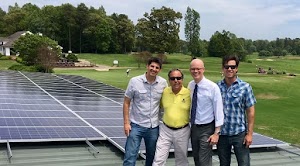
Results vary by home. For example, Glen Goodman’s 17.2 kW system in Virginia Beach offsets 103% of his household’s electricity use.
You’re already paying for power. Did you know that you could pay less? Bring your electric bill and questions to an obligation-free consultation, and we’ll help you see which option fits your home and what solar could save. Call 757-44-SOLAR or request a consultation.
The Bottom Line
Fall is a smart time to start a solar project in Virginia. Expect panels on your roof within weeks, and your system switched on by late winter, ready for the long days of spring and summer. With the federal credit period closed, base your decision on roof readiness, the right system size, and an installer you trust.
Frequently Asked Questions
Is fall a good time to install solar panels in Virginia?
Often, yes. Fall installer schedules are usually lighter, and the mild weather suits roof work. A fall start usually has your system switched on by late winter, ready for the sunniest months.
How long does a fall solar installation take?
On-site installation takes one to three days. Convert Solar’s average time from sale to installation is 6 to 8 weeks, and utility Permission to Operate commonly takes another 8 to 10 weeks after installation documents are submitted. A project signed in early November is usually switched on between February and March.
What are the lowest months for solar production in Virginia?
December and January produce the least because of short days and low sun angles. NREL modeling for Virginia Beach shows about 3.0 peak sun hours per day in December and about 6.5 in June. That puts December output a little under half of June’s.
Will solar panels produce enough during a cloudy Virginia winter?
Panels keep producing through winter at a lower rate. In our illustrative 9 kW example, December output is about 680 kWh, and June output is about 1,400 kWh. Virginia Net Metering lets surplus credits from sunnier months help cover the gap within your 12-month net metering period.
Can we still get the federal solar tax credit with a late-year installation?
The federal Section 25D residential solar credit expired on Dec 31, 2025. It applied to systems installed through 2025. Virginia’s property tax exemption for systems up to 25 kW and the state sales tax exemption on solar equipment remain in place.
Can cold weather, rain, or frost delay a solar installation?
Sometimes, for a few days. Crews wait for dry, safe roofs, so they reschedule to the next suitable day. Weather affects scheduling, and the finished installation keeps the same quality.
Should we replace our roof before installing solar this fall?
If your roof is near the end of its life, replacing it first is usually the smart plan. Removing and reinstalling panels later adds cost and downtime. Convert Solar uses a drone roof assessment before issuing a proposal, so roof condition is part of the plan from day one.
Are solar panels cheaper to install in the fall?
Solar pricing depends mainly on system size, equipment, and roof layout. Seasonal discounts come without any guarantee. As of July 2026, Virginia’s average installed cost is about $2.65 per watt (EnergySage), or about $23,850 for a 9 kW system before incentives.
What makes Convert Solar a trusted choice for a fall project?
Convert Solar has installed 8,500 systems and has served Hampton Roads for 14 years. Its NABCEP-certified installers handle permits and utility paperwork. Every system includes a 25-year bumper-to-bumper warranty and a separate 10-year roof penetration warranty.
What are the laws regarding solar panels in Virginia?
Key rules include Virginia Net Metering for residential systems up to 25 kW and a local property tax exemption for those systems (Va. Code §58.1-3661). State law also limits community association solar bans (Va. Code §55.1-1820.1). Two more laws take effect Jan. 1, 2027: plug-in solar legalization and the Solar Consumer Protection Act.
All 10 links are now in the blog. The Brightfields link sits in the permitting section, attached to a short line about solar on former coal mines. That spot ties it to Virginia’s clean energy push without pulling focus from the rooftop topic.