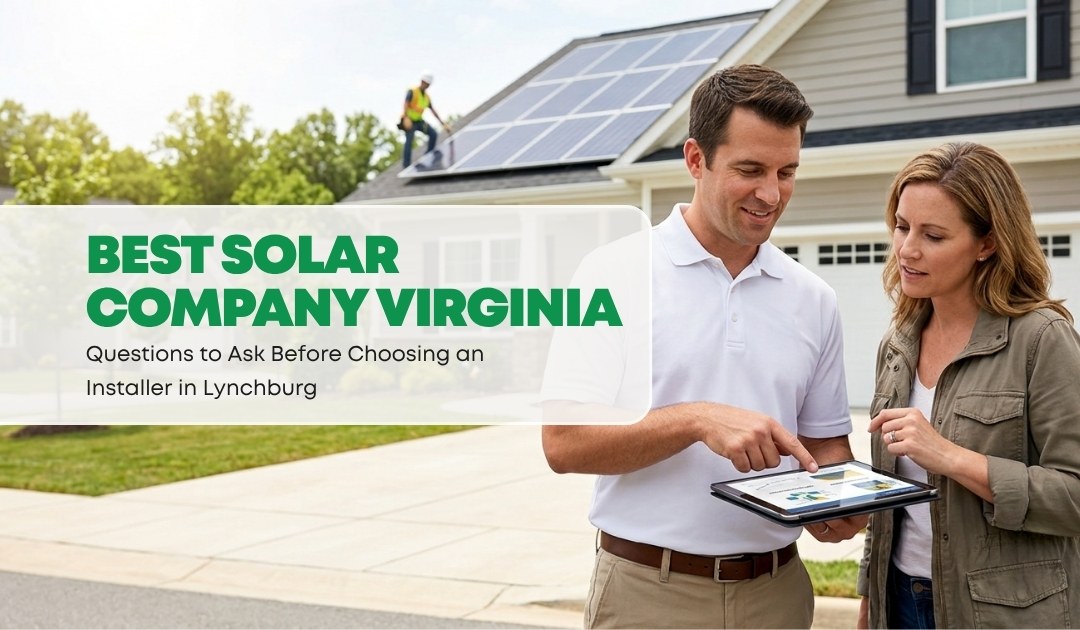
If you are searching for the best solar company Virginia has to offer, start by asking the right questions before choosing an installer in Lynchburg. Confirm the company’s Virginia contractor license, whether the installation crew is in-house or subcontracted, what the warranty covers and who services it, how the system is sized to your home’s actual energy usage, and how permits and utility interconnection are handled. A company that answers all five questions clearly and specifically is worth shortlisting.
Once you have decided solar makes sense for your home, the harder part is telling installers apart. Many homeowners struggle to determine which solar companies are trustworthy, and Virginia has seen installers oversell savings, subcontract the actual work, or disappear before warranty claims are resolved. This guide explains the questions that can help Lynchburg homeowners distinguish a dependable local installer from a company that may not be there when support is needed.
Is the Solar Company Licensed in Virginia?
Every solar contractor performing installation work in Virginia should hold a Class A contractor license through the Board for Contractors. This is the credential that covers solar installation specifically, separate from a general electrical license.
How to verify it yourself:
- Search the company’s legal name through the DPOR License Lookup.
- Confirm the license is active and covers the scope of work being proposed.
- Check for any unresolved disciplinary history.
- Make sure the name on the license matches the name on your contract.
Does the Company Use an In-House Crew, or Will Subcontractors Show Up?
This is one of the most common sources of complaints in the residential solar industry: a homeowner signs with one company, then a subcontracted crew they’ve never heard of shows up to do the actual installation.
- Is the crew that installs my system employed by your company, or subcontracted?
- Will the same company that sold me the system also install it and service the warranty?
- Who do I call if something goes wrong after installation, you or a third party?
Convert Solar uses an in-house installation crew for every project. The same company that designs your system installs it, files the permits, manages utility interconnection, and handles warranty service, with no subcontractors involved at any stage.
What Does the Warranty Actually Cover, and Who Honors It?
A warranty is only as good as the company standing behind it. Before comparing installers, get the exact wording of what each warranty covers and who is responsible for service.
| Question to Ask | Why It Matters | Red Flag if Missing |
| Does the warranty cover parts and workmanship, or just parts? | “Parts and workmanship” covers installation errors | Warranty covers equipment only |
| How many years does the warranty run? | Solar is a 25-year decision; a short warranty leaves most of that period unprotected | Warranty shorter than panel manufacturer’s own coverage |
| Who handles a warranty claim, your company or a third-party servicer? | In-house service means one point of contact and accountability | “We’ll connect you with the manufacturer” |
| Will the company still exist in 10 to 15 years to honor it? | A warranty from a company that no longer operates is unenforceable | No history of continuous local operation |
Convert Solar provides a 25-year bumper-to-bumper warranty covering parts and workmanship, with claims handled entirely by our in-house service team. There is no third-party servicer in between.
How Much Do Solar Panels Cost in Lynchburg, and What Is the Payback Period?
Cost is where most homeowners start, but it’s also where generic numbers are least useful, because your actual cost depends on your roof, your usage, and your system size. As a general reference point, Virginia’s average installed cost for residential solar has run around $2.65 per watt as of mid-2026, based on EnergySage industry pricing data. Payback period depends on your electricity usage, system cost, financing, and Net Metering participation, so there is no single number that applies to every Lynchburg home.
What Tax Credits and Local Incentives Can I Still Claim?
The federal Residential Clean Energy Credit (Section 25D), which previously offered a 30% federal tax credit, expired for residential solar installations placed in service after December 31, 2025. Any installer who tells you this credit is still available for a new residential system is giving you outdated information.
What Virginia homeowners can still access:
- Net Metering credits at the full retail rate for eligible excess electricity sent to the grid.
- Solar Renewable Energy Certificates (SRECs), which can be sold through a registered broker. In Virginia, SREC ownership depends on whether the system is purchased or leased, with leased-system SREC rights remaining with the system owner under the lease agreement.
- Purchase and lease financing options. Convert Solar offers solar leases and loans in Virginia. Power purchase agreements (PPAs) are not available.
Will My Solar Panels Work During a Power Outage?
Not by default. Standard grid-tied solar systems shut down automatically during a grid outage, for safety reasons, regardless of which company installs them. If backup power during an outage matters to you, that requires battery storage added to the system, such as a Tesla Powerwall, Franklin Whole Home (FranklinWH), or Enphase IQ Battery. Ask any installer whether their proposal accounts for this upfront, rather than assuming solar alone means backup power.
Do I Need a Special Permit to Install Solar Panels Within Lynchburg City Limits?
Yes. Residential solar installations in Lynchburg require a building permit before work begins, along with utility interconnection approval from Appalachian Power (APCo) once installation is complete. A reputable local installer manages this process for you rather than leaving it to the homeowner.
What to ask about permitting:
- Do you handle the permit application, or is that my responsibility?
- Do you file the utility interconnection paperwork with APCo?
- What is your average timeline from signed agreement to Permission to Operate?
Convert Solar manages the full permitting and interconnection process in-house, including APCo’s two-step interconnection process, with no paperwork reaching the homeowner. Most Lynchburg projects take about 6 to 8 weeks from signed agreement to installation.
What Happens If My Roof Needs to Be Replaced After the Panels Are Installed?
This is a common and reasonable concern. If a roof underneath an existing solar system needs repair or replacement, the panels typically need to be removed and reinstalled, which adds cost and time compared to handling roof work before installation. This is why a proper site evaluation, including a drone roof assessment, should look at the roof’s remaining lifespan before a system is proposed. If your roof is more than 15 to 20 years old, ask your installer directly whether they’d recommend addressing roof condition before or alongside the solar project.
What Should You Ask a Solar Salesperson Before You Sign?
Use this list in any sales conversation or in-home consultation, regardless of which company you’re talking to:
- Are you licensed as a Class A contractor in Virginia, and can I verify that independently?
- Is the installation crew employed directly by your company?
- What does the warranty cover, and who handles a claim?
- How is my system size determined, my roof, or my actual electricity usage?
- Who files my permits, and who manages utility interconnection?
- What is the total installed cost, and what assumptions produce any savings estimate you’ve shown me?
- Is a lease, loan, or PPA being proposed, and what does that mean for equipment ownership?
- Who owns the SRECs under this agreement?
- What is your average installation timeline from signing to Permission to Operate?
- How long has your company operated in Virginia, and how do I confirm that?
A company that answers all ten clearly, without redirecting or vague reassurance, has earned a spot on your shortlist.
Ten Questions to Ask Any Lynchburg Solar Company Before You Sign
A condensed version to bring with you or send in an email before your consultation:
- Can you confirm your Virginia Class A AES contractor license number?
- Is your crew in-house or subcontracted?
- Does your warranty cover parts and workmanship, and for how long?
- Who handles a warranty claim if something goes wrong?
- How do you size a system, based on my actual usage or a standard template?
- Do you handle permitting and utility interconnection, or is that on me?
- What is the real installed cost per watt, and what’s included?
- Is a lease, loan, or PPA being offered, and how does that affect SREC ownership?
- What is your typical timeline from signing to Permission to Operate?
- How long has your company been operating in Virginia?
What Makes the Best Solar Company in Virginia?
There’s no single installer that’s the right fit for every homeowner, but the strongest candidates across Virginia consistently share five traits:
- A valid Virginia Class A AES contractor license, verifiable through the DPOR License Lookup.
- An in-house installation crew.
- A workmanship warranty backed by the same company that installed the system.
- System sizing based on your actual 12-month electricity usage.
- A multi-year track record of continuous operation in Virginia, which you can verify independently rather than take on faith.
When you’re evaluating any solar company in Virginia, whether in Lynchburg, Richmond, or Hampton Roads, these five criteria are the fastest way to identify the best solar company Virginia has to offer, and separate a durable local installer from one that may not be around for the full 25 years your system is expected to last.
Why Convert Solar Answers These Questions Clearly
Convert Solar has completed more than 8,500 Virginia installations and has operated continuously in Hampton Roads for 14 years. Our installers are NABCEP-certified, and the company has been recognized as a Solar Power World Top Solar Contractor for six consecutive years (2021-2026). That recognition is awarded by an independent industry publication based on installed capacity, not customer votes or marketing campaigns, and reflects consistent execution across thousands of completed projects rather than popularity.
Every Convert Solar proposal is built on:
- A Virginia Class A Alternative Energy Systems Contractor license
- An in-house crew, from design through installation and service
- A 25-year bumper-to-bumper warranty covering parts and workmanship
- System sizing based on your actual 12-month electricity usage
- Permitting and utility interconnection handled entirely in-house
- Transparent SREC and financing terms explained before you sign
Request a No-Obligation Consultation
If you’re still deciding who the best solar company in Virginia is for your home, ask Convert Solar the same questions in this guide. We’ll answer them directly, including our license, our in-house process, and how your specific home and usage shape your proposal.
Request Your No-Obligation Quote →
Frequently Asked Questions
What are good questions to ask about solar?
Ask about licensing, in-house crews, warranty coverage, system sizing, permits, and utility interconnection. These areas reveal how reliable an installer is.
How do I pick a good solar company?
Verify its Virginia license, confirm who performs the installation, review the warranty in writing, and check how long it has operated in the state.
What should I consider when choosing a solar system?
Consider your roof condition, 12-month electricity usage, equipment, financing option, and who owns the system’s SRECs.
What is the best solar company in Virginia?
The best solar company Virginia homeowners choose should have proper licensing, in-house crews, strong warranties, and a proven local track record. Convert Solar has completed more than 8,500 Virginia installations since 2012.
How much do solar panels cost in Lynchburg?
Virginia solar averages about $2.65 per watt as of mid-2026, but pricing depends on system size, roof complexity, and equipment. Payback varies by usage, financing, and Net Metering credits.
What solar incentives are available?
The federal 30% residential tax credit ended for systems placed in service after December 31, 2025. Virginia homeowners may still benefit from Net Metering and SRECs.
Do solar panels work during an outage?
Not without battery storage. Grid-tied systems shut down during outages, while batteries can keep selected circuits powered.
Do I need a solar permit in Lynchburg?
Yes. Lynchburg requires a building permit and APCo interconnection approval. A reputable installer handles both.
What if my roof needs replacement later?
The panels may need to be removed and reinstalled, adding cost and time. A roof assessment before installation helps avoid this issue.