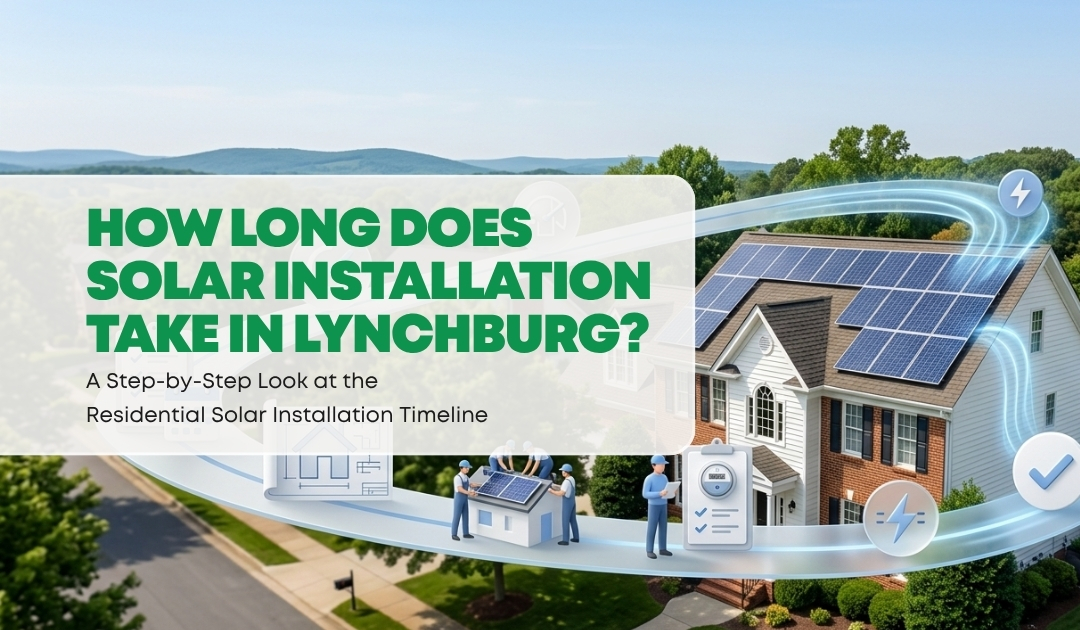
The average solar installation timeline in Lynchburg is 6–8 weeks from signed agreement to installation. Afterward, Appalachian Power may take up to 30 additional days to issue Permission to Operate. Permitting, inspections, and utility review can affect timing, but an experienced installer helps prevent delays. Convert Solar has completed 8,500+ Virginia installations since 2012.
What Is the Solar Installation Timeline in Lynchburg, VA?
The total solar installation timeline in Lynchburg is about 10–14 weeks from signing to activation. Pre-installation takes 6–8 weeks, installation takes 1–2 days, and interconnection may add up to 30 days.
Complete Lynchburg Solar Installation Timeline
| Phase | What Happens | Who Handles It | Typical Duration |
| Site assessment | Drone roof assessment + 12-month utility data review | Convert Solar | Before signing |
| System design | Custom system sized to actual consumption | Convert Solar | 1–2 weeks post-signing |
| APCo pre-approval | NMIN form submitted to Appalachian Power before installation | Convert Solar | Concurrent with design |
| Permit application | Building and electrical permit filed with City of Lynchburg | Convert Solar | 1–2 weeks |
| Permit review | City of Lynchburg building department review | City of Lynchburg | 1–3 weeks |
| Installation scheduling | Crew scheduling once permit is approved | Convert Solar | 1–2 weeks |
| Physical installation | Panels, racking, inverters, wiring | Convert Solar in-house crew | 1–2 days on-site |
| City inspection | Building inspector verifies code compliance | City of Lynchburg | 1–2 weeks post-install |
| APCo final interconnection | Completed NMIN submitted, meter exchanged | Convert Solar + APCo | Up to 30 days |
| Permission to Operate (PTO) | System legally activates | Appalachian Power | End of interconnection |
Total: approximately 10–14 weeks from signed agreement to PTO.
What Happens Before Installation Starts
Most of the solar installation timeline in Lynchburg is spent on design, permitting, and utility approvals rather than roof work.
Step 1 — Site Assessment and System Design
Convert Solar reviews the home’s roof, shading, structure, and 12-month electricity usage to design a system based on actual energy needs. After signing, the engineering plans are prepared and submitted for permitting and utility pre-approval at the same time to help reduce delays.
Step 2 — Appalachian Power Pre-Approval
Before installation, Convert Solar submits the proposed system details through Appalachian Power’s Net Metering Interconnection Notification process. The completed form is submitted again after installation and inspection for final approval.
Review may take up to 30 days for systems under 10 kW and up to 60 days for larger systems, making early submission important.
Step 3 — City of Lynchburg Permits
Solar projects require building and electrical permits from the City of Lynchburg, and Convert Solar handles the entire permitting process on your behalf. As a trusted solar company in Lynchburg, VA, we prepare complete, code-compliant documentation to help avoid resubmissions that could delay your solar installation timeline by one to three weeks.
What Happens on Installation Day in Lynchburg
Physical installation is the shortest part of the solar installation timeline in Lynchburg. Most residential systems are completed in one to two days.
What to Expect
Convert Solar’s in-house crew stages the equipment, installs roof racking and panels, connects the inverter, and wires the system to the electrical panel. As an experienced Solar Installation Company in Virginia Beach, Convert Solar completes most of the work on the roof or in the attic, so disruption is minimal. The system remains off after installation until it passes city inspection and Appalachian Power issues Permission to Operate.
Why In-House Installation Matters
As a trusted Solar Installation Company in Virginia Beach, Convert Solar uses its own in-house installation crews rather than subcontractors, helping prevent scheduling delays and maintain consistent workmanship. The same experienced team also provides ongoing support backed by the company’s 25-year parts and workmanship warranty. Convert Solar has also been recognized as a Solar Power World Top Contractor for five consecutive years, from 2021 through 2025.
What Happens After Installation: Inspection and Appalachian Power Interconnection
Two steps remain before your Lynchburg solar system can activate: city inspection and Appalachian Power interconnection.
City Inspection
Convert Solar schedules the required inspection after installation. A city inspector verifies that the system meets building and electrical codes. Timing depends on the local inspection queue.
Appalachian Power Final Approval
After the inspection passes, Convert Solar submits the completed interconnection paperwork. Appalachian Power reviews the documents, verifies the system, installs or programs the bidirectional meter, and issues Permission to Operate.
Final approval may take up to 30 days for systems under 10 kW and up to 60 days for larger systems. The system must remain off until approval is issued.
Permission to Operate
Permission to Operate marks the end of the solar installation timeline. Once approved, the system can activate, begin earning net metering credits, and move forward with SREC registration based on the ownership structure.
What Can Delay the Solar Installation Timeline in Lynchburg
Most delays in the solar installation timeline in Lynchburg fall into predictable categories. Understanding them in advance helps you ask the right questions before signing with any installer.
Delays You Can Avoid or Reduce
- Incomplete permit documentation — a common cause of resubmission requests that add 1–3 weeks to the permit phase. An installer with Lynchburg permitting experience submits complete documentation on the first submission.
- Subcontracted installation crews — when installation is subcontracted, scheduling depends on that party’s availability. Convert Solar’s in-house crew is scheduled directly.
- Roof issues identified late — a pre-installation drone assessment identifies roof conditions that would require repairs before solar can be installed. Discovering this early avoids mid-project delays.
Delays Outside Anyone’s Control
- City of Lynchburg permit review queue — building departments process permits in the order received. Peak periods take longer.
- Appalachian Power interconnection queue — APCo processes applications in sequence. The 30-day clock starts when the completed NMIN is received.
- Inspection scheduling — city inspectors work on a fixed schedule. Convert Solar requests inspections immediately after installation is complete to minimise the wait.
- Material availability — specific panel or inverter models occasionally have supply constraints. Convert Solar confirms equipment availability before proposals are issued.
An experienced Lynchburg solar installer compresses every step within their control and sets accurate expectations about the steps they cannot control. The solar installation timeline in Lynchburg is predictable, manageable when you know what to expect at each stage.
Does Lynchburg Support Net Metering, and When Does It Start?
Yes. Lynchburg homeowners served by Appalachian Power may qualify for Virginia Net Metering. Bill credits begin only after the system receives Permission to Operate and the bidirectional meter is installed. Until interconnection is complete, the system cannot generate net metering credits.
How Virginia Net Metering Works in Lynchburg
Once PTO is issued and the bidirectional meter is installed:
- Surplus solar generation flows to the grid and earns credits at the full retail rate
- Credits bank monthly and roll forward on a 12-month cycle
- Summer production offsets winter bills within the same annual period
- Any year-end surplus is compensated at APCo’s avoided-cost rate
At $0.164 per kWh, Appalachian Power’s residential rate makes each unit of solar energy offset more valuable, strengthening the financial return for Lynchburg homeowners.
How Long Do Solar Panels Take to Pay for Themselves in Lynchburg?
The average solar payback period in Lynchburg is about 11–13 years for a cash purchase on a 25-year system. Financed systems may also be structured so the monthly payment is comparable to or below the current electricity bill.
Appalachian Power’s $0.164/kWh residential rate increases the value of each kilowatt-hour offset, helping Lynchburg systems generate stronger annual savings than similar systems in many other parts of Virginia.
The 25-Year Financial Picture for Lynchburg Homeowners
| Metric | Estimate |
| Annual electricity savings (9 kW system) | ~$2,200–$2,400/year |
| Annual SREC income (where applicable) | $300–$520/year at current prices, rising under HB 628 |
| Property tax savings | ~$100–$350/year (§58.1-3661) |
| Projected 25-year net savings | ~$55,800 |
| Estimated payback period (cash purchase) | ~11–13 years |
In Virginia, SREC ownership depends on how the solar system is financed. With a lease, the system owner typically retains the SREC rights under the agreement. Convert Solar offers leased and purchased systems, but not Power Purchase Agreements, so the best option depends on the homeowner’s goals.
Practical Questions About Solar in Lynchburg
Do Solar Panels Work on Cloudy or Rainy Days?
Yes. Solar panels still generate electricity from diffuse sunlight. Output is lower during cloudy weather, but Lynchburg’s average peak sun hours already account for seasonal rain and cloud cover. Rain can also help clean pollen and debris from the panels.
Will Solar Panels Work During a Power Outage?
Standard grid-tied systems shut down during outages to protect utility workers. Battery storage is required for backup power.
Convert Solar installs Tesla Powerwall and Franklin Whole Home batteries, and every new system is designed to support future battery installation.
Can Solar Panels Handle Severe Virginia Weather?
Yes. Quality panels and IronRidge racking are built to withstand strong winds, hail, snow, and decades of outdoor exposure. Snow usually slides off as the panels warm, creating little effect on annual production.
Is My Roof Suitable for Solar?
Most roofs with south-, west-, or east-facing surfaces, limited shade, and at least five years of useful life remaining may qualify. Convert Solar uses a drone assessment to evaluate roof condition, orientation, available space, and shading before preparing a proposal.
Who Handles the Permits for Solar in Lynchburg?
Convert Solar handles all of the following on every Lynchburg installation:
- Permit filing with the City of Lynchburg’s Permitting Center (900 Church Street)
- Appalachian Power NMIN pre-approval (before installation)
- Appalachian Power final interconnection application (after inspection)
- SREC registration, managed in accordance with the system’s ownership structure
No paperwork reaches the homeowner’s desk at any stage of the process.
Are There Tax Incentives Available for Solar in Lynchburg in 2026?
Virginia’s current solar incentive stack for Lynchburg homeowners:
| Incentive | What It Provides |
| Virginia Net Metering | Full retail-rate credits at APCo’s $0.164/kWh rate, protected by SCC August 2025 ruling |
| Virginia SRECs | Passive income tied to system production; ownership depends on system ownership structure |
| Property tax exemption | Virginia Code §58.1-3661, 100% exemption on solar-added home value in City of Lynchburg and surrounding counties |
| Sales tax exemption | Solar equipment exempt from Virginia state sales tax, approximately $1,000–$2,200 at point of purchase |
The federal 30% residential tax credit (Section 25D) expired December 31, 2025. It is not available for new residential solar installations in 2026.
Ready to Start the Lynchburg Solar Installation Timeline?
Understanding the process is the first step. Convert Solar has completed 8,500+ Virginia installations since 2012 and manages the entire solar installation timeline in Lynchburg, from roof assessment and permitting to Appalachian Power interconnection. Your project starts with a free, no-obligation review of your 12-month electricity usage and roof.
Request a No-Obligation Quote →Frequently Asked Questions
How long does solar installation take in Lynchburg, VA?
The average solar installation timeline is 6–8 weeks from signing to installation, plus up to 30 days for Appalachian Power approval. Total time to activate is typically 10–14 weeks.
How long does Appalachian Power interconnection take?
Interconnection may take up to 30 days for systems under 10 kW and up to 60 days for larger systems. Approval includes pre-installation review and final submission after inspection.
Who handles solar permits in Lynchburg?
Convert Solar manages city permits, Appalachian Power interconnection paperwork, and SREC registration based on the system’s ownership structure.
How much do solar panels cost in Lynchburg?
A typical 9 kW system costs about $24,750–$32,130 before available incentives. Final pricing depends on equipment, roof conditions, and energy usage.
What is the solar payback period in Lynchburg?
Cash-purchased systems typically reach payback in about 11–13 years. Actual returns depend on system size, electricity rates, production, and financing.
Does Lynchburg support net metering?
Yes. Eligible Appalachian Power customers can earn net metering credits after receiving Permission to Operate and having a bidirectional meter installed.
Do solar panels work in the rain?
Yes. Production decreases during rain and cloud cover but does not stop completely. Rain can also wash pollen and debris from the panels.
Will solar panels work during a power outage?
Standard grid-tied systems shut down during outages. A Tesla Powerwall, Franklin Whole Home battery, or similar backup system is required to keep the home powered.
Can solar panels withstand severe Virginia weather?
Yes. Quality panels and mounting systems are built to withstand strong winds, hail, snow, and long-term outdoor exposure.
How are SRECs handled?
SREC ownership depends on the system’s ownership structure. Convert Solar manages registration according to the customer’s purchase or lease agreement.
Does Convert Solar offer solar leases?
Yes. Convert Solar offers purchased and leased systems in Virginia but does not offer Power Purchase Agreements. The best structure depends on the homeowner’s goals.