
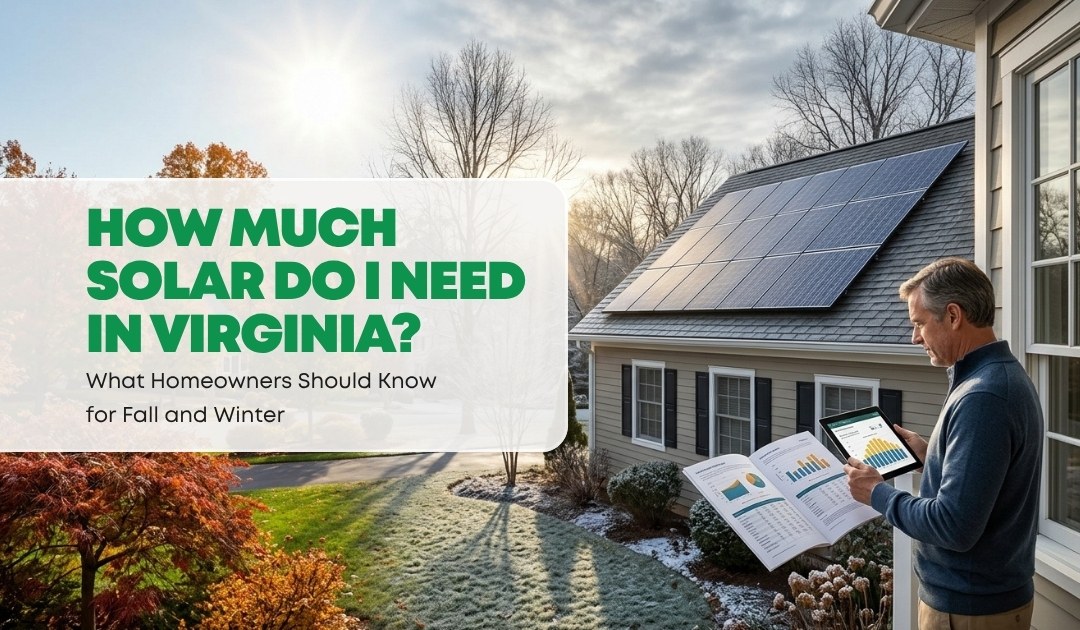
A Virginia home that uses about 12,000 kWh of electricity annually might need a solar system around 9 kW, estimated to produce roughly 12,000 kWh per year under the stated modeling assumptions. Actual system size and production will vary based on roof conditions, equipment, location, and utility rules.
Solar production also changes with the seasons. The same system may produce about half as much electricity in December as it does in July. That doesn’t necessarily mean you need a larger system. Virginia’s net metering rules allow eligible homeowners to use credits from periods of excess production to offset electricity use when their panels generate less. That’s why sizing a system around annual electricity consumption is a useful starting point.
TL;DR
- The average Virginia home used 993 kWh of electricity a month in 2023, or about 12,000 kWh a year (EIA).
- A home that uses about 12,000 kWh a year typically needs a solar system of about 9 kW, or roughly 22–23 panels.
- Winter production runs about 70–90 kWh per kW of panels each month, roughly half of peak summer output.
- Winter household demand in Virginia runs close to summer’s peak, so most homes draw on Net Metering credits from December through February.
- Size for annual use. Oversizing for winter breaks utility size caps and roughly doubles cost.
How Much Solar Do I Need in Virginia? Start With Your Annual kWh
The solar system size you need equals your yearly electricity use divided by how much each kilowatt of panels produces in a year. In Virginia, a well-oriented, unshaded roof produces roughly 1,300–1,400 kWh per kW of panels annually, based on the state’s average of about 4.0–4.7 peak sun hours per day (NREL).
This is the core of solar sizing in kWh: start with your usage, then match production to it.
The table below shows typical system sizes for common Virginia usage levels.
| Monthly use | Annual use | Approx. system size | Approx. panels (400 W) |
| 750 kWh | 9,000 kWh | 6.5 kW | 17 |
| 1,000 kWh | 12,000 kWh | 8.7 kW | 22 |
| 1,250 kWh | 15,000 kWh | 10.9 kW | 28 |
| 1,500 kWh | 18,000 kWh | 13.1 kW | 33 |
Basis: assumes 1,375 kWh per kW per year for a well-oriented, unshaded Virginia roof and 400-watt panels. These are illustrative estimates. Roof direction, tilt, shade, and panel model change the result.
So when someone asks how much solar they need in Virginia, the honest answer is: it depends on their bill first and their roof second. Two homes on the same street can need very different systems.
Why Fall and Winter Change the Solar Sizing Math
Fall and winter matter because Virginia solar output drops by about half from summer to December, while household demand climbs back toward its summer peak. That mismatch is why the right answer to “how much solar do I need in Virginia?” can look too small in winter, even when the solar system size is right for the year.
Solar Output Falls From September to February
Shorter days and a lower sun angle mean fewer usable sun hours. Here is how a typical well-oriented Virginia system’s output spreads across the year.
| Season | Output per kW of panels | Share of annual production |
| Spring (Mar–May) | ~385 kWh | ~28% |
| Summer (Jun–Aug) | ~440 kWh | ~32% |
| Fall (Sep–Nov) | ~310 kWh | ~23% |
| Winter (Dec–Feb) | ~236 kWh | ~17% |
| Full year | ~1,375 kWh | 100% |
Basis: illustrative monthly model consistent with NREL PVWatts patterns for a south-facing, unshaded Virginia roof. Actual output varies with weather, shading, and equipment.
In this model, December produces about 47% as much as July. January reaches about 53%, and February about 58%. September and October still deliver roughly three-quarters of peak summer output, so fall is a gradual slide.
Your Home’s Demand Doesn’t Fall With It
Virginia homes use the most electricity in July, but December and January come close behind. Federal survey data shows Virginia household electricity use in December runs at roughly 88% of July levels, while October is the lowest month of the year (EIA RECS).
Electric heating can be a major reason for higher winter electricity use. Many Virginia homes use heat pumps, electric furnaces, or baseboard heat, and those loads rise exactly when solar output is lowest.
Cold Helps Panels, Short Days Don’t
Cold weather actually improves solar panels’ efficiency. Losses come from fewer daylight hours, Whole-home backup requires at least two battle sun angles, cloud cover, and occasional snowfall. For a closer look, see how solar panels perform in a Virginia winter.
How Much Solar Energy Does a Virginia Home Need Per Day in Fall and Winter?
An average Virginia home uses about 33 kWh of electricity per day across the year, and about 39–40 kWh per day in December. A useful rule of thumb for winter production on a good Virginia roof is:
\text{Winter kWh per month} \approx \text{System size (kW)} \times 70\text{ to }90
Here is what that means for common system sizes.
| System size | Fall output (per month) | Winter output (per month) | December output (per day) |
| 6 kW | ~525–720 kWh | ~420–540 kWh | ~14–17 kWh |
| 8 kW | ~700–960 kWh | ~560–720 kWh | ~18–23 kWh |
| 10 kW | ~875–1,200 kWh | ~700–900 kWh | ~23–29 kWh |
Basis: 87.5–120 kWh per kW per month in fall and 70–90 kWh per kW per month in winter, using the same illustrative model. Daily figures divide December output by 31 days.
Compare those numbers with your own December bill. A 9 kW system makes roughly 20 kWh a day in December. A home using 39 kWh a day will draw the rest from the grid or from banked credits. Working with a trusted solar company in Richmond VA can help you evaluate seasonal production, electricity usage, and the right system size for your home’s energy needs.
How to Calculate the Right Solar System Size From Your Electric Bill
To answer “how much solar do I need in Virginia?” for your own home, you need about 10 minutes, your electric bill, and the steps below. Solar sizing in kWh comes down to one division, plus a few checks.
- Find your usage. Your bill lists kWh used each month. A full year of history is helpful, but a few recent bills, including at least one winter month, are enough to start.
- Estimate your annual total. Add up 12 months, or average the bills you have and multiply by 12. Note your December–February usage separately.
- Divide by production per kW. Use about 1,300–1,400 kWh per kW per year for a good Virginia roof.
- Check your roof. Direction, tilt, shading, and usable space decide how much of that system actually fits and performs.
- Check your utility’s Net Metering size limit. Some Virginia utilities cap systems at 100% of annual use; others allow up to 150%.
- Add planned loads. An electric vehicle, a heat pump conversion, or a home addition will raise future usage.
Solar system size (kW) = your yearly electricity use (kWh) ÷ how much 1 kW of panels produces in a year (kWh)
For example, a Virginia home that uses 12,000 kWh a year, on a roof where each kW of panels produces about 1,375 kWh a year, needs roughly an 8.7 kW system (12,000 ÷ 1,375 ≈ 8.7). That rounds to about 9 kW, the size used in the worked example below.
Worked Example: An Average Virginia Home From September to February
An average Virginia home with a 9 kW system produces more than it uses in early fall, falls short from November through February, and still covers its full year of electricity through Net Metering credits.
Assumptions for this illustrative example:
- Annual usage: 12,000 kWh (about 1,000 kWh/month), following Virginia’s seasonal usage pattern from EIA survey data
- System: 9 kW, producing about 12,375 kWh/year (about 103% of usage)
- Production: the same illustrative monthly model used above
- This is a demonstration
| Month | Home uses | 9 kW system produces | Difference |
| September | 898 kWh | 1,080 kWh | +182 kWh |
| October | 735 kWh | 945 kWh | +210 kWh |
| November | 816 kWh | 765 kWh | −51 kWh |
| December | 1,224 kWh | 630 kWh | −594 kWh |
| January | 1,143 kWh | 702 kWh | −441 kWh |
| February | 1,034 kWh | 792 kWh | −242 kWh |
| Sep–Feb total | 5,850 kWh | 4,914 kWh | −936 kWh |
From September through February, this home comes up about 936 kWh short. From March through August, the same system produces about 7,461 kWh against 6,150 kWh of use, a surplus of roughly 1,311 kWh. Over the full year, production exceeds usage by about 375 kWh.
That is why the answer to how much solar you need in Virginia should come from a full year of usage. The winter gap is real, but it is a timing gap.
It also matches installations. Charles Griffin’s 9.36 kW system in Hampton Roads covers 100% of his home’s electricity use, close to the size in this example.
How Much Solar Do I Need in Virginia to Cover Winter? Annual vs. Peak Sizing
In almost every case, you should size for your full year of electricity. Sizing for winter alone produces a system far larger than your home needs, one that most Virginia utilities won’t allow under Net Metering.
Here is why, using the worked example above:
- Covering December’s 1,224 kWh directly at about 70 kWh per kW would take roughly a 17.5 kW system.
- That system would produce about 24,000 kWh a year, roughly 200% of the home’s annual use.
- Virginia law caps Net Metering systems at 100% or 150% of expected annual use, depending on the utility (Va. Code §56-594).
- At $2.65 per watt, a 17.5 kW system costs about $46,375, compared with about $23,850 for 9 kW.
Basis: $2.65/W is the average installed cost of residential solar in Virginia before incentives (EnergySage Virginia data, July 2026). Figures are illustrative.
| Approach | Covers winter? | Fits Net Metering limits? | Approx. cost (illustrative home) |
| Size for annual use (9 kW) | Yes, through banked credits | Yes | ~$23,850 |
| Size for peak winter (17.5 kW) | Yes, directly | No: about 200% of annual use | ~$46,375 |
| Annual use + room for a planned EV or heat pump | Yes, through banked credits | Yes, if within your utility’s limit | Depends on added capacity |
| Annual use + battery storage | Yes, through banked credits; battery adds outage backup | Yes | ~23,850+battery(from~18,000) |
When does a little extra capacity make sense? Mainly when you know your usage will grow. If you plan to buy an EV or switch to a heat pump, sizing for that now, within your utility’s limit, is simpler than adding panels later.
How Net Metering Bridges the Winter Gap in Virginia
Virginia’s Net Metering lets the solar power you send to the grid in spring and summer offset the power you pull from it in fall and winter. That’s why the answer to how much solar you need in Virginia can be based on your annual usage.
- Credits for excess power. When your panels produce more than your home uses, the excess flows to the grid and earns a bill credit at the full retail rate.
- Credits carry forward. Unused credits roll from month to month within your 12-month Net Metering period, so summer surplus is available for December bills.
- Annual true-up. At the end of the 12 months, leftover credits are settled at a much lower rate. For Virginia’s largest utility, that rate is about 5.8¢ per kWh (SCC ruling, April 2026). Appalachian Power’s is about 5.7¢. Cash payment instead of a carried credit requires opting in.
- Size limits differ. Virginia’s largest utility allows residential systems up to 150% of expected annual use. Appalachian Power and electric cooperatives cap systems at 100%. Residential systems are limited to 25 kW.
Because year-end surplus earns well below retail, oversizing to “bank” extra winter credits rarely pays off. These rules are part of Virginia’s broader push toward its clean energy targets.
Winter bills also carry new costs. Since Virginia rejoined RGGI on July 1, 2026, the program’s cost is back on bills at about $10–13 a month, based on the largest utility’s SCC filing. Solar offsets the energy portion of your bill year-round, including those winter months.
Heat Pumps, Electric Heat and EVs: Adjusting Solar System Size for Winter
If your home heats with electricity, your winter bills will best show how much extra solar you may need. Electric heating is the main reason Virginia homes use nearly as much power in December as in July. Understanding the uses of solar energy explained can also help homeowners see how solar production offsets electricity consumption throughout the year, including during colder months.
- Heat pumps use far less electricity than electric furnaces or baseboard heat for the same warmth, but they still push winter usage up.
- Electric resistance heat (furnaces, baseboards) can make winter the highest-usage season of the year.
- EVs add steady year-round load that your system size should account for.
Before adding panels, look at efficiency. Sealing air leaks, adding insulation, and setting your thermostat sensibly can shrink winter usage, and with it, the system you need. Then size for the usage that’s left, plus any loads you know are coming. For homeowners researching agrivoltaics Virginia law, it’s also worth understanding how Virginia’s solar policies address different solar applications before planning a project.
Does a Battery Help With Winter Solar Production?
A battery doesn’t create more energy, so it can’t close a winter production gap. Instead, it stores solar power for use during a grid outage, which is valuable during Virginia winter storms and hurricane season.
- Essential backup: one battery is generally enough to power critical loads like the refrigerator, lights, and outlets.
- Whole-home backup: requirements must be calculated from the home’s loads, desired runtime, equipment ratings, and system design.
- Cost: Battery storage systems typically start around $18,000, with final pricing depending on equipment, system design, installation complexity, and your energy needs.
- Options: Convert Solar installs the Tesla Powerwall 3 (generally the preferred choice), the Enphase IQ Battery 5P, and the Enphase IQ Battery 10C. Battery warranties generally range from 10 to 15 years, depending on the product.
Without a battery, a grid-tied system shuts off during an outage for line-worker safety. Learn more about whether solar panels work during a power outage, what solar and a battery each do during an outage, and how panels hold up in severe storms.
Common Solar Sizing Rules of Thumb, Checked
Quick rules of thumb are popular, but each one needs Virginia context. Here’s how the most common ones hold up, using the same 1,375 kWh per kW per year assumption as the rest of this guide.
What Is the 20% Rule for Solar Panels?
The “20% rule” means adding a buffer of up to 20% above your current usage to allow for future loads and gradual panel aging. In Virginia, check your utility’s limit first: a 20% buffer fits within a 150% cap, but not within a 100% cap.
Can I Run 2 Air Conditioners on a 5 kW Solar System?
Yes, in the sense that a grid-tied system runs your ACs together with grid power. A 5 kW system produces about 6,875 kWh a year, a little over half of an average Virginia home’s 12,000 kWh. Two central AC units running through a Virginia summer would use a large share of that.
Can 8 Solar Panels Power a House?
Eight 400-watt panels make a 3.2 kW system, which produces about 4,400 kWh a year. That covers roughly a third of an average Virginia home’s usage, so 8 panels can reduce a bill but rarely cover it.
Is 10 kW Enough to Run a House?
A 10 kW system produces about 13,750 kWh a year, enough to cover an average Virginia home with some room to spare. Larger homes, homes with electric resistance heat, or homes with an EV may need more.
How Convert Solar System Sizes for Virginia Fall and Winter
Convert Solar sizes every system based on two key factors: how much electricity your home uses and how much your roof can realistically produce. Your Dominion Energy rate can also help determine potential savings by showing how solar production may offset the electricity you purchase from the grid. You don’t need a full year of bills to get started. General usage information, ideally including a winter bill, is enough to estimate how a system would perform month by month, including through December.
What Virginia homeowners get:
- Experience at scale: NABCEP-certified installers have installed 8,500 systems across Virginia and Maryland.
- Independent recognition: Solar Power World has named Convert Solar a Top Solar Contractor for six consecutive years (2021–2026), including #22 Top Residential Solar Contractor in the U.S. for 2026. The rankings are based on each year’s installed solar capacity.
- Equipment built for real-world conditions: panels from leading North American and European manufacturers, including Silfab, REC, and Mission Solar, paired with U.S.-made Enphase IQ8 microinverters that provide panel-level power conversion, which can help limit the effect of differing conditions between modules by low winter sun.
- Long-term coverage: a 25-year bumper-to-bumper warranty covering materials and workmanship, plus a separate 10-year roof penetration warranty.
- Flexible ways to go solar: purchase, $0-down loan financing for qualified homeowners, or a solar lease. Power Purchase Agreements are not available.
Every home is different. How you live, how you heat your home, and what your roof can support all shape the right answer to how much solar you need in Virginia for your household.
You’re already paying for power. Did you know that you could pay less? Bring your electric bill and questions to Convert Solar, and we’ll show you the right system size for your home, how it performs through fall and winter, and what solar could save you.
Frequently Asked Questions
How much solar do I need in Virginia for an average home?
Most average Virginia homes need about a 9 kW system. Virginia homes averaged 993 kWh a month in 2023 (about 12,000 kWh a year), and each kW of panels on a good Virginia roof produces about 1,375 kWh a year. Understanding solar panel costs alongside your household energy usage and roof conditions can help you determine the right system size and budget for your home.
How many solar panels do I need when winter days are shorter?
You need the same number of panels you’d need for the rest of the year. Panel count is set by annual usage, which is about 22–23 panels (400 W) for an average Virginia home. Shorter winter days are covered by Net Metering credits banked in sunnier months.
How much does solar production drop from October to February in Virginia?
Output declines steadily through fall. October still produces about three-quarters of peak summer output, while December falls to roughly half of July. January and February recover slightly, to about 53% and 58% of July. Together, December through February make up only about 17% of a system’s yearly production.
Do solar panels work in a Virginia winter or when it snows?
Yes. Cold temperatures actually help panels convert sunlight efficiently. Snow pauses production until it slides off or melts. Never climb onto the roof to clear panels. See our guide to getting your system ready for winter.
Can unused summer solar credits cover higher winter electric bills?
Usually, yes. Under Virginia Net Metering, credits for excess solar power roll forward month to month within your 12-month Net Metering period. Surplus built up in spring and summer can offset December–February bills. Leftover credits at the end of the period are settled at a much lower rate, about 5.8¢ per kWh for Virginia’s largest utility.
How much do solar panels cost in Virginia?
As of July 2026, residential solar in Virginia averages about $2.65 per watt installed, before incentives (EnergySage Virginia data). That puts a 6 kW system at about $15,900, a 9 kW system at about $23,850, and a 12 kW system at about $31,800. These are averages.
What solar incentives are available in Virginia right now?
Virginia exempts residential solar systems up to 25 kW from local property tax and exempts solar equipment from state sales tax. Net Metering credits your excess production at the retail rate. The federal Residential Clean Energy Credit (Section 25D) expired on December 31, 2025, and homeowners can no longer claim it.
Can I use solar power during a power outage in Virginia?
Not with a standard grid-tied system alone. It shuts off during an outage to protect utility lines and workers. Adding a battery lets you keep power flowing: one battery generally covers essential loads, while whole-home backup needs at least two. Read more about whether solar works during a power outage.
How long do solar panels last, and what maintenance do they need?
Quality solar panels are designed to produce power for decades, and Convert Solar backs its systems with a 25-year coverage, subject to the written warranty’s terms, exclusions, equipment, and transfer conditions covering materials and workmanship. Maintenance is light: mostly ground-level visual checks for debris, shading, and damage. See what to check before winter.
Is it better to buy, lease, or finance solar panels in Virginia?
It depends on your goals and budget. Convert Solar offers cash purchases, $0-down loan financing for qualified homeowners, and solar leases, each suited to different households. Power Purchase Agreements are not available for Virginia homes. A consultation can compare monthly costs and long-term value for your situation.