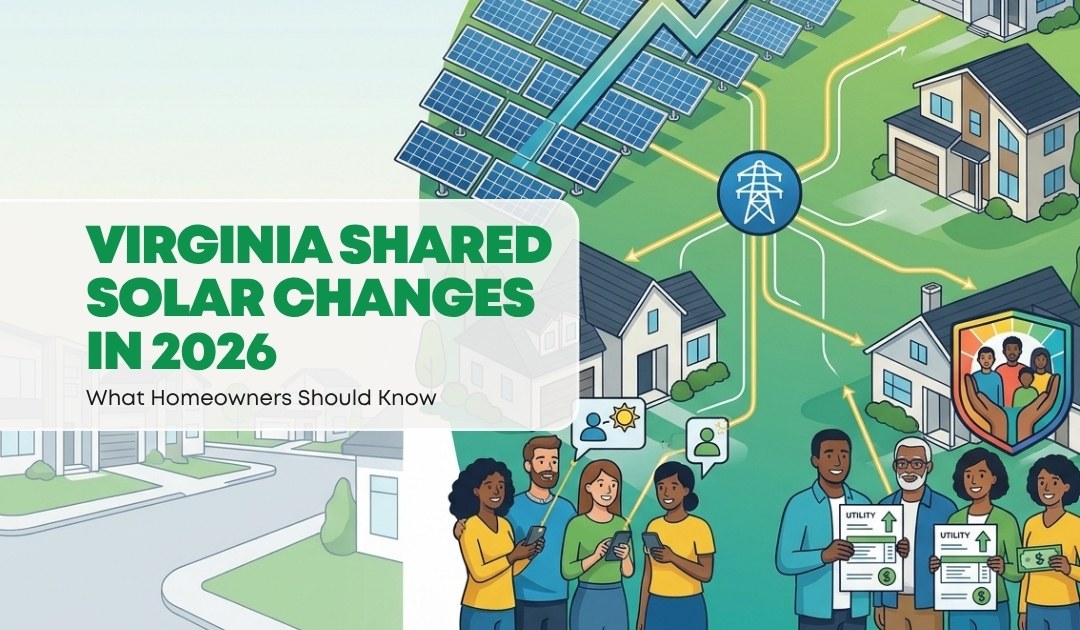
Virginia shared solar 2026 changes add 525 megawatts (MW) of new capacity in Dominion Energy Virginia territory and 100 MW for Appalachian Power through 2028. More homeowners can now subscribe to a nearby solar farm and receive monthly bill credits. Savings depend on the subscription price, your utility’s minimum bill, and your income status.
Key Takeaways
- Two new laws, SB 254/HB 807 and SB 255/HB 809, took effect on July 1, 2026.
- Dominion Energy Virginia territory gained 525 MW: 450 MW for projects serving up to 51% low-income customers and 75 MW for projects with a majority of low-income subscribers.
- Appalachian Power customers get 50 MW now and another 50 MW by January 1, 2028.
- The minimum bill now works as a floor for your monthly bill, and low-income Dominion customers are exempt.
- Under the Virginia shared solar 2026 rules, renters and homeowners can join with $0 upfront and an off-site solar farm.
- Shared solar and Net Metering are separate programs, so Dominion customers choose one.
- Plug-in balcony solar up to 1,200 watts becomes legal on January 1, 2027.
- Convert Solar helps homeowners compare rooftop solar, batteries, and shared solar options.
Virginia Shared Solar 2026 at a Glance
The Virginia shared solar 2026 expansion works a little differently in each utility territory. Here is how the two programs compare after the July 1, 2026 changes. Each figure comes from the Code of Virginia, utility tariffs, or market research.
| Topic | Dominion Energy Virginia | Appalachian Power (APCo) |
| Governing law | Va. Code § 56-594.3 (amended by SB 254/HB 807) | Va. Code § 56-594.4 (amended by SB 255/HB 809) |
| Original program | 200 MW, fully awarded across 52 projects | 50 MW, launched in 2025 and quickly oversubscribed |
| New capacity in 2026 | 525 MW, released July 1, 2026 | 50 MW on July 1, 2026, plus 50 MW by January 1, 2028 |
| Low-income allocation | 450 MW for projects up to 51% low-income; 75 MW for majority low-income projects | At least 10% net savings guaranteed for low-income subscribers |
| Minimum bill | Applies, with low-income customers exempt | Applies to all subscribers under the statute |
| Residential credit rate | 13.528¢ per kWh for facilities on and after October 1, 2026 | Set by the APCo shared solar tariff, with new rates due March 1, 2027 |
| Billing | Net crediting, with the subscription fee on your utility bill | Consolidated billing now and net crediting from July 1, 2027 |
| Next expansion | Part three petition once 268 MW of part two is substantially complete | Part four petition by May 1, 2029 |
Sources: Va. Code § 56-594.3, Va. Code § 56-594.4, Dominion Energy Schedule SS, and Power Advisory LLC (October 2026).
What Is Virginia’s Shared Solar Program and How Does It Work?
As part of the Virginia Homeowner’s Complete Guide to Going Solar, it’s worth understanding Virginia’s Shared Solar Program. This program lets you subscribe to a portion of a local solar farm and receive credits on your electric bill based on your share of its electricity production. Because the solar installation is located off-site, you don’t need to install panels on your home or make changes to your property. Other states commonly refer to this arrangement as community solar, while Virginia law calls it shared solar.
Who’s Involved
Three parties make each subscription work:
- You, the subscriber: any residential, commercial, or industrial customer of the utility that serves the solar farm.
- The subscriber organization: the company that owns or operates the farm. It must hold a State Corporation Commission (SCC) license before it markets subscriptions.
- Your utility: Dominion Energy Virginia or Appalachian Power, which applies the credits to your account.
Each facility can reach up to 5 MW and sits on a single parcel of land. It needs at least three subscribers. At least 40% of its capacity goes to subscriptions of 25 kilowatts and under, which keeps the focus on households and small businesses.
How Credits Show Up on Your Bill
Your monthly credit equals your share of the farm’s kilowatt-hour (kWh) output times your utility’s credit rate. In Dominion Energy Virginia territory, the residential rate is 13.528¢ per kWh for facilities on and after October 1, 2026. Credits post within two billing cycles. Utilities provide credits for at least 25 years from the day a facility starts operating.
Subscription fees reach you in one of two ways:
- Net crediting (one bill): your utility bill shows the subscription fee and a net credit. The processing fee is capped at 1% of the credit value, and each fee is set so your credits cover it every billing period.
- Separate billing (two bills): your utility bill shows the credit, and the subscriber organization sends its own bill.
Net crediting is optional for subscriber organizations. Ask each project which method it uses before you sign.
What Changed in Virginia’s Shared Solar Law in 2026
The Virginia shared solar 2026 changes come from two bill pairs sponsored by Sen. Scott Surovell and Del. Rip Sullivan. Gov. Abigail Spanberger signed them, and both took effect on July 1, 2026. They answer one clear need, since the original programs filled up and left projects and customers on waitlists. The expansion also supports the state clean energy goals tracked in our VCEA progress report.
Dominion Energy Virginia Territory: 525 MW of New Capacity
Dominion’s original 200 MW program was fully awarded across 52 projects. SB 254/HB 807 required the utility to release 525 MW as part two by July 1, 2026. That step brings the program to 725 MW in total.
The new capacity splits two ways:
- 450 MW for projects serving up to 51% low-income customers
- 75 MW for projects that may serve a majority of low-income customers
Dominion accepted 28 projects into part two on July 1, 2026. They range from Norfolk’s Campostella Landfill to solar farms in Suffolk, Chesapeake, and Petersburg. By October 2026, Power Advisory LLC reported that about 105 MW of part two had been awarded.
Appalachian Power Territory: 100 MW Over Two Years
SB 255/HB 809 requires Appalachian Power to release 50 MW as part two on July 1, 2026. Another 50 MW follows as part three by January 1, 2028. The law adds consolidated billing and requires net crediting starting July 1, 2027. Low-income subscribers also receive at least 10% net savings on their subscription fee for the life of the subscription.
What Happens Next
Dominion petitions the SCC for part three once 268 MW of part two is substantially complete. Appalachian Power files its part four petition by May 1, 2029. The SCC weighs costs and benefits before it sets any new capacity. Grid upgrades also shape the pace, as our look at PJM delays explains.
The expansion arrives as household power costs climb. Virginia’s return to the Regional Greenhouse Gas Initiative adds about $10 to $13 per month to Dominion bills, based on Dominion’s SCC filing. Our RGGI debate breakdown covers the details.
Who Qualifies for Shared Solar in Virginia?
Any Dominion Energy Virginia or Appalachian Power customer can subscribe to a facility in their utility’s territory. Renters and homeowners both qualify. Joining costs $0 upfront and leaves your roof untouched.
- Open eligibility: Virginia law prohibits credit checks for residential subscribers.
- Right-sized subscriptions: estimated credits stay within your average annual bill.
- One program at a time: Dominion customers choose between shared solar, Net Metering, and the Multi-Family Shared Solar Program.
What Counts as Low-Income?
Under Va. Code § 56-594.3, a low-income customer is a household earning up to 80% of its locality’s median income. The figures come from the U.S. Department of Housing and Urban Development (HUD). In Dominion territory, low-income status brings three protections. These include an exemption from the minimum bill, freedom from early termination fees, and protection from credit reporting tied to the subscription.
The Shared Solar Minimum Bill, Explained
The shared solar minimum bill is the lowest amount your utility bill can reach after credits. It covers your share of grid infrastructure and program costs. Your credits lower the bill down to that floor each month.
The SCC’s November 24, 2025 order changed how this works. The Coalition for Community Solar Access used these illustrative figures to show the shift.
| Scenario | Bill Before Credits | Minimum Bill | What You Pay |
| Old method (2022 to 2025) | $100 | $60 | Up to $160, with the minimum bill added on top |
| Current method (floor) | $100 | $60 | As low as $60, with credits lowering the bill to the floor |
Illustrative figures. Your utility calculates your minimum bill from your own account.
For residential subscribers outside the low-income group in Dominion territory, the minimum bill has four parts:
- The basic customer charge
- A $1.00 monthly program administrative charge
- Subscription-related distribution, transmission, and nonbypassable charges
- A shared solar benefits credit, which lowers the total
Credits above your bill, minus the minimum bill, roll forward to the next month. Dominion’s tariff keeps carryforward credits for up to 12 months. Sizing your subscription to your usage helps you use every credit.
Low-income exemption: Low-income Dominion customers are exempt from the minimum bill. Appalachian Power’s statute applies the minimum bill to every subscriber. APCo customers should plan for it in their savings math.
Will Virginia Shared Solar Lower Your Electric Bill?
Yes, shared solar brings modest monthly savings. The Coalition for Community Solar Access estimates that participating Virginia customers save 10% or more, about $175 per year. This figure is an industry estimate, and your contract terms shape your own results. Under the Virginia shared solar 2026 rules, savings also depend on whether you use every credit within 12 months.
Illustrative Example: A Dominion Household
| Line Item | Amount |
| Monthly usage | 1,000 kWh |
| Bill before credits (at $0.16/kWh) | $160.00 |
| Subscribed shared solar output | 600 kWh |
| Bill credit (600 kWh × 13.528¢) | $81.17 credit |
| Subscription fee (10% discount to credit value) | $73.05 |
| Net monthly savings | $8.12 (about $97 per year) |
Basis: illustrative only and separate from any quote or offer. Assumes a $0.16/kWh blended residential rate, Dominion’s 13.528¢/kWh residential credit rate effective October 1, 2026, a subscription priced at a 10% discount to credit value, and an illustrative $60 minimum bill. After credits, the bill ($78.83) stays above the floor.
Subscription size and discount explain the gap between this example and the $175 industry estimate. A larger subscription or a deeper discount raises savings up to the minimum bill floor. In this example, a 900 kWh subscription creates about $122 in credits. That month uses $100 of it, and the remaining $22 rolls forward.
Costs to Check Before You Count on Savings
- Subscription price: a percentage discount to credit value or a fixed ¢/kWh rate
- Annual escalators: any yearly increase built into your price
- Minimum bill floor: the share of your credit you can use each month
- Credit expiration: seasonal swings that leave credits unused past 12 months
- Contract length and exit terms: cancellation fees and transfer rules
Seasonal output matters too. Solar farms produce the most in spring and summer, so credits build up then and carry into winter. Our guide to winter production shows how output shifts through the year.
How to Evaluate a Shared Solar Offer and Spot Red Flags
Virginia’s shared solar program is legitimate, created by state law and overseen by the SCC. As Virginia shared solar 2026 projects start enrolling, you’ll get more offers by phone and at your door. These questions help you pick a strong subscription.
| Ask This | A Good Answer Looks Like |
| What is your SCC license number? | A license number you can confirm with the SCC |
| Can I see the standard consumer disclosure form? | Yes, shared before you sign, since Virginia requires a standardized form |
| How is the subscription priced? | A clear discount to credit value, such as 10%, or a fixed ¢/kWh rate in writing |
| Can the price rise each year? | A fixed price or a clearly disclosed escalator |
| How long is the contract, and what does it cost to cancel? | Clear terms in writing, with zero fees for low-income subscribers |
| What happens if I move? | Transfer to your new home in the same utility territory, as Virginia rules require |
| Will I get one bill or two? | A clear answer on net crediting or separate billing |
| How do you verify low-income status? | A defined process using HUD income limits |
Red flags to watch for:
- A missing or hidden SCC license number
- Guaranteed savings or pressure to sign the same day
- Requests for utility account access before you give written or electronic consent, which Virginia law requires
- A credit check as a condition of joining
- Claims that the company is your utility
Shared Solar vs. Rooftop Solar in Virginia
Shared solar and rooftop solar serve different homes. Shared solar suits homes with shade, unsuitable roofs, or rental agreements. Rooftop solar on Net Metering suits homes with good sun and can offset most of a household’s usage. Dominion Energy Virginia keeps shared solar and Net Metering as separate programs, so comparing both pays off.
| Factor | Shared Solar Subscription | Rooftop Solar With Net Metering |
| Roof needs | Off-site farm, so your roof stays untouched | A roof with good sun exposure |
| Upfront cost | $0 | About $2.65/W in Virginia before incentives (9 kW = $23,850), with zero down payment loans and leases for qualified homeowners |
| Credit value | 13.528¢/kWh residential rate (Dominion), within the minimum bill floor | 1:1 credit at the retail rate under Dominion Energy Net Metering, kept by the SCC’s April 30, 2026 ruling (Case PUR-2025-00079), plus a $1/month admin fee |
| Bill impact | About 10% savings (industry estimate) | Sized to offset most or all usage |
| Ownership | A subscription | A system you own or lease |
| Outage power | Bill credits only | Backup power with a battery |
| Maintenance | Handled by the subscriber organization | Covered by your installer’s warranty |
| Moving | Transfer within the same utility territory | System stays with the home |
Market snapshot: $2.65/W is the EnergySage Virginia average as of July 2026. The federal Section 25D residential tax credit ended on December 31, 2025.
What Rooftop Solar Looks Like in Numbers
A 9 kW rooftop system in Virginia produces about 10,500 to 12,350 kWh per year. That output equals roughly $1,680 to $1,975 in annual bill credits. Convert Solar customer Charles Griffin in Hampton Roads installed a 9.36 kW system that offsets 100% of his electricity use.
Basis: illustrative only. Assumes 4.0 to 4.7 peak sun hours per day (NREL-based range for Virginia), about 80% overall system efficiency, $0.16/kWh, and full 1:1 Net Metering credit. Roof direction, shade, and usage shape each home’s production.
What Shared Solar Covers During an Outage
A shared solar subscription produces bill credits. During a grid outage, your home goes dark along with your neighbors. Rooftop solar also shuts off for safety during power outages, and a battery keeps critical loads running. See how battery backup works for Virginia homes.
Convert Solar installs the Tesla Powerwall 3, our generally preferred recommendation, along with the Enphase IQ Battery 5P and Enphase IQ Battery 10C. One battery generally covers critical loads, and whole-home backup generally needs two or more. Battery storage starts around $18,000, with final pricing based on equipment, system design, installation complexity, and your energy needs.
Storms, Winter, and Upkeep
With shared solar, the subscriber organization handles weather and maintenance. With rooftop solar, you own the system and its care, backed by your installer’s warranty. Convert Solar systems carry a 25-year bumper-to-bumper warranty covering materials and workmanship, plus a separate 10-year roof penetration warranty. Our guide to Virginia hurricanes explains how systems handle severe storms.
Seasonal checks keep rooftop systems running well. Our winter maintenance checklist covers simple checks you can do from the ground. Small habits like these protect your production all year.
What About Plug-In Balcony Solar?
Plug-in solar became legal in Virginia on January 1, 2027, under HB 395/SB 250, signed April 22, 2026. It sits outside the shared solar program and serves many of the same renters and homeowners. Here are the key rules:
- Size limit: up to 1,200 watts per dwelling
- Setup: small panels plug into a standard outlet on your side of the meter
- Interconnection: exempt from a utility interconnection agreement
- Renter protections: landlords with five or more rental units must allow plug-in solar and can set reasonable size and placement rules
A 1,200-watt system offsets baseline use, such as a refrigerator and electronics. It pairs well with shared solar for apartment dwellers. Rooftop or shared solar covers a larger share of household use.
How to Find and Join a Virginia Shared Solar Project
Joining a Virginia shared solar 2026 project takes a few steps. Some projects keep waitlists while new capacity gets built. Follow this order to stay organized:
- Confirm your utility. Subscriptions serve Dominion Energy Virginia and Appalachian Power customers within the same territory. Electric co-op members follow their co-op’s own programs.
- Find active projects. Check the Virginia Department of Energy shared solar page and your utility’s list of awarded projects.
- Verify the subscriber organization. Confirm its SCC license before you share account details.
- Request the disclosure form. Review pricing, contract term, cancellation terms, and billing method.
- Compare at least two offers. Use the checklist above.
- Sign and give written consent. The subscriber organization needs it to access your billing data, and credits appear within two billing cycles once the project runs.
Some new projects sit on reused land. Norfolk’s Campostella Landfill project was among Dominion’s first two awards. Virginia law offers incentives for projects on rooftops, brownfields, landfills, and dual-use farmland. Former coal sites follow a similar path, as our look at brightfields solar shows.
Find the Right Option for Your Home With Convert Solar
The Virginia shared solar 2026 expansion opens solar to more homeowners. Every home is different, from energy use to roof conditions. Your choice also depends on whether backup power matters to you.
Convert Solar focuses on rooftop solar and battery storage. We help Virginia homeowners compare rooftop solar, with or without a battery, against a shared solar subscription. Here is what backs our work:
- 8,500 systems across Virginia and Maryland
- 14 years serving Hampton Roads
- NABCEP-certified installers
- Solar Power World Top Solar Contractor for six consecutive years (2021 to 2026), including #22 Top Residential Solar Contractor in the U.S. for 2026, based on the previous year’s installed capacity
- 25-year bumper-to-bumper warranty covering materials and workmanship
- Flexible options, including cash, zero down payment loans for qualified homeowners, and solar leases
You’re already paying for power. Did you know that you could pay less? Bring your electric bill and your questions, and we will show you what solar could save. Request a quote or call 757-44-SOLAR.
Virginia Shared Solar 2026 FAQs
What changed in Virginia’s shared solar program in 2026?
Two laws took effect on July 1, 2026. They added 525 MW in Dominion Energy Virginia territory and 100 MW for Appalachian Power through January 1, 2028. They also set low-income allocations and expanded net crediting on utility bills.
How much can Virginia homeowners save with shared solar?
The Coalition for Community Solar Access estimates savings of 10% or more, about $175 per year. Our illustrative Dominion example shows about $97 per year with a 600 kWh subscription. Subscription price, the minimum bill, and credit use shape each household’s results.
Do shared solar subscribers still pay a minimum bill?
Yes, the minimum bill applies to most subscribers. It works as a floor for your bill after credits. Low-income Dominion customers are exempt, and Appalachian Power applies the minimum bill to every subscriber.
Who counts as low-income for Virginia shared solar?
A household earning up to 80% of its locality’s median income qualifies. The limits come from HUD figures. Low-income Dominion subscribers are exempt from the minimum bill and protected from early termination fees.
Will I get one electric bill or two?
It depends on the project. With net crediting, one utility bill shows the subscription fee and a net credit. With separate billing, the subscriber organization sends its own bill alongside your utility bill.
What happens to unused shared solar credits?
Credits above your bill, minus the minimum bill, roll forward to later months. Dominion’s tariff lets you keep them for up to 12 months. Sizing your subscription to your usage helps you use every credit.
Can I transfer my subscription when I move?
Yes, Virginia rules allow transfers within the same utility territory. Your contract sets the cancellation terms, so read them before you sign. Low-income subscribers are protected from early termination fees.
Is Virginia’s shared solar program legitimate?
Yes, state law created it, and the SCC oversees it. Only SCC-licensed subscriber organizations can market subscriptions, and each one must give you a standardized disclosure form. Ask for the license number before you share any account details.
Is shared solar or rooftop solar a better fit for my Virginia home?
Rooftop solar on Net Metering earns a 1:1 retail credit and can offset most or all of your usage. Shared solar suits homes with shade or roof limits and costs $0 upfront. Convert Solar helps homeowners compare both, and our winter prep guide shows how rooftop systems stay ready year round.
How does Convert Solar help homeowners weighing shared solar?
Convert Solar reviews your electric bill, roof, and backup goals. Our team has completed 8,500 systems across Virginia and Maryland and backs them with a 25-year bumper-to-bumper warranty covering materials and workmanship. We share clear numbers so you can choose the option that fits your home.