
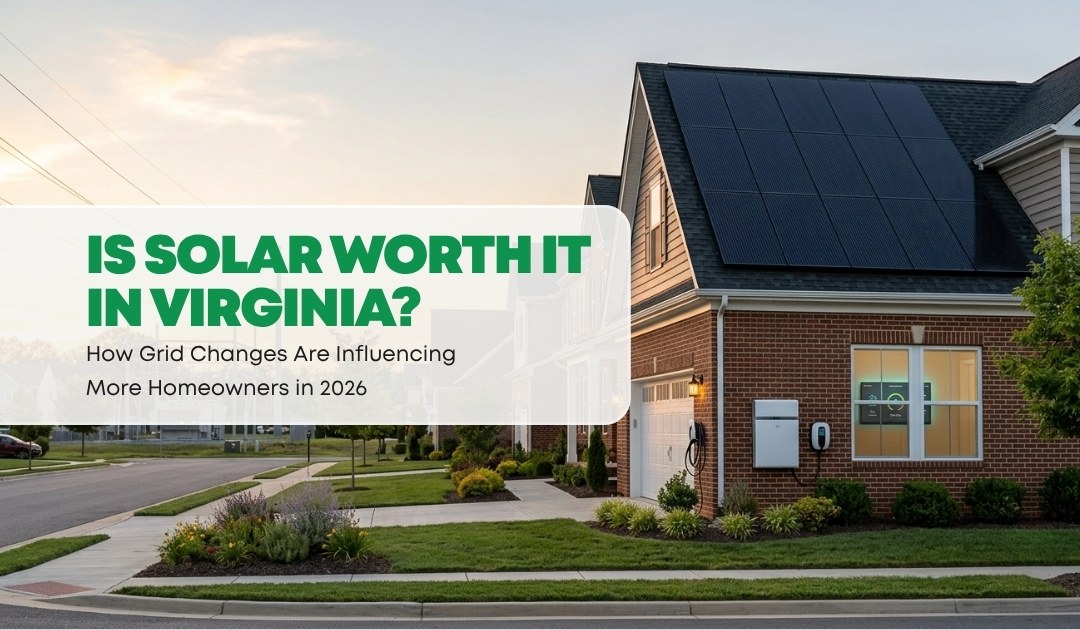
Is solar worth it in Virginia? For a growing number of homeowners, the honest answer is yes, and the reason has less to do with your household than with what’s happening on the grid around you.
Your electric bill isn’t climbing because of anything you did. It’s climbing because Virginia’s grid is under more strain than at any point in its history, and the single biggest driver is the data center boom happening a few counties over.
According to the Electric Power Research Institute’s “Powering Intelligence” study, data centers are projected to consume 41% to 59% of Virginia’s electricity by 2030. This sharp increase from the state’s current 25% share highlights the massive grid impact driven by rapid AI infrastructure expansion.
That single stat explains most of what’s happening to Virginia’s grid right now, and why homeowners are starting to look at solar and battery storage as something closer to a necessity than a nice-to-have.
Why Is Power Demand Rising So Fast in Virginia?
The Data Center Boom Behind the Numbers
Northern Virginia’s data center inventory reached 4,039.6 MW, representing a 37% increase over the previous year. The region maintains nearly three and a half times more capacity than all secondary U.S. data center markets combined. For more details, visit CBRE.
That growth isn’t evenly spread across the year. PJM Interconnection, the regional grid operator covering Virginia and 12 other states, projects that the utility zone covering most of Virginia will see the largest absolute increase in summer peak demand of any zone in its entire footprint between 2026 and 2030, driven overwhelmingly by data center load. The numbers back that up:
| Metric | 2025 / 2025-26 Value | Change Since 2019 |
| Summer peak load | 23,905 MW | +23% |
| Winter peak load | 25,413 MW | +45% |
Source: PJM 2026 Long-Term Load Forecast Report, via U.S. Energy Information Administration.
What This Means for Your Electric Bill
Data center growth doesn’t hit your bill directly and instantly, but it does move the wholesale costs that utilities pass through over time. PJM’s capacity auction, the market that pays power suppliers to guarantee future capacity, saw system-wide baseline clearing prices jump 833% for the 2025/2026 delivery year, surging from $28.92 to $269.92/MW-day according to official rate tracking from UtiliChoice Energy Group and the KilowattLogic PJM Market Report.
Driven by structural grid supply shortfalls, prices rose another 22% for the 2026/2027 cycle to reach the maximum FERC-approved administrative price cap of $329.17/MW-day, as detailed in regional analyses by CONET Energy and the Introl Grid Shock Report.
Data metrics published within the PJM Load Forecast Report confirm this consecutive multi-year pricing escalation represents an intense capacity crunch, caused by a rapid wave of fossil-fuel plant retirements colliding head-on with surging, energy-intensive data center electricity demand.
That kind of increase in wholesale capacity costs is a meaningful part of why utility bills across Virginia have been trending upward, on top of the Regional Greenhouse Gas Initiative (RGGI) impact of approximately $10 to $13 per month already built into many residential bills.
Virginia’s largest utility’s residential average bill sits at approximately $161 per month, based on a default residential rate of about $0.16 per kilowatt-hour. Neither of those numbers is dropping on its own while regional demand keeps climbing.
Virginia’s Own Policy Response Confirms It
Virginia lawmakers aren’t waiting to see how this plays out. HB 628, signed into law earlier this year, raised the distributed solar carve-out requirement from 1% to 4.5% between 2026 and 2030, climbing to 5% through 2045.
That single change is projected to push annual Solar Renewable Energy Certificate (SREC) demand from roughly 740,000 to 3.4 million by 2030 for the utility serving the Richmond region. When the state raises its own distributed solar requirements aggressively, it’s a strong signal that grid planners see local generation, the kind sitting on homeowners’ roofs, as part of the actual fix.
Is Solar Worth It in Virginia With the Grid Under This Much Strain?
For most homeowners, yes, and the grid strain above is exactly why the math is getting stronger rather than weaker. Three things haven’t changed even though the federal 30% tax credit expired at the end of 2025:
- Net Metering still credits your excess solar generation at the full retail rate.
- Virginia’s SREC market provides additional income on top of your electricity savings, and demand for SRECs is climbing.
- Utility rates are under structural upward pressure from data center-driven grid demand, which means every kilowatt-hour your system produces is worth more over the life of the system than it was a few years ago.
That combination, retail-rate credits, a growing SREC market, and rates with more room to rise than fall, is why the answer to “is solar worth it in Virginia” is holding up even without the federal credit that used to anchor the pitch.
How to Protect Your Home From Rising Grid Strain
The good news: while the grid-level problem is genuinely large, the homeowner-level response is straightforward and doesn’t require waiting on utility infrastructure projects that take years to build.
Lock In Your Net Metering Rate Now
In April 2026, the Virginia State Corporation Commission ruled in Case No. PUR-2025-00079 to protect full retail-rate, 1:1 net metering for new residential solar customers, with a $1 per month administrative fee and a year-end surplus rate of $0.05829 per kilowatt-hour for any credits that don’t roll forward.
That means solar electricity you send back to the grid earns a credit at the same rate you’d otherwise pay for it. This protection applies going forward, but net metering terms are set by regulatory rulings that can change as the underlying grid economics shift. Interconnecting sooner rather than later locks in today’s terms for your system rather than whatever terms apply when you eventually sign.
Add Battery Storage for True Independence
Solar alone reduces how much electricity you buy from the grid. It doesn’t do anything for you during an outage, because standard grid-tied systems shut down automatically when the grid goes down, for safety reasons. Pairing solar with battery storage is what actually decouples your home from grid conditions, both the rate pressure and the reliability risk.
Convert Solar installs several battery systems, matched to different backup needs and budgets:
| Battery System | Typical Fit |
| Tesla Powerwall | Whole-home backup and everyday energy management; generally our preferred recommendation |
| Franklin Whole Home (FranklinWH) | Flexible whole-home backup |
| Enphase IQ Battery 5P | Modular backup and storage |
| Enphase IQ Battery 10C | Larger-capacity modular storage |
The right choice depends on your home’s critical circuits, budget, and how much backup duration matters to you, which is why this is a conversation for your specific proposal rather than a one-size answer.
Time Your Interconnection Before Demand Climbs Further
The same HB 628 SREC demand curve that’s driving state policy is also a practical timing consideration for homeowners. As distributed solar requirements rise through 2030 and SREC demand grows toward 3.4 million annually, the economics of interconnecting now versus later are shaped by real, dated policy. For homeowners considering residential solar installation Virginia, understanding these policy changes can help them make a more informed long-term investment decision.
Grid-Tied Solar vs. Solar Plus Battery Storage
| Grid-Tied Solar Only | Solar Plus Battery Storage | |
| Reduces monthly electricity costs | Yes | Yes |
| Earns Net Metering credits | Yes | Yes |
| Works during a grid outage | No, shuts down automatically | Yes, for backed-up circuits |
| Protects against rising peak demand pressure | Partial | Full, since stored power is available regardless of grid conditions |
| Typical use case | Homeowners focused on bill reduction | Homeowners who also want outage protection and energy independence |
Is Solar Worth It in Virginia for Your Home? Request Your Assessment
Lock in your energy independence before the grid faces more summer strain. Request a no-obligation assessment, and we’ll review your roof, your actual electricity usage, and whether a grid-tied solar and battery backup system makes sense for your home. We can also explain how solar panel maintenance services help support reliable system performance over the long term.
Request Your No-Obligation Assessment →
Frequently Asked Questions
Is solar worth it in Virginia?
Yes, for many homeowners. Virginia’s net metering program still credits excess solar generation at the full retail rate, the state’s SREC market provides additional income, and rising utility rates make each kilowatt-hour your system produces more valuable over time, even without the expired federal tax credit. A reputable solar company Virginia Beach homeowners trust can help you determine whether these long-term savings apply to your home and energy usage.
What is causing the Virginia grid strain?
Rapid data center growth is the primary driver. Virginia has the highest concentration of data centers in the world, and the utility zone covering the state is projected to see the largest increase in peak electricity demand of any zone in the regional PJM grid through 2030.
Will my electric bill keep going up because of data centers?
Data center growth is a significant factor behind rising wholesale capacity costs, which utilities factor into rates over time, though it isn’t the only variable in your bill. Virginia’s average residential bill and electricity rate have both been under upward pressure as regional demand climbs.
Does battery storage protect me from grid strain?
Yes, for the outages and reliability side of the issue. A battery system stores the electricity your solar panels produce so your home can keep running selected circuits during a grid outage, independent of what’s happening on the broader grid.
How do I lock in Virginia’s current net metering rate?
Net metering terms are set by the Virginia State Corporation Commission and can change as grid conditions evolve. Interconnecting your system sooner secures today’s terms, including the 1:1 retail-rate credit confirmed in the SCC’s April 2026 ruling.