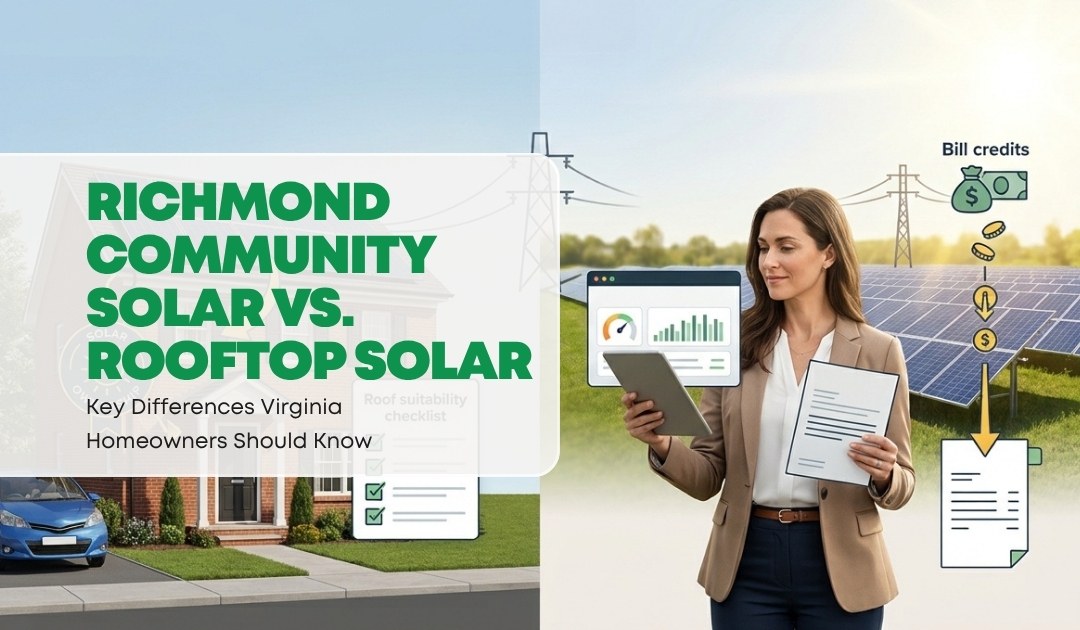
When comparing community solar vs. rooftop solar, Richmond homeowners with a suitable roof may see greater long-term savings with rooftop solar. Through Virginia Net Metering, rooftop panels can help offset electricity costs. Community solar offers an alternative for renters and homeowners whose roofs are shaded or otherwise unsuitable for solar panels, providing electricity bill credits from an offsite solar farm.
Richmond electric bills are climbing in 2026. The first base rate increase since 1992 adds $11.24 a month this year. Regional Greenhouse Gas Initiative costs of about $10 to $13 a month also returned after Virginia rejoined on July 1, 2026. This guide puts both solar paths side by side so you can see how each one responds.
Key Takeaways
- Rooftop solar is a system on your home, purchased or leased, and community solar is a subscription with zero equipment on your property.
- Rooftop systems in Virginia average about $2.65 per watt, so a 9 kW system costs about $23,850 before financing.
- Community solar usually costs $0 to join.
- Virginia Net Metering credits rooftop exports at the full retail rate.
- Virginia’s Shared Solar Program forecasts about 10% in savings, with a minimum bill floor for most subscribers.
- The utility’s separate Community Solar pilot adds a renewable-energy premium to your bill.
- The 30% federal residential solar credit (Section 25D) ended on December 31, 2025, for both paths.
- Rooftop solar paired with a battery can power essential circuits during an outage.
What Is Community Solar in Richmond?
Richmond community solar is a subscription to a share of an offsite solar facility. Virginia law calls it “shared solar,” and the panels sit on a solar farm elsewhere in the state. You pay a subscription, the project makes power, and your utility credits your bill for your share.
If you’re a Dominion Energy Virginia customer, look closely at the program name when comparing community solar vs. rooftop solar. Shared Solar can credit your electric bill, while the separate Community Solar pilot adds a charge to support solar generation.
Virginia’s Shared Solar Program
The Shared Solar Program is the savings option. Private companies called subscriber organizations build facilities of up to 5 megawatts on a single parcel. Subscribers receive a bill credit for their share of production, guaranteed for at least 25 years from the day a facility starts operating.
Key rules to know:
- Savings are forecast at around 10%. Subscriber organizations usually keep part of the credit value as their fee.
- A minimum bill sets a floor. A November 24, 2025, State Corporation Commission order established the minimum bill as a floor. For example, if your utility bill is $100 and your minimum bill is $55, solar credits can reduce the utility portion to $55. If your subscription fee is billed separately, add it back to calculate your total cost.
- Low-income households are exempt from the minimum bill, which makes the program most valuable for income-qualified subscribers.
- Subscriptions are capped so estimated credits stay at or below your average annual bill.
Each project stays small, so it connects to the local grid and skips the regional queue behind PJM delays. That speed helps Virginia reach its clean energy goals. Other offsite projects, such as Brightfields Solar on former mine land, follow the same idea of putting solar on open land.
The Utility’s Community Solar Pilot
Virginia’s largest utility also runs a Community Solar pilot that functions as a green premium. Residential customers can buy up to five 100 kWh blocks at $2.013 each. They can also match 100% of their usage for an extra $0.02013 per kWh, about $20.13 a month at 1,000 kWh. Enrollment starts with a one-year commitment, then runs month-to-month with 30 days’ notice to cancel.
This pilot supports solar built in Virginia and adds a charge to your bill. Its first facility is fully subscribed. New enrollments depend on future projects.
Can Richmond Homeowners Join Community Solar Right Now?
Space is limited today. The program’s first 200 megawatts are allocated and reportedly waitlisted. In 2026, the General Assembly approved 525 more megawatts: 450 MW for projects serving up to 51% low-income customers and 75 MW for projects serving a larger low-income share.
Several projects sit near Richmond, including sites in Mechanicsville, Moseley, Petersburg, and South Chesterfield, accepted in 2025 and 2026. Many reserve most or all of their capacity for income-qualified households. Market-rate homeowners should plan for a project-by-project search and a possible waitlist.
What Is Rooftop Solar for Richmond Homes?
Rooftop solar Richmond, VA homeowners install sits on their own roof. It powers the home first and sends extra energy to the grid. You can buy it with cash, use $0-down loan financing if you qualify, or lease it. Convert Solar offers loans and leases in Virginia, but residential power purchase agreements aren’t available.
How Net Metering Credits Your Rooftop System
Virginia Net Metering drives rooftop solar savings. Under the State Corporation Commission’s April 30, 2026, order (Case PUR-2025-00079), customers of Virginia’s largest utility keep full retail 1:1 credit for the power they export. The order adds a $1 monthly administrative fee. It pays $0.05829 per kWh for any surplus left at the annual true-up.
What Your Home Needs for Rooftop Solar
- A roof with good sun. South, east, and west faces work well, and open sky boosts production.
- A roof with years of life left. Replacing an older roof first saves the cost of removal and reinstall later.
- Enough space and structural capacity for the system size your usage calls for, up to 25 kW for residential net metering.
- Community association approval where it applies. Under Va. Code § 55.1-1820.1, an association can set placement rules within limits. A full ban requires explicit language in the declaration.
Virginia also exempts residential systems up to 25 kW from local property tax. Solar equipment is also exempt from state sales tax. Seasonal care is simple, and a little winter prep keeps production steady through colder months.
Community Solar vs Rooftop Solar: Side-by-Side Comparison
This table compares community solar vs rooftop solar on cost, savings, ownership, and eligibility. It also covers the practical details that shape a Richmond homeowner’s choice. Community solar figures refer to Virginia’s Shared Solar Program.
| Factor | Rooftop Solar | Community Solar (Shared Solar) |
| Upfront cost | About $15,900 (6 kW) to $31,800 (12 kW) at $2.65/W; $0-down loans and leases available | Usually $0 to join |
| Expected savings | Can offset most or all of an average bill on a well-sized system | Forecast at around 10% off |
| Ownership | Your own system (purchased) or a leased system on your home | A subscription with zero equipment on your property |
| Eligibility | Homeowners with a suitable roof | Utility customers, including renters, where project capacity is open |
| Bill credit method | Net Metering at full retail 1:1, annual true-up | Credit for your share of project output, down to the minimum bill |
| Maintenance | Low; covered by Convert Solar’s 25-year bumper-to-bumper warranty covering materials and workmanship | Handled by the project operator |
| Outage backup | Available with a home battery | Grid power only |
| Moving | System stays with the home; leases follow agreement terms | Subscription follows its contract’s cancellation or transfer terms |
| Federal tax credit | Section 25D ended Dec 31, 2025 | Program bill credits only |
Rooftop systems need little upkeep. Simple ground-level panel maintenance checks help you spot issues early. A quick look after storms and before winter keeps the system in good shape.
Costs and Savings Over 20 Years in Richmond
Over 20 years, rooftop solar can save a Richmond household several times what a community solar subscription saves. Rooftop solar calls for financing or an upfront investment. The illustrative example below shows how community solar vs. rooftop solar plays out on an average bill.
| Illustrative Example | Community Solar | Rooftop Solar (9 kW, purchased) |
| Upfront cost | $0 | $23,850 |
| Estimated monthly savings | About $16 | About $139 to $160 |
| Estimated annual savings | About $193 | About $1,668 to $1,920 |
| 20-year savings (flat rates) | About $3,860 | About $33,360 to $38,400 |
| 20-year savings after system cost | About $3,860 | About $9,510 to $14,550 |
| Simple payback | Immediate | About 12 to 14 years |
Basis for these figures. This example is for illustration only and is separate from any offer or quote. It assumes an average monthly residential bill of $161 at $0.16/kWh (about 12,075 kWh/year), plus a 9 kW system at $2.65/W, 4.0 to 4.7 peak sun hours per day, and an 80% system performance factor. It also assumes credits capped at annual usage, the $1 monthly net metering fee, and a 10% community solar discount. Rates stay flat, panel degradation is excluded, and a cash purchase is shown, so loan and lease payments will change the monthly cash flow.
Flat rates understate the value of both options. Every rate increase raises the value of each kWh you offset, and rooftop solar offsets far more kWh. With the 2026 base rate increase, another $2.36 a month in 2027, and RGGI costs back on bills, a home that makes its own power gains more each year.
Production also shifts with the seasons. Shorter days lower output in December and January. Net metering credits carry summer surplus into those months, as our guide to winter production explains.
A Virginia customer example. John Harrison of Suffolk installed a 9.9 kW system that offsets 95% of his usage. His projected 30-year savings come to $55,390. Results like this show what a well-sized rooftop system can do over time.
Leasing changes the math. A lease puts a system on your roof with little or zero upfront cost in exchange for a monthly payment. Your savings depend on the gap between that payment and the bill it offsets. Pick the path that fits your budget and goals.
How Bill Credits Work: Net Metering vs Shared Solar Credits
The biggest money difference in community solar vs rooftop solar comes from how each credit is valued. Net metering credits every exported kWh at the full retail rate. Power your panels use in the home lowers your bill at the source. Shared Solar credits equal your share of project output times a yearly bill credit rate, applied through the utility’s fuel factor.
Shared Solar credits stop at the minimum bill. Net metering can bring the energy portion of a bill close to zero. Each account enrolls in Shared Solar or Net Metering, one at a time, so a Richmond home picks one path per account.
When Community Solar Makes More Sense: Shade, Roof Age, and Renting
Community solar vs home solar becomes an easy call when the home itself is a poor fit for panels. Richmond’s tree-lined neighborhoods shade many homes and limit roof sun exposure. A shared solar subscription gives those homes the same clean-energy benefits. Community solar is the practical route for:
- Renters and condo owners who share a building roof.
- Heavily shaded lots where mature trees block most direct sun.
- Roofs due for replacement when the household plans to reroof later.
- Households planning to move within a few years.
- Income-qualified households, exempt from the minimum bill and most likely to benefit from Shared Solar credits.
Outages, Batteries, and Storm Resilience
Community solar panels sit on an offsite farm, so your home relies on the grid during an outage. A grid-tied rooftop system also shuts off during a power outage to keep line workers safe. Adding a battery lets rooftop solar keep essential circuits running.
Convert Solar typically recommends the Tesla Powerwall 3, along with the Enphase IQ Battery 5P and IQ Battery 10C. One battery usually covers critical loads, and whole-home backup generally requires at least two. Battery storage systems usually start around $18,000, with final pricing based on equipment, system design, installation complexity, and energy needs. Battery warranties range from 10 to 15 years depending on the product.
Our comparison of solar and battery backup covers sizing in more detail. Our guide to severe storms explains how rooftop systems handle Virginia hurricane season. Both are good next reads before you plan a backup setup.
Contracts, Moving, and Fees to Check
Read every contract closely for either path. Clear terms protect your savings over the years. For a community solar subscription, confirm these points:
- The subscription fee compared with the credit value you receive.
- How the minimum bill applies to your account.
- Contract length, early cancellation terms, and transfer options if you move within the utility’s territory.
- How savings appear on your bill. Under net crediting, subscription fees stay at or below the credits you receive.
A purchased rooftop system conveys with the home when you sell. A leased system follows the transfer terms in the lease agreement. Starting January 1, 2027, Virginia’s Solar Consumer Protection Act requires written residential solar contracts and gives buyers a 3-day cancellation right.
Convert Solar’s rooftop systems carry a 25-year bumper-to-bumper warranty covering materials and workmanship. A separate 10-year roof penetration warranty protects the points where the system attaches to your roof. Both give homeowners clear coverage from day one.
Community Solar vs Rooftop Solar: Who Each Option Suits
The right answer in community solar vs rooftop solar depends on whether your home can produce its own power and how long you plan to stay. Every home has its own situation. Use these profiles as a starting point.
Rooftop solar suits you if you:
- Own your home and have a roof with good sun and years of life left.
- Plan to stay long enough for a 12 to 14-year cash payback, or prefer a loan or lease with a low upfront cost.
- Want the largest long-term savings as Richmond electricity rates climb.
- Want the option of battery backup during outages.
Community solar suits you if you:
- Rent, own a condo, or live under rules that keep panels off your roof.
- Have heavy shade or a roof due for replacement soon.
- Expect to move within a few years.
- Want a modest, low-commitment credit with $0 upfront.
- Qualify as a low-income household and skip the minimum bill.
Find Out What Your Roof Can Do
You’re already paying for power. Did you know that you could pay less? The quickest way to compare community solar vs. rooftop solar for your own home is to see what your roof can produce.
Convert Solar has installed 8,500 systems across Virginia and Maryland. Our NABCEP-certified installers work with panels from leading North American and European manufacturers, including Silfab, REC, and Mission Solar. Solar Power World has named Convert Solar a Top Solar Contractor for six consecutive years (2021 to 2026), including #22 Top Residential Solar Contractor in the United States for 2026. These rankings come from the previous year’s installed capacity, so they reflect completed projects.
Bring your electric bill and your questions to an assessment with zero obligation. General usage information is enough to start. We’ll show you what rooftop solar could save and tell you plainly whether community solar is the better fit for your home.
Frequently Asked Questions
Which is better for a Richmond home, community solar or rooftop solar?
In the community solar vs rooftop solar decision, rooftop solar usually wins for homeowners with a sunny, sound roof who plan to stay. In our illustrative example, a 9 kW rooftop system saves about $1,668 to $1,920 a year, and a community solar subscription saves about $193 a year. Community solar is the better fit for renters, shaded homes, and short stays.
Is Richmond community solar worth it?
Richmond community solar is worth it when rooftop solar is a poor fit for your home. Savings through Virginia’s Shared Solar Program are forecast at around 10%, with $0 upfront and the project operator handling the equipment. Income-qualified households gain the most because they are exempt from the minimum bill.
Can renters sign up for community solar in Richmond?
Yes, renters can subscribe to shared solar because eligibility is tied to the electric account rather than property ownership. The program was designed to accommodate renters and residents of shared buildings who cannot install solar panels on their own roofs. When exploring options with a Solar Energy Company Richmond VA, renters should also understand that availability depends on open project capacity, and many current projects reserve most of their capacity for income-qualified households.
How much does rooftop solar cost in Richmond?
Rooftop solar in Virginia averages about $2.65 per watt before incentives. That puts a 6 kW system at about $15,900, a 9 kW system at about $23,850, and a 12 kW system at about $31,800. Convert Solar offers $0-down loan financing and solar leases for qualified homeowners, so you can choose the path that fits your budget.
Does community solar qualify for the 30% federal tax credit?
The 30% federal residential solar credit under Section 25D ended on December 31, 2025. That change applies to homeowner rooftop systems and community solar alike. Virginia still exempts residential systems up to 25 kW from local property tax and exempts solar equipment from state sales tax.
Can a home have rooftop solar and community solar at the same time?
Each account can enroll in Virginia’s Shared Solar Program or Net Metering, one at a time. Rooftop solar relies on net metering, so a Richmond home chooses one path per account. Choose the option that fits your roof and plans, and revisit it when your situation changes.
What happens to solar panels or a subscription after a move?
A purchased rooftop system conveys with the home when you sell. A leased system transfers according to the lease agreement. A community solar subscription follows its contract, which sets cancellation and transfer options.
What fees should homeowners check before joining community solar?
Check the subscription fee, the minimum bill, and the contract’s cancellation terms. Under net crediting, Virginia rules keep subscription fees at or below the credits you receive. Also confirm which program you’re joining, since the utility’s Community Solar pilot adds $0.02013 per kWh to your bill.
Does community solar work during a power outage?
Community solar panels sit on an offsite farm, so your home relies on the grid during an outage. A grid-tied rooftop system also shuts off for safety. Convert Solar pairs rooftop systems with batteries such as the Tesla Powerwall 3 to keep essential circuits running.
What warranty comes with a Convert Solar rooftop system?
Convert Solar’s rooftop systems carry a 25-year bumper-to-bumper warranty covering materials and workmanship. A separate 10-year roof penetration warranty covers the points where the system attaches to your roof. Our NABCEP-certified installers back that coverage with experience from 8,500 systems across Virginia and Maryland.