
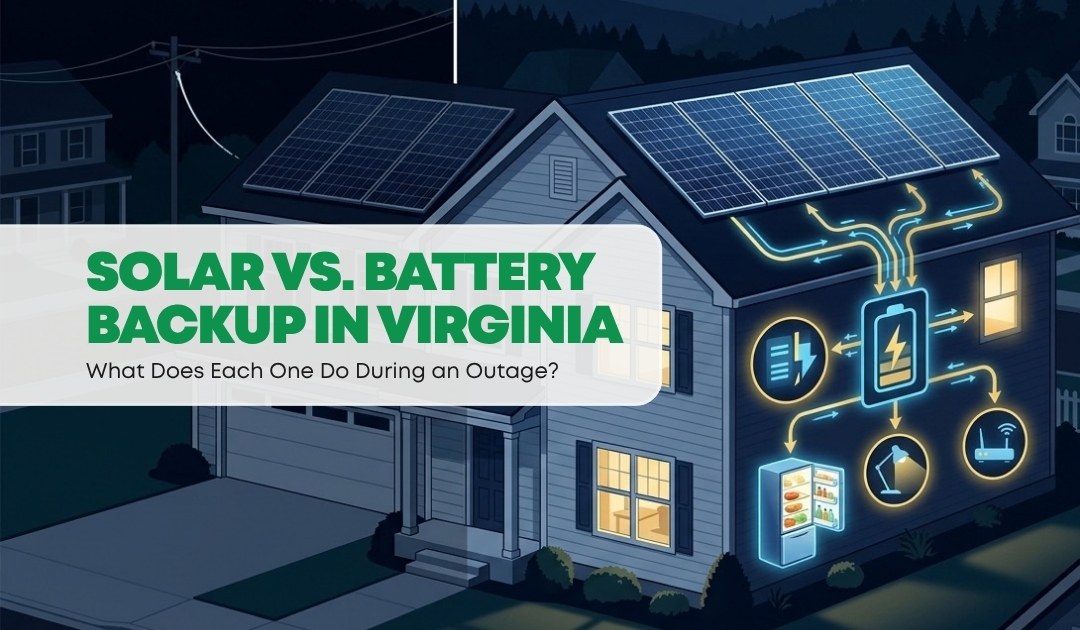
Quick Answer: In the solar vs battery backup comparison, each one does a different job: solar panels generate electricity and lower what you buy from the grid, while a battery stores electricity and keeps selected circuits running when the grid goes down. A standard grid-tied solar system shuts off during an outage, even in full sun, unless it is paired with a battery and the equipment that isolates your home from the grid. How much a battery can run, and for how long, depends on its capacity and the loads you connect to it.
Key Takeaways
- Solar panels alone lower your electric bill but provide no power during a grid outage.
- A battery alone keeps backed-up circuits running in an outage but generates nothing and does little for your bill.
- Solar plus a battery does both, and the panels can recharge the battery in daylight while the grid is down.
- One battery is generally enough for critical-load backup. Whole-home backup typically requires at least two.
- Virginia customers averaged about 7 hours without power in 2024 once major storms are counted, according to the U.S. Energy Information Administration.
- Battery storage systems typically start around $18,000, and the federal residential tax credit ended December 31, 2025.
Solar vs Battery Backup: What Is the Difference?
Solar panels produce electricity. A battery backup stores it. That single difference explains almost everything about how the two behave on a normal day and during an outage.
Solar panels convert sunlight into electricity your home uses as it is produced. They cut the amount of power you buy from your electricity provider, which is why most homeowners install them. They cannot hold energy for later.
A home battery holds energy until you need it. It can charge from solar panels or from the grid, then discharge at night or when utility power fails. A battery makes no electricity of its own.
Many Virginia homeowners assume solar panels come with backup power built in. They do not. Backup power comes from the battery and its supporting equipment.
What Do Solar Panels Do in a Virginia Home?
Solar panels in a Virginia home generate electricity during daylight, power the house first, and send any surplus to the grid for a bill credit. Their purpose is lower electricity costs, not outage protection.
On a normal day
When the sun is up, your home draws from the panels before it draws from the grid. If the panels produce more than the house is using, the extra flows out to the grid. Net metering is a utility billing arrangement that credits eligible solar customers for electricity their systems send to the grid.
At night and in poor weather
After sunset, a home with solar panels and no battery runs on grid power exactly as it did before. Credits earned from daytime surplus offset part of that use. Cloudy days reduce production without stopping it.
During a grid outage
A standard grid-tied solar system turns itself off when the grid fails and stays off until utility power returns.
Why Do Solar Panels Shut Off During a Power Outage?
Grid-tied solar panels shut off during a power outage because their inverters are required to stop sending electricity to the grid when utility power is lost. The safety feature is called anti-islanding.
Line crews repair damaged lines on the assumption that those lines are not energized. A solar system that kept exporting power could put electricity back onto a line someone is working on. Interconnection standards therefore require the inverter to detect the loss of grid power and disconnect within seconds.
Sunshine makes no difference. A solar-only home in Norfolk can sit under a clear sky the morning after a tropical storm with its panels producing nothing, because the inverter is waiting for the grid.
For storm-season detail, see how solar panels hold up in a Virginia hurricane.
What Does a Home Battery Backup Do During an Outage?
A home battery backup disconnects your house from the grid when utility power fails, then supplies stored electricity to the circuits it is wired to support. The switch happens automatically.
The U.S. Department of Energy notes that solar and storage can provide backup power during an electrical disruption. Three pieces of equipment make that possible in a home: the battery, an inverter that can run without the grid, and a device that isolates the home from utility lines.
Critical-load backup
Critical-load backup powers a chosen set of circuits. Typical choices are the refrigerator, lighting, internet equipment, a few outlets, a security system, and a well pump or sump pump where the home has one. One battery is generally sufficient for this kind of backup.
Whole-home backup
Whole-home backup keeps every circuit available, including large appliances. It typically requires at least two batteries, and often load controls that stop several heavy appliances from running at once.
The right size depends on your household electricity use, the loads you want backed up, the system configuration, and your backup goals.
A battery without solar panels
A battery can be installed without solar panels and charged from the grid. It will carry backed-up circuits through an outage until its stored energy runs out. It cannot recharge until the grid returns, and it does not meaningfully lower your bill, because every kilowatt-hour it stores was purchased from your electricity provider.
What Happens During a Virginia Power Outage With Each System?
During a Virginia power outage, a solar-only home loses power, a battery-only home runs backed-up circuits until the battery is drained, and a solar-plus-battery home runs backed-up circuits and recharges in daylight.
| System | What happens when the grid goes down |
| Solar panels only | The inverter shuts off. The home has no power until the grid returns. |
| Battery only, charged from the grid | Backed-up circuits stay on until the stored energy is used. The battery cannot recharge until the grid returns. |
| Solar panels plus battery | Backed-up circuits stay on. The panels recharge the battery during daylight, which can stretch backup across several days. |
| Solar panels plus battery plus generator | The battery handles routine backup. The generator covers long stretches of poor weather. |
The main point of the table: only a system that includes a battery keeps any part of the home powered, and only a system that includes both panels and a battery can refill itself while the grid is down.
Outage length matters here. EIA reliability data shows the average Virginia customer was without power for 418.3 minutes in 2024, about 7 hours, across roughly 1.6 interruptions. With major events such as hurricanes and ice storms excluded, the figure falls to 166.4 minutes. In 2023, a quieter storm year, the total was 221.1 minutes.
Most of the outage time in a bad year comes from a small number of large storms. Those long, storm-driven outages are where the gap between solar alone and solar with a battery is felt most.
Solar Panels vs. Battery Backup: Side-by-Side Comparison
Solar panels lead on bill savings, a battery leads on outage protection, and the combined system delivers both at the highest upfront cost.
| Feature | Solar panels only | Battery backup only | Solar plus battery |
| Main job | Lower electric bills | Outage protection | Lower bills and outage protection |
| Generates electricity | Yes | No | Yes |
| Daytime power | From the panels | From stored grid power | From the panels |
| Nighttime power | From the grid | From the battery until drained | From the battery, then the grid |
| Power during an outage | No | Yes, for backed-up circuits | Yes, for backed-up circuits |
| Recharges during an outage | No | No | Yes, in daylight |
| Effect on monthly bill | Reduces grid purchases | Little to none | Reduces grid purchases |
| Relative upfront cost | Lowest | Middle | Highest |
| Fits best when | The grid is reliable and savings come first | Outages are a concern and the roof does not suit solar | You want savings and backup together |
No column wins outright. The solar vs battery backup decision comes down to which problem you are solving: the size of your electric bill, the risk of losing power, or both.
How Long Can a Battery Backup Power a House?
A single home battery typically powers critical loads for most of a day, and a few hours if central air conditioning or electric heat is running. Runtime is the battery’s usable capacity divided by the power your home draws.
Two numbers describe a battery. Capacity, measured in kilowatt-hours (kWh), is how much energy it holds. Power, measured in kilowatts (kW), is how much it can deliver at one moment. Capacity sets how long it lasts. Power sets how many things it can run at once.
Convert Solar’s current battery lineup shows the range:
| Battery | Usable capacity | Continuous power | Manufacturer warranty |
| Tesla Powerwall 3 | 13.5 kWh | Up to 11.5 kW | 10 years |
| Enphase IQ Battery 10C | 10 kWh | 7.08 kW | 15 years |
| Enphase IQ Battery 5P | 5 kWh | 3.84 kW | 15 years |
Figures come from Tesla’s Powerwall 3 specifications and Enphase. Enphase batteries are modular, so several units are often installed together.
A worked example
Take a Virginia Beach household with one 13.5 kWh battery. This is an illustration with stated assumptions, not a measured result.
- Critical loads only, averaging 0.75 kW: 13.5 kWh divided by 0.75 kW is about 18 hours.
- The same loads plus a central air conditioner drawing 3.5 kW: 13.5 kWh divided by 4.25 kW is a little over 3 hours.
The same battery lasts six times longer when the air conditioner stays off. Large loads such as central air, electric resistance heat, water heaters, dryers, ranges, and EV chargers are what drain a battery quickly.
Recharging from solar while the grid is down
With solar panels attached, the battery refills each day the sun is out. Virginia averages approximately 4.0 to 4.7 peak sun hours per day, a measure of equivalent full-strength sunlight and not the number of daylight hours. At that average, an 8 kW array produces roughly 32 to 38 kWh on a typical day before system losses, more than twice the capacity of one Powerwall 3.
Winter days, heavy clouds, and snow cover produce less. A solar-plus-battery system extends backup considerably, but it does not promise uninterrupted power. For weather detail, see how solar panels perform on cloudy days in Virginia.
When Does a Battery Backup Make Sense in Virginia?
A battery backup makes sense in Virginia when losing power carries a real cost for your household. It makes less sense when your only goal is a lower electric bill, because net metering already gives you credit for surplus solar.
A battery is more likely to be worth adding if
- Outages where you live are frequent or tend to last many hours.
- Someone in the home works remotely or depends on powered equipment.
- The home has a well pump or sump pump.
- You want backup without storing fuel or running an engine.
- You are installing solar panels anyway and want one integrated system.
Solar panels alone may be enough if
- Outages in your area are rare and short.
- Lowering your bill is the whole goal.
- Your budget is fixed and a battery would stretch it.
- You would rather add storage later.
How Virginia net metering affects the decision
As of 2026, Virginia’s two largest investor-owned utilities still credit eligible residential solar customers for exported electricity against their own usage over a 12-month period. Solar panels convert sunlight into electricity, which is converted into usable Alternating Current (AC) for your home. When production exceeds household demand, the surplus can be sent to the grid, which effectively acts as a financial store for your excess solar energy through net metering credits.
That shapes our solar vs battery backup recommendation. If bill savings are your priority and outages rarely trouble you, start with solar panels and leave room to add a battery. If you have sat through multi-day outages, or your home cannot go without a pump, a refrigerator, or an internet connection, a battery earns its place on resilience alone. The exception is a home on a time-varying rate or an electric cooperative with different crediting terms, where stored solar can carry more bill value.
Read more on whether home battery storage is worth it, how net metering works, and the 2026 net metering rules in Virginia.
Battery backup without solar
A battery on its own suits a narrow group: homes with heavily shaded or unsuitable roofs where backup is the only goal. Every home has a unique situation, and roof condition, shading, and electricity use all affect which setup fits.
How Much Do Solar Panels and Battery Backup Cost in Virginia?
Solar panels in Virginia average approximately $2.65 per watt before incentives, and battery storage systems typically start around $18,000. A combined system costs more than either part alone.
| System | Benchmark cost | Basis |
| 6 kW solar | $15,900 | 6,000 watts x $2.65 |
| 9 kW solar | $23,850 | 9,000 watts x $2.65 |
| 12 kW solar | $31,800 | 12,000 watts x $2.65 |
| Battery storage | From around $18,000 | Approximate starting point |
As of July 2026, EnergySage data puts the average installed cost of residential solar in Virginia at approximately $2.65 per watt before incentives. That is a statewide market benchmark, not a Convert Solar quote. Battery storage systems typically start around $18,000, with final pricing depending on equipment selection, system design, installation complexity, and homeowner energy needs.
The former federal Residential Clean Energy Credit ended December 31, 2025. Residential solar and battery systems installed in 2026 do not receive it. Convert Solar does not provide tax advice. Consult a qualified tax professional about how current tax rules apply to your situation.
Payment options include cash purchase, loan financing, and solar leases, each with its own trade-offs. See the cost of solar panels in Virginia for a full breakdown and residential solar financing options for how the payment paths compare.
Can You Add a Battery to Existing Solar Panels Later?
Yes, a battery can be added to most existing solar panel systems later. Installing both at once is usually simpler and often costs less in total.
A retrofit depends on the inverter already on your home. Some systems accept a battery with modest changes. Others need added equipment or electrical work, such as a backup panel for the circuits you want supported.
Adding a battery does not automatically give you whole-home backup. The number of batteries and the way your electrical panel is configured decide what stays on.
Is a Battery Backup or a Generator Better for Virginia Storm Outages?
A battery backup suits short to medium outages and homeowners who want quiet, automatic power. A standby generator suits long outages and heavy whole-home loads. Some homes use both.
| Factor | Home battery | Standby generator |
| Energy source | Stored electricity, refilled by solar or the grid | Natural gas or propane |
| Switchover | Automatic, near instant | Automatic, after a short start-up |
| Runtime | Limited by capacity and solar production | As long as fuel is available |
| Noise and exhaust | None | Engine noise and exhaust outdoors |
| Upkeep | Minimal | Regular engine service |
| Use between outages | Can store solar daily | Idle |
A battery paired with solar panels handles the common case, an outage of several hours to a couple of days. A generator handles the rare week-long outage in poor weather. If your home has had both kinds, pairing the two is reasonable.
What Should You Ask a Virginia Installer About Battery Backup?
Ask a Virginia installer six questions about battery backup before you compare quotes. The answers tell you what will stay on in an outage.
- Which circuits will be backed up?
- Can the solar panels recharge the battery while the grid is down?
- What is the usable capacity, as opposed to the nameplate figure?
- How are heating, cooling, and other large loads handled?
- What does the battery warranty cover, and for how many years?
- Is the quoted price fully installed or equipment only?
Convert Solar, a residential solar installer with 8,500 systems across Virginia and Maryland, currently installs the Tesla Powerwall 3, Enphase IQ Battery 5P, and Enphase IQ Battery 10C. The Powerwall 3 is our generally preferred option, and the Enphase batteries remain available where they fit the home better.
If you are still deciding on solar itself, start with the residential solar installation guide for Virginia homeowners.
Frequently Asked Questions About Solar Panels and Battery Backup
Does a battery backup charge from the solar panels or the grid?
A battery backup can charge from either solar panels or the grid. In a home with solar panels, the battery typically charges from solar production first and may also draw power from the grid, depending on its settings. A battery installed without solar panels can charge only from the grid, meaning it cannot recharge during an outage. Regular Solar System Maintenance & Support can help ensure your equipment, battery settings, and backup functions are working as intended.
Can a battery backup make my home completely off-grid?
Not in a typical installation. Most Virginia homes with solar panels and a battery stay connected to the grid, which preserves net metering credits and supplies power when the battery is empty. Running fully off-grid takes a much larger solar array and battery bank, sized for the darkest weeks of winter.
How long do solar panels and battery backups last?
Solar panels generally outlast batteries. Convert Solar systems carry a 25-year bumper-to-bumper warranty covering materials and workmanship, explained in our solar panel warranty guide. Battery warranties run approximately 10 to 15 years depending on manufacturer and model: 10 years for the Tesla Powerwall 3 and 15 years for Enphase IQ Batteries.
Are there tax incentives for solar panels and battery storage in Virginia in 2026?
The federal Residential Clean Energy Credit ended December 31, 2025, and does not apply to residential systems installed in 2026. Virginia law provides a property tax exemption for qualifying residential solar equipment. Solar incentives, utility programs, eligibility requirements, and program deadlines can change. Confirm current requirements with the relevant agency or utility before making a financial decision.
Which Setup Fits Your Home?
For most Virginia homes, the solar vs battery backup question resolves this way: choose solar panels if your goal is a lower electric bill. Add a battery if you also need power when the grid is down. Choose a battery alone only if your roof rules out solar.
Actual solar production and savings vary based on property conditions, electricity use, utility rates, system design, financing, weather, and other project-specific factors.
Bring your electric bill and questions to a Convert Solar consultation. We can review what your home can support, which circuits you would want backed up, and whether solar panels, a battery, or both fit your priorities.