
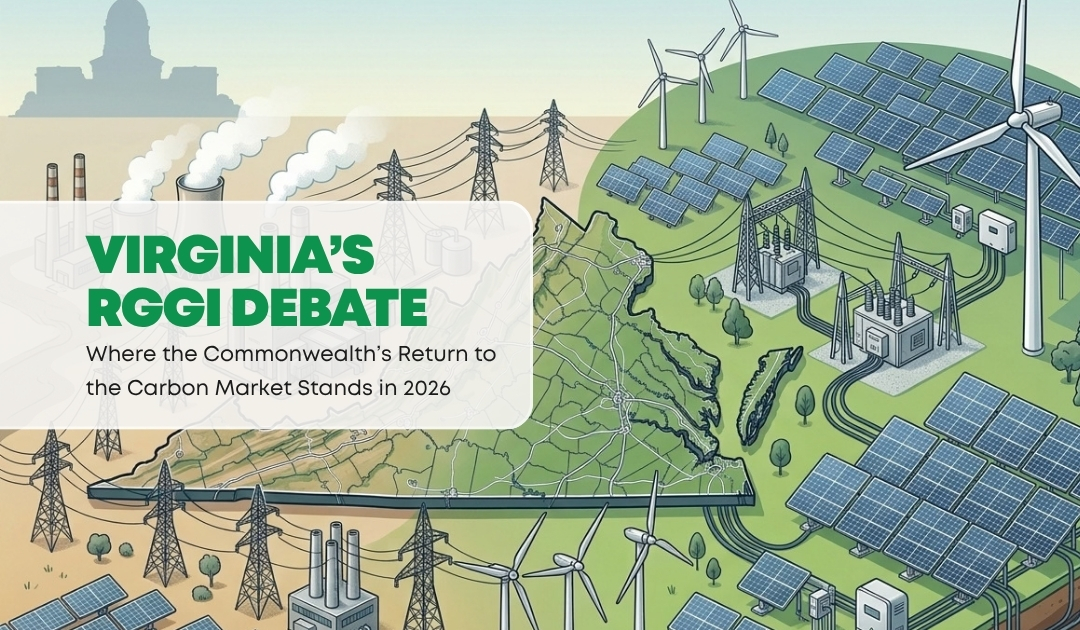
Quick Answer: Virginia’s RGGI participation requirements resumed on July 1, 2026, under legislation enacted in April 2026, resolving a key issue in the Virginia RGGI rejoin debate. The return reversed former Gov. Glenn Youngkin’s 2023 exit, and Virginia took part in its first carbon allowance auction back on September 9, 2026. What’s still being fought over is cost. State regulators have not yet decided how much RGGI will add to residential electric bills, or when.
Here’s where things stand, what the numbers mean, and what Virginia homeowners should watch next.
What Is RGGI in Virginia?
RGGI is a multi-state “cap-and-invest” program that limits carbon dioxide emissions from power plants. Virginia and 10 other states participate.
How it works:
- A cap is set. Participating states agree on a total limit for power-sector CO₂ emissions, and that limit tightens over time.
- Plants buy allowances. Fossil-fuel power plants above a certain size must hold one allowance for every ton of CO₂ they emit.
- Allowances are auctioned quarterly. The price is set by bidding, not by the state.
- States reinvest the proceeds. Each state decides how to spend its share of auction revenue.
RGGI applies to power plants, not directly to homes or businesses. Customers may see allowance costs through utility charges approved by their state regulator., because utilities can ask regulators for permission to pass allowance costs on to customers.
Is Virginia Rejoining RGGI? The Full Timeline
Yes. Virginia has already rejoined. Its participation and compliance obligations resumed July 1, 2026, according to RGGI, Inc.
| Date | What happened |
| 2021 | Virginia joins RGGI under Gov. Ralph Northam |
| 2022–Dec. 2023 | Gov. Youngkin issues an executive order to leave; state regulators repeal the rule, and Virginia exits |
| 2024 | A Floyd County Circuit Court rules the repeal unlawful; the Youngkin administration appeals |
| Feb. 20, 2026 | Gov. Abigail Spanberger signs the HB 29 budget directing state agencies to rejoin RGGI |
| April 2026 | Spanberger signs HB 397/SB 802; the Virginia DEQ reinstates the state’s CO₂ trading regulation |
| July 1, 2026 | Virginia officially rejoins; compliance obligations resume |
| Sept. 9, 2026 | Virginia’s first auction back (RGGI Auction 73) |
| Oct. 28, 2026 | State Corporation Commission (SCC) hearing on the utility’s RGGI cost-recovery request |
| Dec. 2, 2026 | Next RGGI auction |
| Jan. 1, 2027 | Deadline for DEQ to align Virginia’s rules with RGGI’s updated model rule |
Why Did Virginia Leave RGGI in the First Place?
Youngkin argued that RGGI worked like a regressive tax on families and businesses, because utilities passed allowance costs directly to ratepayers. Supporters countered that the program cut emissions and paid for flood protection and energy efficiency. The courts sided with them on process: the circuit court found the executive and regulatory exit unlawful. The Spanberger administration dropped the appeal and chose to rejoin through legislation.
Can a Future Governor Pull Virginia Out Again?
Not as easily as last time. Youngkin’s exit relied on executive and regulatory action. Virginia’s participation now rests on statute passed by the General Assembly (HB 397/SB 802), so leaving again would most likely require new legislation, not just an executive order.
What Are the Current RGGI Allowance Prices?
RGGI allowances cleared at $37.65 per ton at the September 9, 2026 auction, the highest price in the program’s history. That’s more than double what Virginia’s power plants paid the last time the state participated.
| Auction | Clearing price (per allowance) | Context |
| December 2023 | $14.88 | Virginia’s last auction before exiting |
| June 2026 | $35.00 | Record at the time (Virginia not yet participating) |
| September 2026 | $37.65 | Virginia’s first auction back; new record |
Several things are pushing prices up:
- Tighter supply. RGGI’s cost containment reserve, which releases extra allowances when prices rise, was already used up for the 10 longer-standing states earlier in 2026. Virginia’s reserve allowances all sold in September.
- Rising electricity demand. Researchers who briefed Virginia lawmakers pointed to demand growth, including data centers, as a driver.
- A stricter cap ahead. RGGI’s updated framework calls for a steeper annual reduction in the regional emissions cap beginning in 2027
The September auction raised more than $1.07 billion across all participating states. Virginia’s share was roughly $259 million.
How Does Rejoining RGGI Affect Your Electric Bill?
The short answer: it isn’t final yet. Here’s what we know.
What the utility has proposed. In June 2026, Virginia’s largest utility asked the SCC to reinstate its RGGI rider, a separate line-item charge on customer bills. The request covers about $1.18 billion in projected compliance costs over 20 months. It would add approximately $13 per month for a typical residential customer using 1,000 kWh. An alternative “mitigation” option would spread costs out and lower the monthly impact to about $10.36.
How that compares to before. When Virginia was last in RGGI, the same charge was about $4.43 per month for a 1,000 kWh customer.
The offset. The 2026–2028 state budget sends 45% of Virginia’s RGGI auction revenue back to residential, small business and church customers as bill credits. The utility has proposed issuing these credits quarterly and estimates they would roughly offset its proposed RGGI charge.
What’s still undecided:
- The final monthly rider amount, pending the SCC hearing on October 28, 2026
- When the charge starts appearing on bills (the utility has proposed beginning in 2027)
- Whether the 45% bill-credit split stays in place beyond the current budget
This comes on top of other increases. The SCC approved a base-rate increase of $11.24 per month in 2026 and a further $2.36 in 2027 for typical residential customers. For the full picture, see our breakdown of the Dominion Energy rate increase.
Where Does RGGI Money Go in Virginia?
RGGI auction revenue goes to the state, not the utility, and Virginia law decides how it’s spent. The split changed for the current budget cycle:
| Use of proceeds | 2021–2023 participation | 2026–2028 budget |
| Bill credits for residential, small business and church customers | — | 45% |
| Low-income energy efficiency and weatherization | 50% | Shared portion of remaining 55% |
| Community Flood Preparedness Fund | 45% | Shared portion of remaining 55% |
| Program administration and climate planning | Remainder | Shared portion of remaining 55% |
What the First Round of RGGI Money Paid For
Virginia collected about $827.7 million over its first three years in RGGI. State agencies recently reported to lawmakers on what that funded:
- Flood protection: $274.7 million awarded through 263 Community Flood Preparedness Fund grants. Another $178.6 million in eligible requests went unfunded.
- Affordable housing: $274 million helped finance nearly 11,000 energy-efficient affordable housing units across 152 projects.
- Home repairs: $45 million supported repairs for 2,488 low-income households through the Weatherization Deferral Repair program.
The new bill-credit share eases costs for ratepayers, but it also leaves a smaller share for efficiency and flood programs than before. That tradeoff is part of the fight.
The Virginia RGGI Rejoin Debate: Who Supports It and Who Opposes It
The Virginia RGGI rejoin debate has always come down to one tradeoff: lower emissions and funded programs on one side, higher and less predictable bills on the other.
| Supporters | Opponents | |
| Who | Environmental groups, the Spanberger administration, many Democratic legislators | Manufacturers’ groups, many Republican legislators, utility-cost critics |
| Main argument | Cuts power-sector emissions while funding flood protection and efficiency that lower long-term costs | Adds a recurring, market-driven charge to bills during an affordability crunch |
| On costs | Bill credits offset the rider; leaving RGGI didn’t make bills cheaper | Allowance prices are volatile and rising; costs pass straight to customers |
| On policy overlap | RGGI complements Virginia’s clean energy goals | RGGI duplicates the Virginia Clean Economy Act’s mandates |
How RGGI Interacts With the Virginia Clean Economy Act
The Virginia Clean Economy Act (VCEA) already requires Virginia’s major utilities to reach 100% carbon-free electricity by 2045 (2050 for the smaller utility). Critics argue that stacking RGGI on top adds cost without much extra benefit. Supporters argue RGGI puts a price on emissions now, during a long transition, while the VCEA sets the endpoint.
The Data Center Problem
Northern Virginia is home to the largest data center market in the world, and AI growth is pushing electricity demand to levels the grid has never handled. As of February 2026, Virginia’s largest utility reported roughly 70,000 MW of delivery point requests from large data center customers, according to testimony filed with the SCC.
That tension has become the newest front in the Virginia RGGI rejoin debate:
- Demand is surging. New load often has to be met quickly, and fast-starting natural gas plants frequently fill the gap.
- The cap is tightening. Every ton those plants emit requires an allowance, and allowances are getting scarcer and more expensive.
- Who pays? Regulators have created a new rate class for very large users (over 25 MW), taking effect in 2027. The RGGI rider itself, as proposed, does not give large users a volume discount.
Whether Virginia can grow its grid fast enough while staying inside a shrinking carbon cap is now the central question.
What the Virginia RGGI Rejoin Debate Means for Homeowners
For most households, RGGI is one more line item in a bill that is already climbing. Base rates, fuel costs, transmission charges and now a carbon rider all rise and fall on decisions made in Richmond and at quarterly auctions, not at your meter.
A few practical takeaways:
- Watch the October 28 SCC hearing. It will set the size and timing of the RGGI charge on your bill.
- Look for the bill credit. If the credit is issued quarterly as proposed, the net effect on your bill may look different month to month.
- Check efficiency assistance. Income-qualified households may be eligible for weatherization programs partly funded by RGGI revenue.
- Reduce the kilowatt-hours you buy. Like many utility charges, the RGGI rider is billed per kilowatt-hour purchased from the grid. Producing more of your own electricity reduces how much of your usage those per-kWh charges apply to.
That last point is where residential solar comes in. Convert Solar has installed 8,500 systems across Virginia and Maryland, and every home’s situation is different: how you use energy, what your roof can produce, and which financing option fits. Learn more about residential solar for homeowners, Net Metering in Virginia and how much you could save with solar.
You’re already paying for power. Did you know that you could pay less? Bring your electric bill and your questions, and we’ll help you understand what option might fit your home and what solar could save. Request a no-obligation assessment.
Frequently Asked Questions
What is the Virginia RGGI rejoin debate about?
It’s the political and legal fight over whether Virginia should belong to the Regional Greenhouse Gas Initiative, and who should pay for it. Virginia settled the membership question by rejoining on July 1, 2026. The open questions now are how much the program adds to electric bills and how auction revenue is split.
Is Virginia currently a member of RGGI?
Yes. Virginia rejoined RGGI on July 1, 2026, took part in its first auction back on September 9, 2026, and is scheduled for the next auction on December 2, 2026.
When did Virginia officially rejoin RGGI?
July 1, 2026. Gov. Spanberger signed the HB 29 budget in February 2026 directing the return, then signed HB 397/SB 802 in April. The Virginia DEQ reinstated the state’s regulation that spring.
Why did Virginia leave RGGI?
Former Gov. Youngkin called RGGI a regressive tax on ratepayers and withdrew Virginia through executive and regulatory action, effective December 2023. A circuit court later ruled the withdrawal unlawful.
How much will RGGI add to my monthly electric bill?
That hasn’t been decided. Virginia’s largest utility has proposed a charge of about $13 per month for a typical 1,000 kWh customer, or about $10.36 under a cost-spreading option. It estimates that state bill credits would roughly offset this. The SCC hearing is October 28, 2026.
Where does RGGI money go in Virginia?
For the 2026–2028 budget, 45% of auction revenue returns to residential, small business and church customers as bill credits. The remaining 55% funds low-income energy efficiency, the Community Flood Preparedness Fund and program administration.
What are the current RGGI allowance prices?
Allowances cleared at $37.65 per ton on September 9, 2026, a program record, compared with $14.88 at Virginia’s last auction in December 2023. Prices are reset at every quarterly auction.
Can a future governor pull Virginia out of RGGI again?
It will be harder than before. Participation is now written into state law, so leaving would likely require the General Assembly to pass new legislation, not just an executive order.
Do data centers pay RGGI costs?
Indirectly, as electricity customers. The utility’s proposed RGGI rider applies to all customer classes without a volume discount, and a separate rate class for very large users begins in 2027.