Quick Answer: The agrivoltaics Virginia law, HB 508 and SB 340, signed June 17, 2026, formally defines agrivoltaics as the intentional co-location of agricultural production and solar energy generation on the same land.
A solar project can no longer count as “farming” just because a few sheep wander the site: it has to genuinely prioritize agricultural productivity, allow the ongoing sale of farm products, and include a plan for restoring the land when the array comes down. It’s a narrow but important step, Virginia now has a legal standard to measure dual-use solar projects against, even though the funding and incentive details are still being worked out.
For Virginia landowners fielding solar lease offers, or farmers wondering whether panels and pastures can coexist, here’s what the agrivoltaics Virginia law does, what it doesn’t, and what to weigh before signing anything.
What Is Agrivoltaics?
Agrivoltaics is the practice of using the same parcel of land for both solar energy production and active agriculture, crops, livestock, or pollinator habitat growing and grazing among or beneath solar panels.
Virginia’s new statute (codified at Va. Code § 10.1-1197.5) spells out six conditions a project must meet to legally qualify as agrivoltaics:
| Requirement | What it means in practice |
| Prioritizes agricultural productivity | Farming is designed into the project from the start |
| Allows ongoing sale of farm products | The land must keep producing something marketable |
| Part of a commercial farm business | The site has to function as a farm operation |
| Includes a decommissioning plan | Provisions must protect the land’s agricultural value once the array is removed |
| Doesn’t significantly displace farming | Solar can’t crowd out the working farm it’s supposedly paired with |
| Preserves flexibility for farmers | The design has to let farmers adapt to changing markets and operations over time |
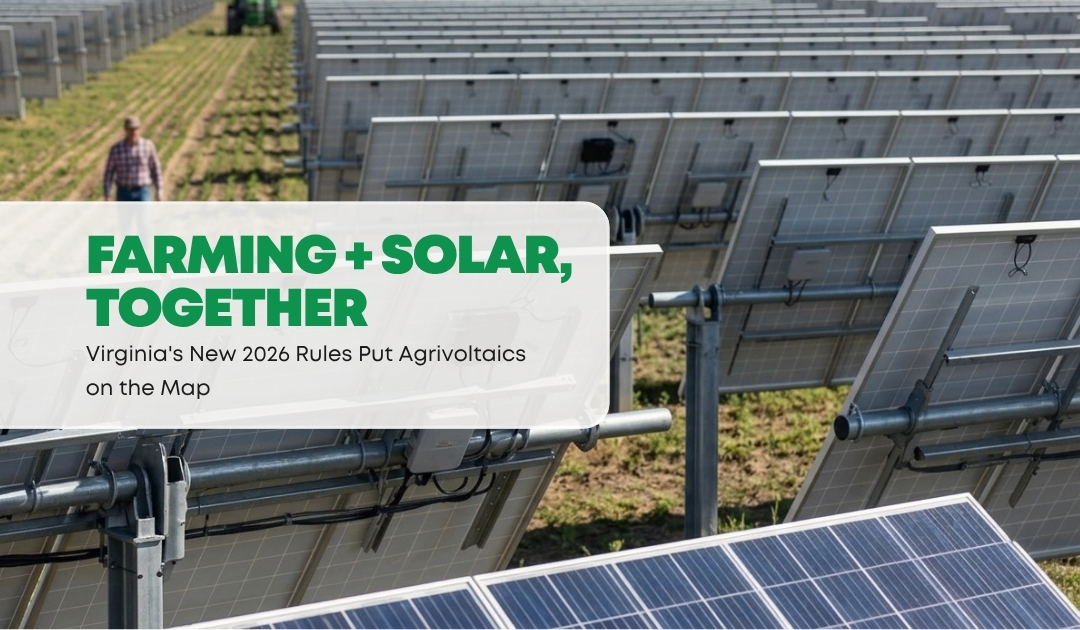
In practice, agrivoltaics in Virginia and nationally tend to take one of two forms: solar grazing (usually sheep, grazed beneath and around the panels) and crop or pollinator co-location (shade-tolerant crops or native plantings growing between rows).
Why Agrivoltaics Is Gaining Ground in Virginia
Virginia is trying to expand solar without accelerating farmland loss. The Virginia Clean Economy Act calls for at least 16,100 MW of solar by 2035, while American Farmland Trust projects the state could lose nearly 594,000 acres of farmland by 2040.
That tension is already visible. Cropland makes up just 5% of Virginia’s land but accounts for 28% of land used for large-scale solar, according to Virginia Commonwealth University researchers. While residential sprawl remains a bigger driver of farmland loss, solar development is disproportionately reaching productive farmland.
Yet land availability itself may not be the problem. The Nature Conservancy found Virginia has roughly 40 times more solar-suitable land than needed to meet its 2035 target, even after excluding millions of acres of priority farmland and conservation land.
That makes agrivoltaics largely a sitting question: when solar is built on farmland, can the land continue supporting agriculture? The agrivoltaics Virginia law creates a framework for managing that tradeoff project by project.
What the Agrivoltaics Virginia Law Changes
Before the agrivoltaics Virginia law passed, the Commonwealth had no legal definition of agrivoltaics at all, which meant there was no consistent standard for what counted as a genuine dual-use project versus a solar farm with a few token animals on it.
What the law does now:
- Establishes the six-part statutory test above for any project claiming to be agrivoltaics
- Applies specifically to small renewable energy projects
- Directs Virginia Cooperative Extension, working with the Virginia Department of Energy, to convene a stakeholder advisory panel
What the law doesn’t finalize yet:
The stakeholder panel will recommend grant criteria, project monitoring standards, and permitting incentives for agrivoltaics. Its report is due November 1, 2026. Until then, Virginia had a legal definition for agrivoltaics but no formal funding or certification system.
A companion law, HB 711, also took effect July 1, 2026. It generally limits ground-mounted solar panels to 25 feet at full tilt but allows height variances when needed for agricultural activity beneath the panels.
How Solar Panels and Farming Can Share the Same Land
Two design approaches show up most often:
- Elevated, wider-spaced arrays — built with extra ground clearance and row spacing specifically so tractors, irrigation equipment, or livestock can move underneath and between panels
- Lower, fixed arrays paired with grazing or shade-tolerant plantings — sacrifices some equipment clearance in exchange for a simpler, lower-cost build
Neither is a fully solved problem yet. Standard farm equipment often doesn’t fit under a conventional solar array’s height and row spacing, which is exactly the practical gap HB 711’s height variance is trying to address. Any agrivoltaic project needs to design around a farmer’s equipment and workflow.
Which Crops and Agricultural Uses Work Best With Agrivoltaics?
- Sheep grazing — the most established form nationally and in Virginia; sheep are short enough to graze safely beneath panels, and grazing replaces mowing as vegetation management for the solar operator
- Pollinator habitat — native wildflower plantings under and around arrays; a multi-year study at Enel’s Aurora solar farm recorded a 20-fold increase in native bee populations on-site
- Shade-tolerant crops — leafy greens, berries, root vegetables, and some brassicas have shown solid or even improved performance under partial shade large-scale row crops can present greater shading and equipment-access challenges, although outcomes depend on the project design.
Do Solar Panels Reduce Crop Yields?
It depends on the crop. Shade-tolerant crops can perform well under solar panels; one Kenya study found cabbages up to 33% larger under panels, with gains for lettuce and eggplant. For Virginia projects, a solar company in Virginia Beach may also consider crop type and site conditions when evaluating agrivoltaic system designs. Full-sun crops are more likely to lose yield when shaded.
Panels can also reduce evapotranspiration and irrigation needs, but results vary by crop, array design, and climate. Virginia-specific large-scale data is still limited.
How Agrivoltaics Could Benefit Virginia Farmers
The main advantage is the potential to combine solar lease income with continued farming revenue. Solar lease payments may exceed traditional crop revenue on a per-acre basis, but rates vary significantly based on location, interconnection access, project size, and contract terms. For some landowners, the additional income may provide another way to support the continued use of the land for agriculture.
Can Agrivoltaics Help Preserve Farmland?
Agrivoltaics may help farming families keep their land while earning solar lease income, especially since residential sprawl remains a larger driver of Virginia farmland loss. But solar plus limited grazing does not automatically make a site a working farm. That is why Virginia’s law requires projects to avoid significantly displacing agricultural activity.
Farmers also remain cautious. In a 2024 American Farmland Trust survey, 64% of Virginia farmers and landowners said solar is better suited to marginal or lower-productivity land than prime farmland.
How Agrivoltaics Could Change Solar Development in Rural Virginia
HB 711 created more consistent rules for local solar permitting. Qualifying projects on agricultural, commercial, or industrial land can go through special-exception review under statewide standards for setbacks, screening, and panel height.
Localities can still deny individual projects, but they can no longer rely on blanket zoning restrictions to prohibit solar development.
What Agrivoltaics Means for Solar Developers and Landowners
Developers now have a legal agrivoltaics standard to design around, including grounds for requesting HB 711 height variances. For landowners, agriculture should be part of the project from the beginning, and working with a solar company in Richmond can help ensure solar development considerations are addressed alongside agricultural requirements. If a project cannot meet Virginia’s statutory requirements, it does not qualify as agrivoltaics regardless of how it is marketed.
Challenges Virginia Agrivoltaic Projects Still Need to Solve
- Decommissioning is now a legal requirement, the statute requires provisions to protect agricultural resources and productivity once the array is removed
- Who pays if a developer exits early or goes bankrupt is an open question the law doesn’t fully resolve yet, this is exactly the kind of thing the stakeholder panel’s November 2026 report is meant to address
- Construction impact is a multi-year land-use event, soil compaction, access roads, and equipment traffic during a build can affect a field well beyond the panels’ footprint, and “the panels come down and it’s a farm again” understates how long full recovery can take
What Virginia Farmers Should Consider Before Leasing Land for Solar
- Treat it as a multi-decade decision. Solar leases typically run 25–30 years, matching the operating life of the array, this isn’t a short-term land rental.
- Get equipment access, water rights, and grazing or planting rights written into the lease.
- Ask directly who bears decommissioning cost and timeline if the developer sells, restructures, or exits the project early.
- Confirm the project’s agrivoltaic design meets the six-part test in the agrivoltaics Virginia law, that determines whether it can rely on any future state incentives tied to the definition.
- Loop in Virginia Cooperative Extension or a land-use attorney before signing, a specific parcel’s zoning, soil type, and lease terms all affect how well agrivoltaics will work on it.
The Future of Agrivoltaics in Virginia
The next milestone is the stakeholder advisory panel’s report, due November 1, 2026. That’s where grant eligibility, monitoring standards, and permitting incentives tied to the agrivoltaics Virginia law will start to take shape, Virginia currently has a legal definition, but not yet a funding or certification system built around it. Expect this to keep evolving over the next several legislative sessions as more projects come online and the state gets data on how well solar and working farms share land.
Frequently Asked Questions
Is agrivoltaics legal in Virginia?
Yes. The agrivoltaics Virginia law, HB 508/SB 340, signed June 17, 2026, formally defined agrivoltaics and established a six-part statutory test for what qualifies.
Can you farm under solar panels in Virginia?
Yes, when a project is designed to meet the law’s requirements, prioritizing agricultural productivity, allowing continued sale of farm products, and avoiding significant displacement of farming activity.
Does agrivoltaics qualify as agricultural use in Virginia?
It can, but qualification isn’t automatic. Note that Virginia’s separate real-property tax exemption for agricultural solar (Va. Code § 58.1-3661) applies specifically to residential and agricultural systems of 25kW or less, a narrower and different rule than the agrivoltaics definition itself, so the two shouldn’t be conflated.
Can livestock graze around solar panels?
Yes, sheep grazing is the most established agrivoltaic practice both in Virginia and nationally, largely because sheep are short enough to safely graze beneath panels without damaging equipment.
Do solar panels reduce crop yields?
It depends on the crop. Shade-tolerant crops (leafy greens, some brassicas, root vegetables) have shown yield gains in agrivoltaic trials, while full-sun row crops generally see reduced yields under panel shading.
How much land is needed for an agrivoltaic project?
It varies by project, but Virginia’s law is framed around small renewable energy projects specifically, and community-solar-scale agrivoltaics (typically under 25 acres and under 5 megawatts) is the most common fit.
Can farmers earn income from both crops and solar?
Yes, that’s the core premise behind the law. How income splits between lease payments and farm revenue depends entirely on the terms of the individual lease.
Are agrivoltaic projects eligible for Virginia solar incentives?
Not yet formally defined. Eligibility criteria for Virginia Power Innovation Fund grants tied to agrivoltaics are still being developed by a stakeholder panel, with recommendations due by November 1, 2026.
How does agrivoltaics affect farmland taxes and land-use status?
This is still an emerging area. The closest existing rule is Virginia’s agricultural real-property tax exemption (Va. Code § 58.1-3661), which applies to qualifying systems of 25kW or less, how it interacts with larger agrivoltaic projects specifically isn’t yet spelled out.
What are the current regulations on solar farms in Virginia?
HB 711, effective July 1, 2026, requires localities to allow a special-exception review for qualifying ground-mounted solar projects on agricultural, commercial, or industrial land, with statewide standard criteria for setbacks, screening, and a 25-foot height cap (with a variance available for agrivoltaic projects). Counties retain the authority to deny individual applications.
What are the top agricultural products in Virginia?
Poultry and eggs rank first, followed by cattle, calves, and dairy, then grains including corn, wheat, and soybeans, according to the Virginia Department of Agriculture and Consumer Services.
This article is for general information and doesn’t constitute legal or tax advice. Every parcel’s zoning, soil conditions, and lease terms are different, talk to Virginia Cooperative Extension or a land-use attorney about your specific situation before signing a solar lease.
Have land in Virginia and am curious what a solar lease could look like for your property?