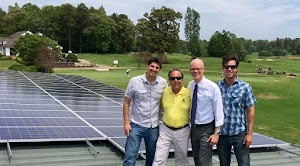

Richmond solar proposals often include Virginia solar SREC income, but many homeowners don’t know how it works. SRECs are tradable credits your system earns for every 1,000 kWh produced. You keep the power and sell the credit to utilities meeting Virginia’s clean energy requirements.
This guide explains how SRECs work, how to register, what the calendar-year rule means, and how Convert Solar helps Richmond homeowners capture this incentive.
What Are Virginia Solar SRECs: Meaning and How They Work
Virginia solar SRECs are tradable certificates your solar panels earn automatically, one for every 1,000 kilowatt-hours (1 MWh) of electricity your system produces. Virginia utilities must purchase a required number of these certificates each year to comply with the state’s clean energy requirements. You earn the credits, and utilities buy them.
The Core Concept — Two Income Streams from One Roof
Your solar panels produce two things simultaneously:
- Electricity — which offsets your utility bill through net metering, reducing or eliminating your monthly electricity charge
- Virginia solar SRECs — certificates sold to utilities through a broker, generating passive income on top of your bill savings
Selling a Virginia solar SREC does not affect your electricity. You still use or bank your solar power through net metering. The SREC is only the certificate proving that power came from solar. If you’re Installing Solar in Virginia, understanding how SRECs and net metering work together can help you maximize the long-term financial benefits of your solar investment.
Why Virginia Solar SRECs Exist
Virginia solar SRECs exist because Virginia law requires utilities to buy credits from small, in-state solar systems. Under the Virginia Clean Economy Act, utilities must source more electricity from renewables over time, including distributed solar systems like Richmond residential rooftops.
Three Things That Operate Independently on a Richmond Solar System
| Mechanism | What It Does | Who Benefits |
| Net metering | Offsets electricity bill at full retail rate through 12-month credit banking | Homeowner (bill savings) |
| Virginia solar SRECs | Passive income from selling production certificates to utilities | Homeowner (cash income) |
| Property tax exemption | Prevents solar value from increasing property tax assessment | Homeowner (tax savings) |
These three mechanisms are completely separate. Selling SRECs does not reduce net metering credits. Using net metering does not reduce SREC earnings. All three run simultaneously on every owned Richmond solar installation.
How Virginia Solar SRECs Work
Your panels produce electricity. For every 1,000 kWh generated, PJM-GATS issues one Virginia solar SREC. Once your system is registered, the process is mostly automatic.
Step 1: Own the System
Purchased and financed systems qualify. Leases and PPAs usually do not because the third-party owner keeps the SREC rights.
Step 2: Receive PTO
Your system starts earning SRECs after Permission to Operate from your utility.
Step 3: Register with PJM-GATS
Registration requires your PTO letter, system details, proof of ownership, monitoring access, and broker authorization.
Step 4: Credits Are Minted
PJM-GATS tracks production and issues SRECs monthly based on your system’s output.
Step 5: Sell Through a Broker
Most homeowners sell through an SREC broker or aggregator, such as Flett Exchange, Xpansiv, or RECmint.
How Many Virginia Solar SRECs Does a Richmond System Generate?
Richmond averages approximately 4.9 peak sun hours per day, producing strong annual output for properly sized residential systems.
| System Size | Annual Production | Annual Virginia SRECs | Current Income ($27/SREC) | Projected Income ($65/SREC) |
| 7 kW | ~9,500 kWh | ~9–10 SRECs | $243–$270/yr | $585–$650/yr |
| 9 kW | ~12,200 kWh | ~12–13 SRECs | $324–$351/yr | $780–$845/yr |
| 10 kW | ~13,600 kWh | ~13–14 SRECs | $351–$378/yr | $845–$910/yr |
| 12 kW | ~16,300 kWh | ~16–17 SRECs | $432–$459/yr | $1,040–$1,105/yr |
Projected income based on Flett Exchange near-term price target of $65–$70/SREC. Actual SREC prices fluctuate based on market conditions.
What Are Virginia Solar SRECs Worth in 2026: Current Prices and the HB 628 Outlook
Virginia solar SRECs are currently trading at $22.25–$27.00 at spot (Flett Exchange, May 2026), with Flett Exchange projecting near-term values of $65–$70 per SREC as HB 628’s 4.5x demand expansion takes effect.
Current Virginia SREC Market Prices
| Metric | Value (Mid-2026) |
| Virginia Distributed REC spot price | $22.25–$27.00 (Flett Exchange, May 2026) |
| SACP ceiling for EY 2026 | $78.82 per SREC |
| Flett Exchange projected near-term target | $65–$70 per SREC |
| Historical 6-year bid average (SRECTrade data) | $34.50–$43.00 per SREC |
| Virginia SREC vintage window | 5 years (2026 SREC valid through 2030) |
The Solar Alternative Compliance Payment (SACP) is the penalty utilities pay for each missing SREC. In 2026, the SACP is $78.82, which acts as a price ceiling. When SREC supply is low and utility demand is high, prices can move closer to that ceiling. Current $22–$27 spot prices reflect the market adjusting after HB 628.
What HB 628 Does to Virginia Solar SREC Prices
House Bill 628, signed by Governor Abigail Spanberger on April 13, 2026, is the most significant change to Virginia’s solar market since the VCEA in 2020. Its direct impact on Virginia solar SRECs:
- Carve-out expansion: The mandatory behind-the-meter distributed solar carve-out increases from 1.0% to 4.5% of total retail electric sales for compliance years 2026–2030, rising to 5.0% through 2045
- Demand increase: For the utility serving most of Richmond, annual SREC demand rises from approximately 740,000 SRECs to 3.4 million SRECs, 4.5 times more required credits than utilities were previously obligated to purchase
- Supply constraint: The installed base of eligible behind-the-meter solar in Virginia has not grown 4.5 times. The gap between mandated demand and available supply is what drives prices upward
How the Price Appreciation Pathway Works
Flett Exchange expects Virginia SREC prices to rise as demand outpaces supply. Based on pricing patterns in similar markets, SRECs often trade just below the annual SACP, supporting projected prices of $65–$70 in Virginia.
The path from $22–$27 to $65–$70 is not a guarantee, it is a supply-demand projection based on:
- A legally mandated 4.5x increase in required SREC purchases
- An installed residential solar base that cannot respond to demand overnight
- A compliance penalty ceiling ($78.82) that sets the upper bound on what utilities will rationally pay
What This Means for a Richmond Homeowner Installing Now
Every Virginia solar SREC your system generates from the day of installation earns income in this market. A Richmond homeowner who installs a 9 kW system today:
- Earns approximately $324–$351/year in SREC income at current $27 spot prices
- Could earn approximately $780–$845/year if Flett Exchange’s $65–$70 projection materializes
- Over 25 years at projected prices: $19,500–$21,125 in cumulative SREC income, more than the cost difference between almost any two competing installer quotes
Homeowners who install later miss the SREC income generated during the price appreciation window. Every month of delay is a month of SRECs earned at lower prices that cannot be recovered.
The Calendar-Year Registration Rule
Richmond homeowners should complete Virginia solar SREC registration in the same calendar year their system receives Permission to Operate. For example, if PTO is granted in October 2026 but registration is delayed until January 2027, the October–December 2026 SRECs may be forfeited.
That loss may be small at current prices, but it can grow if SREC values rise. It also signals whether an installer has a strong post-installation process.
Before signing, ask: “Will you register my system with PJM-GATS and an SREC broker within the same calendar year as my PTO date?”
Convert Solar handles this for every Richmond installation as part of the standard process.
Do I Still Own My Solar Energy If I Sell My Virginia Solar SRECs?
Yes. Selling Virginia solar SRECs does not affect your electricity or net metering credits.
You still use the electricity your panels generate, and any excess power earns net metering credits. An SREC is simply a certificate proving your system produced renewable energy. You keep the electricity, while the utility buys the certificate to meet its clean energy requirements. Working with a trusted Solar Installation Company in Virginia Beach can also help ensure your system is properly installed and registered so you can take full advantage of both net metering and SREC opportunities.
The Three Independent Financial Streams From a Richmond Solar System
- Electricity production → powers your home and earns net metering bill credits — unaffected by SREC sales
- Virginia solar SRECs → certificates sold separately to utilities through a broker — unaffected by how you use your electricity
- Home value increase → approximately 4% added to resale value under Virginia research data — independent of both net metering and SRECs
Selling SRECs does not reduce net metering credits. Using net metering does not reduce SREC earnings. All three run simultaneously on an owned Richmond installation for the full life of the system.
Can I Sell Virginia Solar SRECs If I Lease My Solar Panels?
Generally no. Under a solar lease or power purchase agreement, the third-party company that owns the system typically holds the Virginia solar SREC rights. This is one of the most significant financial disadvantages of solar leases that most salespeople do not make prominent in their pitch. Here is the full math for a Richmond homeowner:
SREC Income Comparison: Owned vs. Leased System
| Scenario | Annual SREC Income | Over 20 Years | Over 25 Years |
| Owned 9 kW system (current $27/SREC) | $324–$351/yr | $6,480–$7,020 | $8,100–$8,775 |
| Owned 9 kW system (projected $65/SREC) | $780–$845/yr | $15,600–$16,900 | $19,500–$21,125 |
| Leased 9 kW system | $0 | $0 | $0 |
At projected $65/SREC prices, leasing instead of owning could cost a Richmond homeowner roughly $19,500–$21,125 in SREC income over 25 years. Convert Solar does not offer leases or PPAs. Every Richmond system is homeowner-owned, so the homeowner keeps the Virginia solar SRECs it generates.
How Long Can You Sell Virginia Solar SRECs?
You can sell Virginia solar SRECs as long as your system produces electricity and stays registered in PJM-GATS. Each SREC has a 5-year vintage window, but most homeowners sell credits soon after they are issued through a broker. Understanding your Solar Panel Warranty Virginia options is also important, as a strong warranty helps ensure your system continues generating electricity efficiently for years to come, allowing you to maximize long-term SREC earnings.
A Richmond system producing 12 SRECs per year could generate about 300 SRECs over 25 years. SREC prices can rise or fall based on supply, demand, and policy changes. Some brokers offer fixed-price contracts for homeowners who prefer predictable income over market upside.
Are Virginia Solar SREC Earnings Taxable?
Probably yes, and consulting a tax professional is the right call.
The IRS has not issued a definitive ruling on SREC taxation. The general principle that applies:
- Virginia solar SREC income is typically treated as ordinary income for federal tax purposes
- SREC brokers issue 1099-MISC forms to homeowners receiving more than $600 in SREC payments in a calendar year
- At current prices of $22–$27 per SREC, a 9 kW Richmond system earning $324–$351/year falls below the $600 threshold
- At projected $65–$70 per SREC, the same system earning $780–$910/year exceeds the $600 threshold and would receive a 1099-MISC
One important note: The tax treatment of Virginia solar SREC income is not fully settled. While one IRS private letter ruling treated SREC proceeds as taxable income, it does not apply broadly or set precedent. Consult a tax professional about your specific situation.
Key points to discuss with your tax professional:
- Whether your SREC income exceeds $600/year given your system size and current market prices
- Whether the return-of-capital argument applies to your specific situation
- How to account for SREC income if you are also claiming depreciation or other solar-related deductions
We are solar professionals, not tax advisors. The right person to answer this question for your specific situation is a CPA familiar with renewable energy incentives.
How Virginia Solar SRECs Affect the Financial Case for Richmond Residential Solar
Virginia solar SRECs are more than a proposal footnote. They can be a meaningful part of your 25-year solar return when properly registered, tracked, and sold.
The Complete Financial Picture for a 9 kW Richmond Solar System
| Income Stream | Annual Value (Current) | Annual Value (Projected) | 25-Year Total (Projected) |
| Net metering bill savings | ~$1,950–$2,200/yr | Grows with rate increases | ~$55,000–$65,000+ |
| Virginia solar SRECs | ~$324–$351/yr | ~$780–$845/yr | ~$19,500–$21,125 |
| Property tax savings | ~$100–$350/yr | Stable | ~$2,500–$8,750 |
| Combined annual benefit | ~$2,374–$2,901/yr | ~$2,830–$3,395/yr | ~$77,000–$94,000+ |
Projections assume 3% annual electricity rate escalation, $65/SREC long-term SREC price, and $250/year average property tax savings. Actual results vary by system size, rate changes, and SREC market conditions.
How Virginia Solar SRECs Change the Payback Period
At current prices, a 9 kW Richmond system can earn about $324–$351 per year from Virginia solar SRECs, or $8,100–$8,775 over 25 years. At projected $65/SREC pricing, that rises to about $780–$845 per year, or $19,500–$21,125 over 25 years.
That difference makes proper SREC registration a meaningful part of solar payback.
What a Richmond Homeowner Needs From Their Installer to Maximize SREC Income
SREC registration handled within the calendar year of PTO, the calendar-year rule is not flexible
- Owned system structure, no leases or PPAs, which forfeit SREC rights to the lessor
- Broker connection, either in-house SREC registration or a direct referral to Flett Exchange or equivalent
- Monitoring connectivity. an Enphase, SolarEdge, or Tesla monitoring setup that maintains continuous production reporting for uninterrupted SREC minting
Find Out What Virginia Solar SRECs Are Worth
Your Virginia solar SREC income depends on your system size, production, and timely registration. Convert Solar has completed 7,000+ Virginia installations since 2012 and handles SREC registration for every Richmond installation as part of the process.
Request a no-obligation quote to see your projected SREC income, net metering savings, and long-term solar return.
Frequently Asked Questions
What are Virginia solar SRECs?
Virginia solar SRECs (Solar Renewable Energy Credits) are certificates earned for every 1,000 kWh your solar system produces. Homeowners can sell them to utilities for additional solar income.
How do Virginia solar SRECs work?
Once your system is registered with PJM-GATS, it earns one SREC for every 1,000 kWh generated. Most homeowners sell them through an approved broker.
How much are Virginia solar SRECs worth in 2026?
Current prices are about $22–$27 per SREC, with some market analysts projecting higher prices as demand increases.
What is HB 628?
HB 628 expanded Virginia’s distributed solar requirement, increasing utility demand for Virginia solar SRECs and supporting stronger long-term market conditions.
How do I register for Virginia solar SRECs?
Your system must be registered with PJM-GATS through an approved broker or aggregator. Many installers handle this as part of the installation process.
What is the calendar-year registration rule?
Registering after the calendar year of your Permission to Operate date may cause you to lose SRECs generated before registration.
Can I earn Virginia solar SRECs if I lease my panels?
Usually no. The leasing company typically owns the SREC rights. Homeowners generally earn SRECs only when they own the system.
Are Virginia solar SRECs taxable?
SREC income may be taxable, but tax treatment can vary. Consult a qualified tax professional for guidance.
How long can I earn Virginia solar SRECs?
You can earn SRECs as long as your system remains operational and registered. Each SREC is valid for five years.
What’s the difference between Virginia solar SRECs and net metering?
Net metering reduces your electric bill through bill credits, while Virginia solar SRECs provide separate income by selling renewable energy certificates. Choosing the best solar company Virginia homeowners trust can help you maximize both benefits by ensuring your system is designed, installed, and registered correctly from the start.
Can I lock in an SREC price?
Some brokers offer fixed-price contracts, while others let you sell at market prices depending on your financial goals.