Quick Answer: For homeowners searching for solar panels hurricane Virginia, the short answer is that properly installed rooftop panels usually stay attached and undamaged through the storms Virginia typically gets. The bigger change is your power: most grid-tied residential solar systems shut down during a grid outage unless they are configured with compatible equipment, such as a battery, that can provide backup power. No rooftop system is hurricane-proof, and flying debris, roof damage, and flooding cause more trouble than wind pressure on the panels themselves.
Key Takeaways
- Solar panels are tested to pressure loads, and each array is engineered to the design wind speed for its address. Inland Virginia localities such as Prince William County use 115 mph for residential solar permits.
- Hurricane Isabel in 2003 brought gusts of 75 mph to Norfolk Naval Air Station and left over 2 million Virginia households without power, according to the National Weather Service. The outage was the largest event for most homes.
- A standard grid-tied system turns itself off when the grid fails. A battery can keep selected circuits running.
- Wind and hail damage to rooftop panels is usually a homeowners insurance matter, but some Virginia policies carry a separate wind or hurricane deductible, and standard policies typically exclude flood and storm surge.
- After a storm, inspect from the ground, stay off the roof, and compare production in your monitoring app once grid power returns.
Are solar panels hurricane proof in Virginia?
What Happens to Solar Panels in a Hurricane depends on the storm’s intensity, wind speeds, and the quality of the installation. Solar panels are not hurricane-proof in Virginia or anywhere else, and any installer who claims otherwise is overpromising. Panels and their mounting hardware are designed and installed to withstand the wind loads specified by local building codes, with a safety margin built in. However, that protection has limits under extreme weather conditions.
Field evidence from much stronger storms is encouraging without being a guarantee. After Typhoon Mawar hit Guam in 2023 with sustained winds up to 140 mph, a National Renewable Energy Laboratory assessment of 30 commercial and utility-scale systems found that rooftop arrays averaged 18% damage, with a median of 2%. Only 8 of the 25 rooftop systems lost more than 5%. Most systems came through lightly damaged, and a few were hit hard.
The systems that failed usually failed at the attachment hardware. The same assessment traced damage to module clamps that released, bolts that vibrated loose, and flying debris. How a system is installed matters more than the panel brand.
How are solar panels rated for wind in Virginia?
Solar panels are rated for wind by pressure, and the complete array is engineered to a design wind speed set by Virginia’s building code for your address. A single miles-per-hour number for “solar panels” skips both of those steps.
Panels are tested to a pressure load
A mechanical load test presses on the front and back of a panel to simulate wind and snow. Results are reported in pascals (Pa), a unit of pressure. One panel Convert Solar offers, the REC Alpha Pure-RX, lists a maximum test load of 4,000 Pa (84 pounds per square foot) on the rear with four-point clamping, per the manufacturer datasheet. The design load is the test load divided by a 1.5 safety factor.
The rear figure is the one that matters in a windstorm, because wind passing over a roof tries to lift the panel away from it.
The array is engineered to your address
The design wind speed is the gust speed a structure must be built to resist at a given location. Virginia’s Uniform Statewide Building Code sets it by area, and your solar permit plans must show the mounting system meets it. Prince William County’s residential solar permit worksheet, for example, requires a design based on 115 mph and attachments spaced no more than 4 feet apart.
Coastal Hampton Roads sits in a higher wind zone than Northern Virginia or the Piedmont. The number that applies to your home is printed on the structural page of your permit plans.
Why “rated to 140 mph” is only a shortcut
Many solar articles say panels withstand 140 mph winds. That figure is a rough conversion of a pressure test into a wind speed, and it describes a panel in a lab. Your roof pitch, building height, the panel’s position on the roof, and the spacing of attachments all change the real load.
| A wind rating covers | A wind rating does not cover |
| Wind pressure pushing and lifting on the panel | A tree limb or loose object striking the glass |
| The racking and attachments, when installed to the engineered plan | Shingles or roof decking that fail beneath the array |
| The design wind speed for your location | Flooding or storm surge reaching ground-level equipment |
A wind rating tells you the array was engineered for expected wind pressure. It says nothing about debris, the condition of the roof underneath, or water.
What keeps solar panels attached to your roof in high winds?
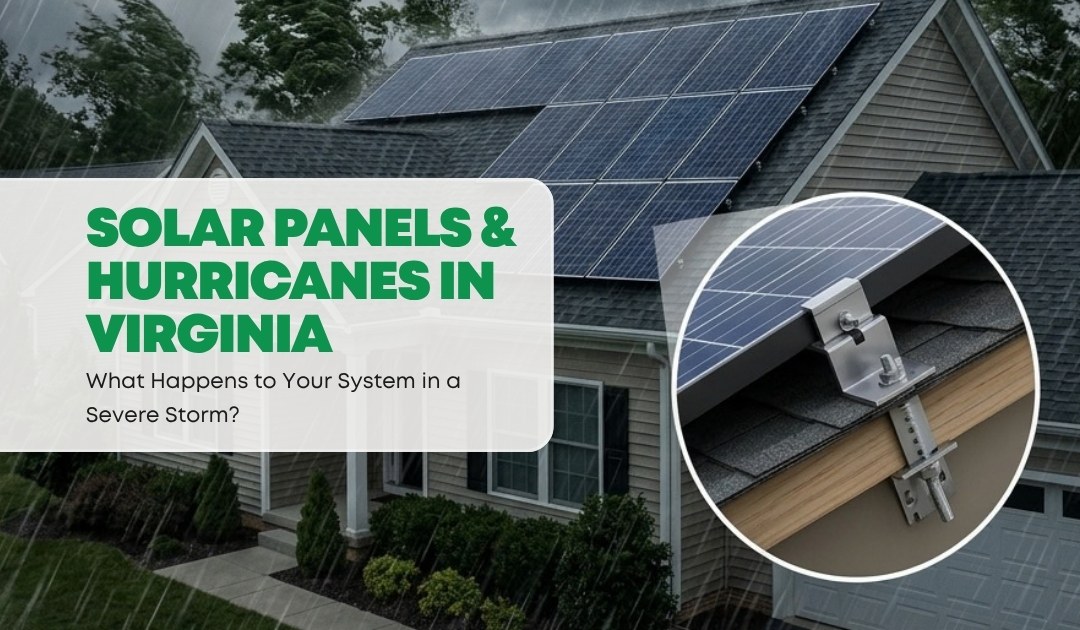
Roof attachments fastened into the rafters hold a solar array down in high winds. Rails connect to those attachments, and clamps secure each panel frame to the rails. Wind load travels from the panel through that hardware and into the structure of the house.
Clamps and bolts are the usual weak point
Federal reviews of storm-damaged systems point to hardware. A Federal Energy Management Program fact sheet on the 2017 hurricane season identified module clamping fasteners as a core cause of equipment loss, along with fasteners that loosened under vibration. Correct torque and the right hardware are installation details you cannot see from the ground, which is why installer training counts. Convert Solar’s installers are NABCEP-certified, meaning they have passed the solar industry’s independent certification for installation practice.
Your roof is part of the system
Panels are only as secure as the roof they are attached to. If shingles or decking fail in a storm, the array on that section can fail with them. A roof near the end of its service life is worth addressing before solar goes on.
Roof penetrations face driving rain
Every attachment point is flashed and sealed to keep water out, and hurricane rain tests those seals harder than an ordinary storm. Convert Solar covers this with a 10-year roof penetration warranty, which is separate from its 25-year bumper-to-bumper warranty covering materials and workmanship.
What happens to a solar system during a Virginia hurricane?
During a Virginia hurricane, a solar system produces very little under heavy cloud, then shuts itself off the moment the grid goes down. It restarts on its own after grid power returns. A battery changes the middle of that sequence.
- Before the storm arrives. Thick clouds and rain cut production sharply, though panels still generate some electricity in daylight.
- A weather alert is issued. If you have a battery, its storm feature charges it to full. Enphase calls this Storm Guard, which monitors National Weather Service alerts and is on by default. Tesla’s version is Storm Watch, which charges Powerwall to maximum capacity when a hurricane or tropical storm watch or warning is issued.
- The grid fails. Inverters stop sending power within moments. This automatic shutdown, called anti-islanding, keeps electricity from flowing back onto lines that utility crews are repairing.
- The outage continues. Without a battery, a grid-tied home has no solar power, even at noon on a clear day after the storm. With a battery, the backed-up circuits run on stored energy, and the panels can recharge the battery in daylight.
- Grid power returns. The system reconnects and resumes normal production without any action from you.
One battery is generally sufficient for critical-load backup, such as a refrigerator, lights, internet, and a sump pump. Whole-home backup typically requires at least two batteries. The right setup depends on your household electricity use, the loads you choose to back up, and how your electrical system is configured. Battery storage systems typically start around $18,000, with final pricing depending on equipment selection, system design, installation complexity, and homeowner energy needs.
Convert Solar’s home battery storage options are the Tesla Powerwall 3, Enphase IQ Battery 5P, and Enphase IQ Battery 10C.
What causes solar panel storm damage in Virginia?
Most solar panel storm damage in Virginia comes from things hitting the array or from the roof and wiring around it. Wind pressure alone rarely breaks a panel. The table ranks the common causes by how often a Virginia homeowner is likely to meet them.
| Cause | Likelihood in Virginia | What you might see |
| Tree limbs and flying debris | Most common | Cracked or shattered glass, dented frames |
| Roof damage under the array | Occasional, more likely on older roofs | Lifted shingles, shifted panels, leaks |
| Water getting into connectors or roof penetrations | Occasional | Error codes, ceiling stains below the array |
| Electrical surges, including nearby lightning | Occasional | Inverter faults, a system that will not restart |
| Large hail | Uncommon | Cracked glass, or hidden cell cracks that lower output later |
| Flooding and storm surge | Location-specific, mainly low-lying coastal areas | Damaged battery, inverter, or disconnect at ground level |
Trees are the risk you can do the most about. Isabel’s widespread outages in 2003 came largely from trees falling on power lines, and the same limbs threaten a roof. Trimming branches that overhang your array before storm season is the single most useful step for most homes.
Hail deserves a plain description. The baseline certification test fires a 25 mm ice ball, about one inch across, at 23 meters per second at eleven points on the panel. Hail larger than that can break glass, so certification is a minimum standard and not a promise.
How do solar panels handle severe weather other than hurricanes?
Solar panels handle Virginia’s more frequent severe weather, including summer thunderstorms, tropical storm remnants, and nor’easters, the same way they handle a hurricane: the hardware usually holds, and the outage is the more common problem. These storms reach every part of the state, from Virginia Beach to Roanoke.
Remnants of Hurricane Helene in September 2024 show the pattern. Southwest Virginia was hundreds of miles from landfall, yet 310,000 customers lost power at the storm’s peak, according to the governor’s office at the time. A Lynchburg or Roanoke homeowner has more reason to plan for that kind of outage than for a direct coastal landfall.
Lightning is a separate concern. A direct strike on an array is rare and can destroy equipment. A nearby strike is more likely and can send a surge through wiring that damages inverters. Surge protection reduces that risk and does not remove it.
Does homeowners insurance cover solar panel storm damage in Virginia?
Homeowners insurance usually covers rooftop solar panel storm damage from wind and hail in Virginia, because panels attached to the house are generally treated as part of the dwelling. Your own policy decides the details, and two Virginia-specific points are worth checking before a storm.
Check for a separate wind or hurricane deductible
Some Virginia homeowners policies carry a special deductible for wind or hurricane losses. The State Corporation Commission’s Bureau of Insurance explains that these deductibles apply separately from the standard one and may be written as a flat amount or as a percentage of the insurance coverage on the dwelling. A percentage deductible on a home can exceed the cost of replacing a few panels.
Flood and storm surge are typically excluded
The Bureau of Insurance also notes that standard homeowners policies issued in Virginia typically do not cover damage from floods, surface water, or storm surge. If your battery or inverter sits at ground level in a flood-prone part of Norfolk or Chesapeake, ask about flood coverage for that equipment.
A warranty is not insurance
A warranty covers defects in equipment and installation. Convert Solar’s 25-year bumper-to-bumper warranty covering materials and workmanship does not pay for a limb through a panel. Storm damage goes to your insurer. For the full picture, see what a solar warranty covers and what it leaves out.
Three things to do before storm season
- Tell your insurer the solar system exists and ask whether your dwelling coverage limit reflects its replacement cost.
- Keep dated photos of the array, inverter, and battery, along with your contract and permit plans.
- If you lease your system, read the lease to see who insures and repairs the equipment.
Your insurance agent or the Bureau of Insurance (1-877-310-6560) can answer questions about your specific policy.
How should you prepare solar panels before a hurricane?
Prepare solar panels before a hurricane by dealing with what could hit them and by documenting their condition. The panels themselves need no covering or removal.
- Trim branches that overhang the roof, ideally well before storm season.
- Bring in or tie down patio furniture, grills, trash cans, and anything else wind can lift.
- Photograph the array, inverter, and battery, and save the photos somewhere off-site.
- Open your battery app and confirm Storm Guard or Storm Watch is turned on.
- Clear gutters and roof drains so water moves away from wiring and roof penetrations.
- Leave the panels alone. Tarps and plywood add wind load and can damage the glass.
You generally do not need to switch the system off, because it shuts down automatically when the grid fails. If flooding could reach ground-level equipment, follow the shutdown steps in your owner’s documentation or call your installer before the storm.
Solar panels hurricane Virginia checklist: what to check after a storm
After a hurricane or severe storm in Virginia, check your solar panels from the ground first and through your monitoring app second. Do not climb onto the roof. Panels produce voltage whenever daylight reaches them, including when the grid is down, so damaged equipment can be live.
- Look from the ground. Use binoculars if you have them. Look for missing or shifted panels, cracked glass, bent rails, hanging wires, and branches resting on the array.
- Check the roof around the array. Lifted or missing shingles near the panels mean the attachments underneath may have been stressed.
- Keep your distance from damage. Do not touch broken panels, loose wiring, or flooded equipment.
- Look inside. Water stains on the ceiling below the array point to a leak at a roof penetration.
- Wait for the grid, then open the app. Once power is restored, confirm the system is producing and note any error codes.
- Compare production. Over the next few sunny days, compare output with a similar day before the storm. A clear drop on one section can indicate cracked cells that are invisible from the ground.
- Photograph everything before cleanup. Your insurer will want dated images.
- Call for help when something is wrong. Contact your installer for an inspection if you see damage, error codes, or low production. Contact your insurer if there is physical damage.
An array that looks fine can still have loosened hardware or hairline cell cracks. Watching production for two to three weeks is the simplest way to catch a hidden problem. Convert Solar customers can reach the service team at service@convert-solar.com or 757-44-SOLAR.
For routine care between storms, see Convert Solar’s solar system maintenance and service page.
What should you ask a solar installer about storm readiness?
Ask a solar installer for the design wind speed your system will be engineered to, how the array attaches to your roof, and what happens if a storm damages it. Specific answers to those three points tell you more than any general durability claim. The storm questions below sit alongside the broader questions to ask before hiring a solar installer in Virginia.
- What design wind speed applies to my address, and where is it shown on the plans?
- How are roof attachments fastened to the rafters and sealed against water?
- What do the warranties cover, and for how long? Ask about the system warranty and the roof penetration warranty separately.
- Who do I call after a storm, and what does an inspection involve?
- If outages are my main concern, which circuits could a battery keep running?
- Is my roof in good enough condition to carry an array for the next two decades?
Consider a Norfolk homeowner with mature oaks and a 20-year-old shingle roof. For that home, tree work and a roof evaluation will do more for storm readiness than choosing between panel models.
Convert Solar, a residential solar installer with 14 years of continuous operation in Hampton Roads, offers multiple premium solar panel options, including Silfab, REC, and Mission Solar, and has installed 8,500 systems across Virginia and Maryland.
Frequently asked questions about solar panels and Virginia storms
Do solar panels generate electricity when it is cloudy and raining heavily?
Yes, solar panels still generate electricity under heavy clouds and rain, at a much lower level than on a clear day. Panels respond to daylight, so some production continues as long as the sun is up. Under the dense cloud of a tropical system, output can fall to a small fraction of normal. Rain does not harm the panels and washes off dust and pollen. See how solar panels perform on cloudy days in Virginia for year-round numbers.
Should I turn off my solar system before a hurricane hits?
In most cases, no. A grid-tied solar system shuts down automatically when the grid fails and restarts when power returns. The exception is flood risk. If water could reach a ground-level inverter, battery, or disconnect, follow the shutdown procedure in your owner’s documentation or ask your installer for guidance before the storm arrives.
Can a lightning strike destroy my solar panel system?
A direct lightning strike can destroy solar equipment, and direct strikes on residential arrays are rare. Surges from nearby strikes are more common and tend to damage inverters and other electronics, leaving the panels intact. Surge protection lowers the risk. Lightning damage is normally handled through homeowners insurance, subject to your policy terms and deductible.
Do solar warranties cover storm damage?
No, solar warranties generally do not cover storm damage. Manufacturer and installer warranties cover defects in materials and workmanship, such as a panel that fails early or a faulty connection. Damage from wind, hail, falling trees, or lightning is treated as an insurance claim. Keep your warranty documents and your insurance policy together so you know which one applies.
Can solar panels damage my roof during high winds?
A properly attached solar array should not damage a sound roof in high winds, because the attachments transfer wind load into the rafters. Problems arise when attachments miss the framing, hardware is loose, or the roof is already in poor condition. A roof evaluation before installation, and an inspection after any storm that damages shingles, addresses most of that risk.
Plan for the outage first, then the panels
If storms are your main worry about solar in Virginia, start with the outage. For most homes, days without power are a more likely outcome than a damaged array, and battery backup is the part of a solar system that addresses it. That advice changes if your outages are short and rare, or if a battery does not fit your budget. In that case, tree trimming and an insurance review cost far less and cover the most likely damage.
Bring your electric bill and your storm questions to a Convert Solar consultation. We can review what your home can support, which circuits a battery could back up, and how a system would be engineered for the wind zone at your address. For more on the backup question, read whether solar battery storage is worth it for Virginia homeowners.