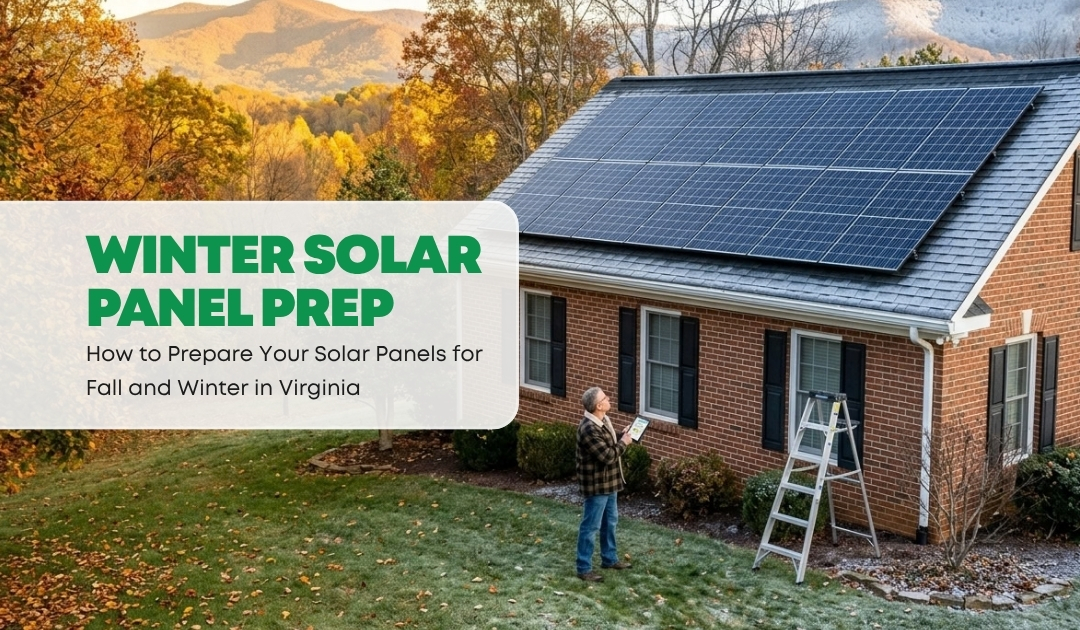
Quick Answer: A brief fall check can help Virginia homeowners spot visible debris, monitoring alerts, new shade, or storm damage before winter. Clear what you can safely reach from the ground and confirm your monitoring app is reporting normally. Anything requiring roof access, electrical testing, or opening equipment should be handled by a qualified solar-service professional or licensed electrician, as applicable.
Key Takeaways
- Debris: Rain keeps most panels clean. Remove leaves and pine needles that sit on the glass or pile up along the bottom edge, and rinse with a garden hose from the ground if needed.
- Shading: The winter sun sits much lower in the sky. Branches that never touched your panels in summer can shade them from November to February.
- Snow: Let it melt. Richmond averages 8.8 inches of snow a year, and snow on pitched panels usually slides off within a day or two.
- Monitoring: Open your app once a week. Compare production to the same month last year, and look for any single panel reading zero on a clear day.
- When to call a professional: Call if a panel or inverter stays offline, you see loose wiring or shifted racking, or a storm or fallen limb hits the array.
What Is on a Winter Solar Panel Prep Checklist for a Virginia Home?
A winter solar panel prep checklist for a Virginia home has seven tasks, and five of them are simple visual checks from your yard. Whether you already have solar panels or are researching a solar installer in Virginia, work through the list between early October and the first hard freeze, when leaves are falling and the weather still makes it easy to be outside.
| Task | Best time | Time needed | Who does it |
| 1. Clear leaves and debris | Mid-October, again after leaf drop | 15 to 20 minutes | You, from the ground |
| 2. Check for new shade | Late October, around midday | 10 minutes | You. Tree service for trimming near the roof |
| 3. Look over hardware and wiring | October | 10 minutes | You, with binoculars |
| 4. Confirm monitoring is reporting | October, then weekly | 5 minutes | You |
| 5. Review battery backup settings | Before the first winter storm | 10 minutes | You, in the battery app |
| 6. Make a snow and ice plan | Before December | 5 minutes | You |
| 7. Book an inspection if needed | October to early November | One visit | Licensed solar technician |
Most of the check can be done in about an hour. A professional inspection is generally most appropriate when monitoring alerts, visible damage, storm exposure, warranty requirements, or system performance indicate a concern.
How Do You Prepare Solar Panels for Winter, Step by Step?
You prepare solar panels for winter by removing what blocks sunlight, confirming the system is reporting correctly, and setting up your battery and snow plan before the first storm. The seven steps below follow the checklist order.
1. Clear leaves and debris from the panels
Remove leaves, pine needles, twigs and bird droppings that sit on the glass, because anything that blocks light blocks production. The U.S. Department of Energy notes that regular precipitation typically keeps solar panels clean and that a hose is all you need if you want to wash them.
- Rinse from the ground with a garden hose on a cool morning or evening.
- Skip pressure washers, abrasive brushes and harsh cleaners. They can damage the glass coating.
- Clear the gutters below the array so water and ice do not back up near the panels.
- Check your warranty terms before using any cleaning tool on the glass.
2. Check for new shade from trees
Look at your panels around midday in late October and note any shadow that was not there in summer. The sun’s path across Virginia is much lower in winter, so a branch that cleared the roof in June can shade the bottom row in December.
Take one example. A Roanoke homeowner with a mature oak on the south side of the yard may see no shade at all in July, then lose the lower third of the array for two hours a day by Thanksgiving. Trimming that one limb in October protects production for the whole season. Hire a tree service for any limb near the roof or a power line.
3. Look over the hardware and wiring from the ground
Stand back with binoculars and scan the array for anything that has moved or come loose. You are looking, not touching.
- Panels that sit crooked or have shifted on the racking
- Wire or conduit hanging below the panels
- Rust or water staining near the roof attachments
- Cracked glass or visible impact marks
If you see any of these, stop and call a technician. Do not climb up to take a closer look.
4. Confirm your monitoring app is reporting
Open your solar monitoring app and check that every panel or inverter is online with no alerts. Then write down this month’s production. That number becomes your baseline, so a real fault stands out later against the normal seasonal dip.
5. Review your battery backup settings
If your home has battery storage, check the backup reserve and backed-up circuits before winter. Battery needs depend on your selected loads, power requirements, available charge, and desired runtime. Whole-home backup may require multiple batteries or load-management equipment.
Cold itself is not the concern in Virginia. The Tesla Powerwall 3, for example, has a rated operating range of -4°F to 122°F.
6. Make a snow and ice plan
Decide before the first storm that you will leave snow and ice alone unless you can reach the panels safely from the ground. Making that call in October is easier than making it while you are staring at a white roof and a flat production graph.
7. Book a professional inspection if you need one
Schedule a professional inspection in October or early November if your system is older, production dropped this year without an obvious cause, or you spotted a problem in step 3. A healthy system with clean monitoring data usually does not need a visit every fall.
How Does Virginia Winter Weather Affect Solar Panels?
Virginia winter weather lowers solar production mainly through shorter days and a lower sun angle, with snow and ice causing brief interruptions on top of that. Solar panels keep producing in cold and cloudy weather, and cold temperatures improve panel efficiency. Solar panel winter care in Virginia is mostly about protecting the sunlight you do get.
Shorter days and a lower sun
December and January production is far below June and July production for every solar home in Virginia. That drop is expected and is built into how your system was sized. The useful comparison is this December against last December.
Snow by region
Snow matters more the farther west you live. The table below uses 1991 to 2020 climate normals.
| Region | Typical snowfall | What it means for your panels |
| Hampton Roads and the coast (Norfolk) | About 6 inches across December to February | A few covered days a year at most. Snow rarely lasts past the next sunny afternoon. |
| Central Virginia (Richmond) | 8.8 inches a year | One to three snow events most winters. Panels usually clear within a day or two. |
| Western Virginia (Roanoke) | About 13 inches a year | More frequent cover and slower melt. A ground-level snow plan is worth having. |
Snowfall figures come from NOAA normals reported for Richmond, Roanoke and Norfolk. For most of the state, snow costs a handful of production days a year. Homeowners in the Lynchburg area can find local detail in the guide to fall and winter solar panel maintenance in Lynchburg.
Freezing rain and ice
Ice is the more common winter problem in much of Virginia. A glaze of ice dims the light reaching the cells and holds snow in place longer. It clears as soon as the dark panel surface warms in direct sun. Never chip, scrape or pour hot water on ice-covered panels.
Wind and winter storms
After any storm with high wind, hail or falling limbs, repeat the binocular check from step 3 and look at your app the next clear day.
Should You Clear Snow Off Solar Panels or Let It Melt?
Let snow melt off your solar panels in almost every case. Panels are dark, smooth and tilted, so they warm quickly in sunlight and shed snow faster than the surrounding shingles, usually within one to two days in Virginia.
Why waiting is usually the right call
The electricity you lose is small and the risk of clearing is not. National Renewable Energy Laboratory modeling puts average annual snow losses between zero and 16% across the contiguous United States, and Virginia’s light snowfall places it near the bottom of that range. A fall from an icy roof or a cracked panel costs far more than two days of January production.
If you decide to clear snow
Clear snow only when all of these are true: the snow is deep, cold weather is forecast to hold for several days, and you can reach the panels from the ground.
- Use a roof rake with a soft foam head made for solar panels.
- Stand on the ground, to the side of where the snow will slide.
- Pull gently down the panel. Do not push or press on the glass.
- Stop when you reach ice. Leave the last thin layer for the sun.
Check your panel warranty terms before using any tool on the glass.
What never to do
- Climb onto a snowy or icy roof
- Use a metal rake, shovel or stiff broom
- Pour hot water on cold glass
- Spread rock salt or de-icer on or above the panels
- Chip at ice
Why a little snow can cut production so much
A strip of snow along the bottom of a panel can reduce that panel’s output sharply, because the covered cells limit the current the rest of the panel can deliver. Systems with panel-level microinverters, such as the Enphase equipment Convert Solar installs, limit that loss to the covered panels while the clear ones keep producing normally.
What Should You Watch in Your Solar Monitoring App During Fall and Winter?
Watch for individual panels or inverters that stop reporting, and compare each month’s production to the same month a year earlier. Monitoring is the one item on a solar panel fall checklist that keeps working all winter, because the app sees problems you cannot see from the yard.
| What you see in the app | What it usually means | What to do |
| Lower daily totals than summer | Normal seasonal drop | Nothing. Compared to last year’s same month. |
| Flat line for a day or two after snow | Panels are covered | Wait for the melt. |
| One panel at zero on a clear day | Shade, debris or a device fault | Check from the ground. Call if it lasts several clear days. |
| Whole system at zero in daylight | Inverter, breaker or communication issue | Call your installer. |
| An error code or alert | A fault the system has logged | Note the code and call your installer. |
| No data at all | Lost internet connection to the system | Check your home Wi-Fi first, then call. |
Seasonal dips are gradual and affect every panel together. Faults are sudden and usually affect one device. For a sense of normal output, see how much electricity a solar panel produces.
When Should You Call a Professional for Solar Panel Service?
Call a professional whenever the fix would require a ladder, a tool or opening electrical equipment. Homeowners can safely look, rinse and monitor. Licensed technicians handle everything else.
Call for service if you notice:
- A panel or inverter offline for more than a few clear days
- Cracked glass, loose wiring or shifted racking
- Water staining or a leak near a roof attachment
- An error code that does not clear
- Storm, hail or fallen-limb impact on the array
- Ice dams that keep forming beside the panels
A technician can test electrical connections, check mounting hardware and run inverter diagnostics, none of which is safe or practical from the ground. Before paying for a repair, check your coverage. Convert Solar systems carry a 25-year bumper-to-bumper warranty covering materials and workmanship, plus a separate 10-year roof penetration warranty. The guide to what a solar warranty covers explains the details.
Convert Solar, a residential solar installer with 8,500 systems across Virginia and Maryland, handles service requests through its solar maintenance and repair team.
Frequently Asked Questions
Do solar panels work during a Virginia winter or on cloudy days?
Yes. Solar panels produce electricity from daylight, so they keep working in cold and overcast weather at a reduced level. Cold temperatures improve panel efficiency. Winter totals are lower because Virginia days are shorter and the sun is lower in the sky. Read more about how solar panels work on cloudy days in Virginia.
Do I need to adjust the angle of my solar panels for the winter sun?
No, not for a rooftop system. Rooftop panels are fixed to the pitch of your roof, and the system was designed around a full year of sun at that angle. Seasonal tilt changes apply only to adjustable ground-mounted arrays, and any adjustment should be made by a technician.
Can cold temperatures or heavy snow damage my solar panels?
Cold temperatures and typical snowfall in Virginia do not damage solar panels. Panels are built and tested for outdoor use in climates far colder and snowier than Virginia’s. Damage is more likely to come from someone trying to remove snow or ice with a hard tool, which is why waiting for the melt is the safer choice.
Will my solar panels power my home during a winter power outage?
Only if your system includes backup-capable equipment. A properly configured battery system may provide backup power during an outage, while some specialized solar equipment can offer limited daytime backup. Capabilities depend on the equipment installed and how the system is configured.
How does Virginia net metering handle lower winter solar production?
Net metering is a utility billing arrangement that credits eligible solar customers for electricity their systems send to the grid. In Virginia, banked kilowatt-hour credits may offset later grid consumption during the applicable net-metering period. Regulators kept that annual structure in place in May 2026. Terms vary by electricity provider. See Virginia net metering explained for homeowners.
Get Your Solar Panels Checked Before the First Freeze
If your fall check turned up an offline panel, a loose wire or a production drop you cannot explain, contact Convert Solar’s service team at service@convert-solar.com or 757-44-SOLAR before the first freeze. Have your monitoring app open and tell us what you saw and when. We can review your system’s data, tell you whether a visit is needed, and answer your questions about winter production and battery backup.