
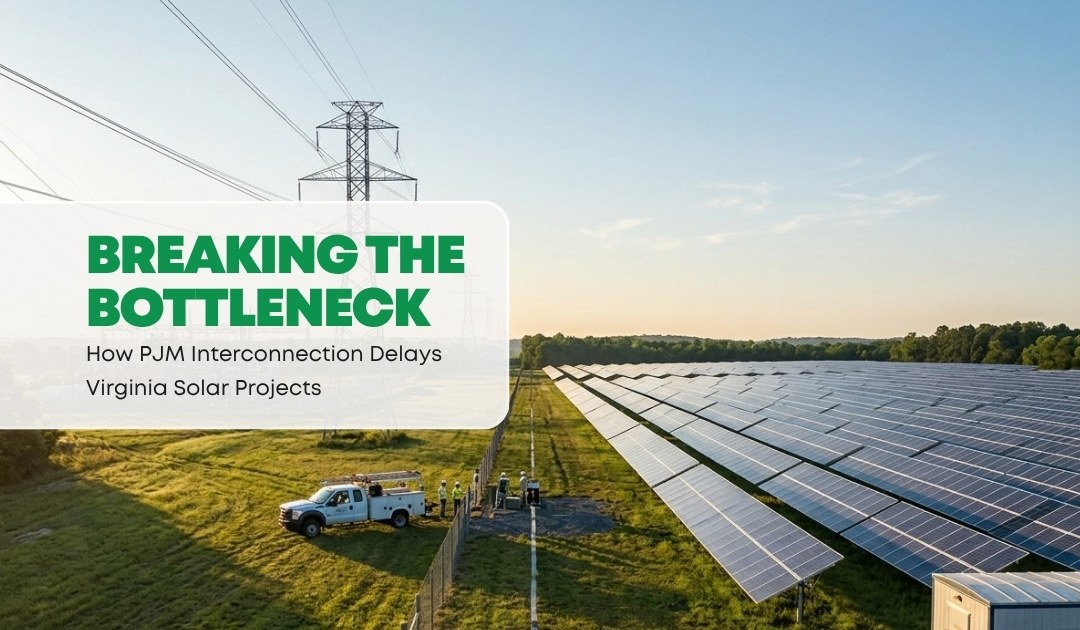
Quick Answer: PJM Interconnection delays Virginia solar projects less at the study stage than it used to, but the wait hasn’t disappeared. Its reformed cycle is designed to be a one- to two-year process, depending on the impact of an individual project. Network upgrades, permitting, equipment lead times and data center demand now drive most of the delay between application and first power.
Key takeaways
- Old timelines: Under the old queue, the path from application to operation rose from an average of less than two years in 2008 to over eight years in 2025.
- Cycle 1: 715 projects totaling more than 200 GW qualified for PJM’s first reformed cycle in August 2026, including 117 solar projects and 37 solar-storage hybrids.
- The bottleneck in Virginia: Transmission network upgrades are the main constraint here.
- Demand pressure: Data center load growth and capacity prices at the cap are raising the stakes for every megawatt that can’t connect.
- Fast tracks: These exist but mostly serve large projects (250 MW+). Most Virginia solar developers will move through the standard cycle.
Why PJM Interconnection Delays Virginia Solar Projects
PJM Interconnection delays Virginia solar projects for two reasons: a queue design that couldn’t keep pace with demand for grid connections, and transmission constraints that persist even after projects are approved.
Under the old serial, first-come, first-served system, every project was studied in order. Speculative applications sat alongside viable ones. When a project ahead in line withdrew, the projects behind it often had to be restudied, which reset their timelines and upgraded cost estimates.
Scale made the problem worse. PJM operates the grid for 67 million people in 13 states and the District of Columbia, and its queue became one of the most crowded in the country.
The national data shows how inefficient the old model was. According to Lawrence Berkeley National Laboratory’s Queued Up: 2026 Edition, only 13% of capacity that submitted interconnection requests from 2000-2020 had reached commercial operations by the end of 2025; 75% of that capacity had been withdrawn.
Old queue vs. reformed cycle process
| Old serial queue | Reformed cycle process (2026) | |
| Study order | First-come, first-served, project by project | First-ready, first-served, studied in clusters |
| Entry requirements | Low barriers, which encouraged speculative filings | Up-front financial deposits and proof of site control |
| Progress checks | Few meaningful exit points | Three phases, each followed by a decision point |
| Withdrawal consequences | Limited | Rising financial exposure after each decision point |
| Target timeline | Grew to 8+ years (application to operation) | 1–2 years for studies |
PJM’s first reformed cycle opened in 2026. The application window closed April 27 with 811 applications. After validation, 715 new generation projects, capable of generating more than 200 GW of electricity, have qualified to be studied in the first Cycle. That group includes 117 solar projects totaling 11.8 GW and 37 solar-storage hybrids totaling 7.5 GW.
PJM is also using AI to speed up administrative review. Google-backed Tapestry has deployed its HyperQ AI platform to handle the initial site control review for PJM Interconnection’s first reformed interconnection queue cycle.
How Long Does Grid Interconnection Take in PJM?
For new projects entering today, PJM’s interconnection studies are designed to take one to two years. Historically, the full journey to operation took far longer, and study time is still not the same as time to first power.
| Metric | Figure | Source |
| Application to operation, 2008 | Under 2 years (average) | RMI, 2026 |
| Application to operation, 2025 | Over 8 years (average) | RMI, 2026 |
| National median, projects built 2018–2024 | Over 4 years | LBNL, Queued Up: 2025 Edition |
| PJM reformed cycle study target | 1–2 years | PJM, Aug. 2026 |
When measuring how long PJM Interconnection delays Virginia solar projects, count from application to first power.
Study time ≠ time to first power
Since 2020, PJM has completed interconnection agreements for 103 GW worth of generation projects. Of those, only 23 GW of the new generation went into service. Another 54 GW have cleared PJM’s process and require nothing from PJM to build, but many are delayed. For developers and investors, the executed agreement is a milestone.
What Are the Steps in the PJM Interconnection Process?
The PJM interconnection process now moves projects through a gated, cluster-based cycle. Each stage asks developers to prove more commitment before moving forward.
- Submit an application during the cycle window. Include study and readiness deposits, plus evidence of site control for the generating facility.
- Pass validation. PJM confirms the application is complete, technically and financially.
- Phase 1 study, then Decision Point 1. Initial cluster study results arrive, and the developer decides whether to proceed or withdraw.
- Phase 2 study, then Decision Point 2. Studies are refined and upgrade cost estimates become clearer.
- Phase 3 study, then Decision Point 3. This produces the final study results and network upgrade assignments.
- Execute the Generation Interconnection Agreement. Terms, facilities and upgrade obligations are locked in.
- Build the upgrades and the project. Transmission owners build the required network upgrades while the developer secures permits, equipment and construction.
- Reach commercial operation. The project begins delivering power.
As Modo Energy’s analysis explains, at each decision point, developers must provide new deposits and/or prove additional control of the project site. This is the core anti-speculation mechanism. Staying in the cycle gets more expensive the longer a project stays in, so weak projects exit early instead of years later.
Why Virginia Solar Projects Still Stall After Approval
Today, PJM Interconnection delays Virginia solar projects most after the study, in the transmission upgrades those studies require.
The Natural Resources Defense Council’s analysis of PJM data found that 103 power plants in Virginia have withdrawn or been significantly delayed by network upgrade bottlenecks since 2018, mostly clean energy projects. The problem extends across the region: across PJM, network upgrades are currently outright preventing 26 GW of new power plants from interconnecting to the grid and delaying 11.7 GW more.
Why can a project near a substation still face major upgrades?
Being close to a substation doesn’t mean the grid behind it has room. Adding power at one point changes how electricity flows across lines and transformers miles away. If any of that upstream equipment would be overloaded, PJM and the transmission owner assign upgrades such as new or rebuilt lines, transformers or substation equipment before the project can connect. When evaluating a project, PJM often identifies spots where adding that amount of energy to the grid requires improving infrastructure, such as new or revamped transmission lines and substations to handle higher voltage.
Who pays for transmission upgrades?
Under PJM’s rules, the developer generally does. Even after the reform, interconnecting resources must still pay for any network upgrades deemed necessary by PJM and the interconnecting utility.
For solar projects, this is often the deciding factor. A project can clear its studies, receive an upgrade assignment large enough to break its economics, and withdraw. That leaves the next projects to absorb new cost estimates.
How Data Center Demand Is Tightening Virginia’s Grid
Northern Virginia’s data center growth is pushing electricity demand up faster than new generation and transmission can be built. That makes interconnection delays more costly for everyone.
Grid reliability events
Large data center loads have begun behaving in ways the grid wasn’t designed for. During a July 22, 2026 event in Northern Virginia, PJM observed an overall load drop from 99,984 MW to 96,205 MW after data centers disconnected following a line fault. PJM also reported that comparable events in Virginia caused sudden load transfers of roughly 1,500 MW each in February 2025 and July 2024.
Capacity prices at the cap
PJM’s capacity market pays for resources to be available at peak demand, and it is signaling a shortage. In PJM’s official auction for the 2028/2029 delivery year, prices hit a $325/MW-day price cap across its region, leaving a roughly 6.8 GW shortfall below the grid operator’s 20% installed reserve margin target. The auction drew only about 525 MW in new resources.
For context, the $325/MW-day figure is the FERC-approved administrative cap, cleared system-wide. For comparison, the 2024/2025 delivery year cleared at $28.92 per megawatt-day. The market wants new supply, but supply stuck in interconnection can’t answer that signal in time. Every month PJM Interconnection delays Virginia solar supply is a month the region keeps paying a premium for capacity it can’t yet get.
What is “Bring Your Own New Capacity” (BYONC)?
BYONC is part of PJM’s proposed Interim Resource Adequacy Service (IRAS) for large new loads such as data centers. Subject to final FERC approval, New Large Loads of 50 MW or greater that fail to secure their own new capacity will be curtailed ahead of Pre-Emergency Load Management beginning June 1, 2027. The proposal is contested. The Electric Power Supply Association filed a protest at FERC on September 3, 2026.
For solar and storage developers, the proposal matters because it could create new demand for bilateral capacity contracts with large loads. Treat it as a proposal until FERC rules on it.
Virginia’s policy response
Virginia is pushing on cost allocation. Governor Spanberger created a cabinet-level Chief Energy Officer who will work alongside the Secretary of Commerce and Trade, the Virginia Department of Energy, PJM Interconnection, and energy utility providers to address rising energy costs, increase clean energy generation in the Commonwealth. Her September 2026 data center order directs that office to work with utilities, the State Corporation Commission and PJM Interconnection on ways to shield households from data-center-driven infrastructure costs.
Fast-Track Options: The RRI and the Expedited Interconnection Track
PJM has created two temporary fast lanes. Both favor large, highly ready projects.
Reliability Resource Initiative (RRI)
This one-time program has resulted in 41 projects representing approximately 8,000 MW of generation whose studies will be completed at the end of 2026.
Expedited Interconnection Track (EIT)
FERC approved the EIT in June 2026. PJM will consider up to 10 interconnection requests a year on a fast-track basis for new or uprated capacity resources of at least 250 MW that can come online within three years. The process is set to expire at the end of 2027. Projects also need a pledge from a state’s “primary siting authority” that it supports expediting the project, and PJM expects about 10 months between the filing of an expedited interconnection request and issuing a generation interconnection agreement.
| Standard Cycle | EIT | |
| Size | Any | 250 MW+ unforced capacity |
| Slots | No fixed cap | Up to 10 per year |
| State support | Not required to enter | State siting commitment required |
| Target | 1–2 year studies | ~10 months to agreement; operating within 3 years |
| Availability | Ongoing annual cycles | Through end of 2027 |
Because most utility-scale solar projects in Virginia fall below the 250 MW threshold, the fast tracks do little to change how PJM Interconnection delays Virginia solar in the standard cycle. That cycle remains the realistic path.
The Oklo lesson: readiness rules cut both ways
The stricter entry rules have consequences. Oklo’s 750 MW mixed-technology project in Virginia was removed from Cycle 1 over application deficiencies. On September 24, 2026, FERC rejected Oklo’s complaint against PJM Interconnection and left the company’s 750 MW Virginia project outside PJM’s current interconnection study cycle. Oklo said missing the cycle means a delay of at least 18 months.
For developers, the message is clear: a deficiency notice is a hard deadline. Complete, accurate submissions now matter as much as project quality.
Pennsylvania’s Parallel Warning
Virginia isn’t alone. A study commissioned by Pennsylvania’s Public Utility Commission found that based on current load forecasts from regional power grid operator PJM and assuming no additional policy actions, the regional grid fails to meet PJM’s reliability planning standard from 2027 through 2030. By 2030, the modeled reliability risk is nearly six times worse than PJM’s planning standard.
Both Commonwealths face the same regional problem: demand is arriving faster than new supply can connect.
What Are the Challenges of Interconnection?
Queue reform fixed how projects are studied. It didn’t fix everything that happens around the study.
| Challenge | Effect on projects | What developers can do |
| Transmission upgrades | Large, uncertain costs; waits for regional lines | Screen points of interconnection for upgrade exposure before filing |
| Permitting and siting | Delays after PJM approval | Align local and state permits with PJM decision points |
| Equipment supply | Long lead times for transformers and switchgear | Order long-lead equipment early; build schedule buffers |
| Load growth | Grid conditions change between studies | Track PJM load forecasts and large-load filings in your zone |
| Project readiness | Deficient applications lose a full cycle | Treat every submission requirement as final |
| Market timing | Capacity auctions buy supply years ahead | Model when the project can realistically qualify for capacity |
Planning Around PJM Interconnection Delays: Virginia Solar Developer Checklist
- Check the upgrade risk before filing. Upgrade exposure is where most Virginia projects fail.
- Build site control ahead of each decision point. Don’t meet thresholds at the last minute.
- Budget for exit costs. Withdrawing after Decision Point 1 carries financial consequences.
- Consider pairing solar with storage. Storage leads Cycle 1 applications and can strengthen a project’s capacity value.
- Watch FERC’s IRAS/BYONC decision. If approved, it could open new contracting paths with large loads.
- Follow Virginia’s cost-allocation policy. Changes to who pays for data-center-driven grid costs could shift project economics.
Does PJM’s Queue Affect Rooftop Solar in Virginia?
Generally, no. PJM’s generator interconnection queue covers projects connecting to the regional transmission system. Residential and most small commercial rooftop systems connect to the local distribution grid through the utility’s own interconnection process under Virginia rules.
Homeowners and businesses still feel PJM’s challenges indirectly, through capacity costs that flow into electric bills. For more on that, see how rising utility rates affect Virginia homeowners and commercial solar installation in Virginia.
Frequently Asked Questions
Is PJM still slowing down Virginia solar projects?
Yes, but less than before. PJM Interconnection delays Virginia solar projects far less at the study stage, though upgrades and permitting still slow many projects after approval.
What are the problems with PJM?
Slow interconnection, transmission constraints, and demand outpacing new supply. Its recent capacity auctions hit the price cap and still fell short of reliability targets.
How long does grid interconnection take?
PJM’s reformed studies target one to two years, down from an average of over eight years from application to operation in 2025 (RMI). Permits and upgrades can extend total timelines.
What are the steps involved in the PJM interconnection process?
Apply with deposits and site control, pass validation, then complete three study phases with decision points. Remaining projects sign an interconnection agreement, build, and begin operation.
What are the challenges of interconnection?
Costly transmission upgrades, permitting delays, equipment shortages, load growth and strict readiness rules. In Virginia, network upgrades are a leading cause of withdrawals.
What is PJM’s first-ready, first-served process?
It replaces first-come, first-served with cluster studies. Projects must prove readiness through deposits and site control at each decision point.
Who pays for transmission upgrades in PJM?
Generally the interconnecting project. High upgrade costs are a common reason projects withdraw.
What is the Expedited Interconnection Track?
A temporary fast track for up to 10 projects a year of at least 250 MW with state siting support, targeting operation within three years. It expires at the end of 2027.
Does PJM’s interconnection queue affect residential solar?
Not directly. Rooftop systems connect through the local utility, though capacity costs still reach electric bills.
The Bottom Line
PJM Interconnection delays Virginia solar projects less on paperwork than at any point in years. The harder constraints are now physical and financial. Transmission upgrades, permitting and data center demand will decide how fast approved projects deliver power. For homeowners and businesses exploring solar while these grid changes unfold, working with a solar company in Richmond VA can help them understand local project timelines, permitting requirements and available options. Developers who plan for those constraints from day one will be best positioned as the grid races to catch up.
Convert Solar has installed 8,500 systems across Virginia and Maryland. If you’re weighing solar for a home or business, talk with our team. Bring your electric bill and your questions, and we’ll help you understand what solar could save.