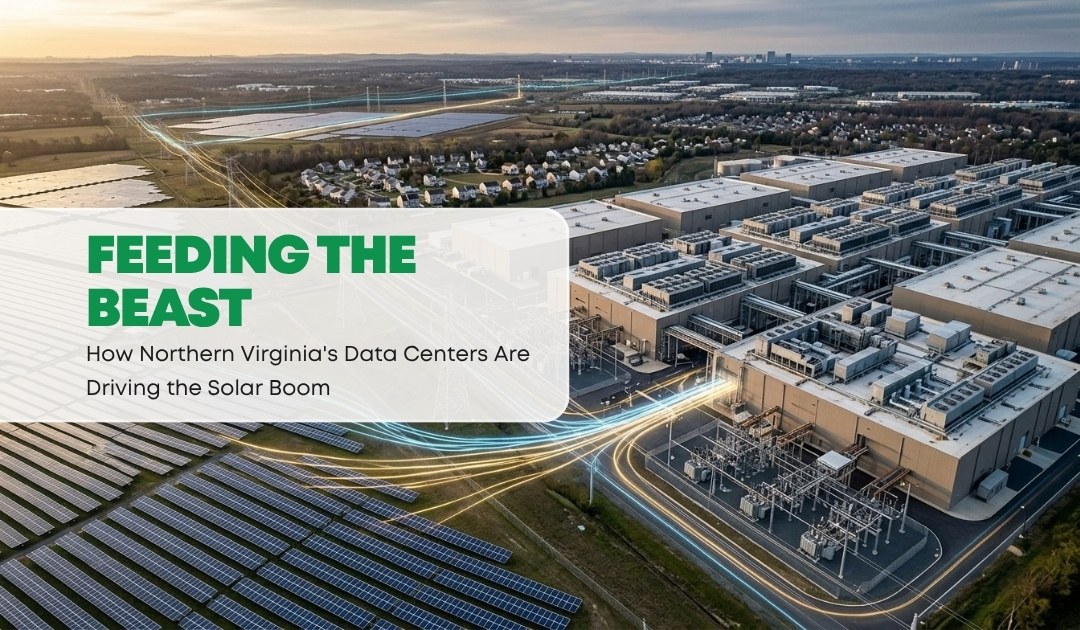
Quick Answer: Data center power demand solar Virginia trends have become the single biggest force reshaping the state’s electric grid, and they’re the main reason Dominion Energy is now building solar and battery storage faster than at any point in its history.
Northern Virginia’s data center cluster already consumes an estimated one-quarter of all the electricity used in the state, a share that could climb close to half by 2030. That growth is why Dominion has committed to roughly 12 gigawatts (GW) of new solar and 4.5 GW of battery storage over the next 15 years, though as this article lays out, even a build-out that size may not be enough to keep up with how fast the data centers keep arriving.
Data Center Power Demand, Solar, and Virginia’s Grid: Key Numbers
| Metric | Figure |
| Share of global internet traffic passing through Northern Virginia | ~70% |
| Northern Virginia data center capacity (2026) | ~20.3 GW (~13% of global live capacity) |
| Growth in Dominion’s data center electricity demand, 2013–2024 | ~7x |
| Data centers’ share of Virginia’s electricity use (2025) | ~25% |
| Projected data center share of Virginia’s electricity use (2030) | Up to ~46% |
| Projected statewide data center power need (2035) | ~11,000 MW (nearly 4x 2022 levels) |
| Dominion’s planned new clean energy capacity (next 15 years) | 21.1 GW total, including 12 GW solar and 4.5 GW storage |
These figures are a current snapshot as of 2026 and will shift as Dominion updates its IRP and as new data center projects are approved, delayed, or cancelled.
What Is “Data Center Alley,” and Why Is Northern Virginia the World’s Data Center Capital?
Northern Virginia’s data center cluster, centered on Loudoun and Fairfax counties and spreading into Prince William, didn’t happen by accident. The region became the internet’s physical backbone starting in the 1990s, when early peering exchanges and AOL’s headquarters in Dulles created a network effect: every new company that connected made the location more valuable to the next one.
That history, combined with a handful of practical advantages, is why the region still anchors the world’s densest data center market:
- Fiber density. Decades of buildout mean Northern Virginia has some of the highest concentrations of dark fiber anywhere in the world.
- Proximity to Washington, D.C. Government, defense, and federal contractor demand for data infrastructure has been a steady anchor tenant base since the earliest days of the internet.
- Land and permitting history. Flat, developable land and historically fast local approvals (before recent zoning pushback, more on that below) made it easy to build at scale.
- Reliable power access. Until recently, Dominion Energy’s grid had enough headroom to absorb new large-load customers relatively quickly.
The result: Northern Virginia now handles an estimated 70% of global internet traffic on a given day, and the broader region reached roughly 20.3 GW of data center capacity in 2026, about 13% of all live data center capacity on Earth, the largest single-market share anywhere.
How Much Power Do Data Centers Use in Virginia?
Data centers now account for an estimated one-quarter of all electricity used in Virginia, and that share could approach half by 2030. Dominion Energy’s data center electricity demand has grown roughly sevenfold since 2013, driven first by cloud computing and now accelerated by AI workloads that require far more power per server rack than traditional computing.
A few numbers put the scale in perspective:
- Dominion’s data center load has grown nearly 7x between 2013 and 2024.
- Data centers are estimated to already use about 25% of Virginia’s total electricity as of 2025.
- That share could reach as much as 46% by 2030, according to the Northern Virginia Regional Commission.
- Statewide, the data center industry is projected to need roughly 11,000 megawatts by 2035, nearly four times what it needed in 2022.
- Newer AI training and inference workloads use significantly more power per server than the cloud-computing workloads that built the original Data Center Alley, meaning demand is growing in intensity per facility.
This is the demand side of the equation. It’s also the reason Virginia’s utilities have had to fundamentally rethink how much new generation they need to build, and how fast.
Why Is Virginia Allowing So Many Data Centers?
Data centers generate more than $1 billion a year in local tax revenue across Northern Virginia, while supporting construction and operations jobs. That economic impact helped drive years of rapid development. Regulators have also introduced Dominion’s GS-5 rate for large-load customers over 25 MW, using long-term contracts and minimum billing requirements to reduce the risk of data center costs shifting to residential customers.
At the same time, soaring AI-driven electricity demand has made data centers a major challenge to Virginia’s clean-energy targets. Demand has grown far beyond what lawmakers anticipated when the Virginia Clean Economy Act passed in 2020, tying the state’s data center expansion increasingly closely to the need for more solar and other new generation.
The Solar and Storage Boom: How Data Centers Are Fueling Renewable Build-Out
The VCEA requires Dominion Energy to deliver 100% carbon-free electricity by 2045, and Appalachian Power to do the same by 2050. Meeting that mandate while also serving explosive data center growth is what’s driving Dominion’s current buildout plans, which include:
- 21.1 GW of new clean energy capacity planned over the next 15 years
- 12 GW of new solar, the single largest category of new generation in Dominion’s plan
- 4.5 GW of new battery storage
Rapidly growing data center power demand has become one of the biggest forces reshaping Virginia’s electric grid, alongside continued investment in the 2.6 GW Coastal Virginia Offshore Wind (CVOW) project, which began delivering initial power to the grid in March 2026 and is expected to be completed in 2027.
Corporate demand is also helping drive Virginia’s solar buildout. The clearest example is the 617 MWdc Spotsylvania Solar Energy Center, the largest solar farm east of the Rockies. Microsoft signed a 315 MW power purchase agreement tied to two of its projects to help offset data center energy use. At full output, the facility can generate enough electricity to power roughly 111,000 homes.
That pattern is spreading across Virginia: large tech companies are financing utility-scale solar as part of securing power for growing data center loads on an increasingly constrained grid.
Can Solar Power a Data Center 24/7?
No, not on its own. Data centers operate 24/7, while solar generation is limited to daylight hours. In Virginia, that creates a fundamental mismatch between round-the-clock data center demand and the hours when solar is producing electricity.
That is why Dominion’s strategy is not solar-only. Its generation plan combines solar with other resources that can help provide power when the sun is not shining, including:
- 4.5 GW of battery storage to shift solar generation into evening and overnight hours
- Offshore wind, including the Coastal Virginia Offshore Wind project
- Nuclear generation as a source of continuous power
- New natural gas capacity, including the $1.47 billion Chesterfield Energy Reliability Center approved under a VCEA reliability exception
Solar is a major part of meeting Virginia’s growing electricity demand, but serving data centers reliably requires a broader mix of generation and storage resources.
Where Is All This New Solar Being Built?
Land around Data Center Alley has become too expensive and contested for large solar projects, pushing much of Virginia’s new utility-scale solar development into more rural counties such as Spotsylvania and Louisa.
That shift creates a separate land-use debate: rural communities are increasingly hosting the solar farms and transmission infrastructure needed to serve data center growth concentrated in Northern Virginia.
Grid and Transmission Strain: Who Pays for the Boom?
Building enough generation is only half the problem. Getting that power to Northern Virginia requires new high-voltage transmission lines, and someone has to pay for them.
A few developments are worth watching here:
- Dominion’s proposed Rider T-1, tied to roughly $1.5 billion in data-center-related transmission costs, has been a major point of regulatory debate throughout 2026.
- Dominion’s November 2025 rate case resulted in its first base rate increase since 1992, adding about $11.24/month to the average residential bill in 2026 and another $2.36/month in 2027.
- Dominion has told state regulators it’s currently seeing roughly 70 gigawatts of data center interconnection requests, about three times the utility’s all-time peak demand, a figure that gives a sense of just how far ahead of actual, built capacity the demand pipeline has gotten.
- A state legislative study (JLARC) found that while data centers are currently covering the cost of the infrastructure built specifically for them, the broader new generation and transmission Virginia will need in the future would not otherwise be built, meaning prices are likely to rise for all customers.
Taken together, these numbers are why data center power demand and solar and transmission spending in Virginia now show up together in nearly every regulatory filing Dominion submits.
Local Friction: Communities Approving Data Centers, Rejecting the Solar Farms Needed to Power Them
The politics here have shifted quickly. In March 2025, Loudoun County, the historic heart of Data Center Alley, eliminated by-right approval for new data centers entirely, meaning every new project now requires a special exception and a public hearing.
Prince William County saw an even more dramatic reversal. The county’s proposed “Digital Gateway” project, a 2,100-acre corridor slated for 37 data centers, once positioned to become the largest data center campus in the world, was struck down by a circuit court in 2025 over a public-notice violation, upheld on appeal in 2026, and officially killed in July 2026 when the developer withdrew its final court challenge. Days later, the county’s Board of Supervisors also rejected a separate, similarly sized rezoning proposal along the Loudoun County line.
Fairfax County has since passed stricter zoning standards, including noise studies and 200-foot residential setbacks. Stafford County began requiring special permits for data centers in 2025.
The result is a genuinely uneven landscape: some localities are pulling back hard on new data center approvals, even as the region’s overall power appetite, and the solar and transmission build-out needed to serve it, keeps growing regardless of where any single project lands.
Is the “Renewable-Powered Data Center” Story as Green as It Sounds?
It’s a fair question, and the honest answer is: not entirely, at least not yet. Consider one data point from 2025: the roughly 716 megawatts of new utility-scale solar Virginia added that year was less than the amount of new data center capacity Dominion says it receives requests for in a single month. Solar is growing at a genuinely historic pace, but demand is growing faster.
At the same time, Virginia is:
- Continuing to build new natural gas capacity (like the Chesterfield Energy Reliability Center) specifically to meet reliability needs the VCEA’s own exceptions allow for
- Rejoining the Regional Greenhouse Gas Initiative (RGGI) effective July 1, 2026, after a 2023 withdrawal, a policy reversal aimed at putting a price back on carbon emissions statewide
So the fairest framing is this: data center power demand is genuinely accelerating Virginia’s solar build-out, and that build-out is large, and historically unprecedented for the state. But it hasn’t yet put Virginia’s 2045 clean-energy target back on track, if anything, most of the recent public commentary from state lawmakers suggests the opposite.
What This Means for Virginia Homeowners
For Virginia homeowners, the takeaway is simple: electricity costs are rising, and growing data center demand is adding pressure to the grid and future infrastructure costs. That is helping make solar more relevant as a way to create more predictable long-term energy costs.
Convert Solar has installed more than 8,500 systems across Virginia and Maryland and has ranked as a Solar Power World Top Solar Contractor for six consecutive years (2021–2026). As of July 2026, residential solar in Virginia averages about $2.65 per watt before incentives, according to EnergySage.
Frequently Asked Questions
What is a data center, and why are there so many in Northern Virginia?
A data center houses servers and networking equipment used to store and process digital information. Northern Virginia became a major hub because of its early fiber infrastructure, proximity to Washington, D.C., and historically favorable permitting.
How much electricity do Northern Virginia data centers use?
Data centers now account for an estimated 25% of Virginia’s electricity use, with that share projected to rise significantly by 2030. Their growth is reshaping how utilities plan new generation and transmission.
How does the Virginia Clean Economy Act affect data centers?
The VCEA requires Dominion Energy to reach 100% carbon-free electricity by 2045. It does not limit data center growth directly, but rising demand makes those clean-energy targets harder to meet.
Can rooftop solar meet data center demand?
Not on its own. Residential solar can reduce household demand and grid pressure, but large data centers require far more continuous power. Meeting that demand requires utility-scale solar, storage, wind, and other generation sources.
Will data center growth make Virginia’s grid less reliable?
Utilities and regulators are adding new rate structures, generation, and transmission to manage the growth. Even so, state studies have warned that rapidly rising demand is creating new reliability and cost pressures.
Are new transmission lines mainly being built for data centers?
Data center growth is a major driver of new transmission projects in Virginia, particularly in Northern Virginia, contributing to local debates over where new infrastructure should be built.
Does utility-scale solar create environmental concerns?
Yes. Large solar projects require significant land, and expansion into rural counties has raised concerns about land use, habitat, and development impacts.
Data center power demand solar Virginia coverage like this will keep evolving fast, subscribe for industry updates on how Virginia’s energy landscape is shifting, from data center policy to solar and grid developments that affect homeowners across the Commonwealth.