If you’re comparing quotes for a full-service solar installation, it helps to know exactly what that phrase should mean before you sign anything. Going solar isn’t a single transaction like buying an appliance, it’s a multi-stage process that spans design, engineering, permitting, utility approval, physical installation, inspection, and years of ongoing support afterward.
“Full-service” or “turnkey” means one company owns every one of those stages, instead of handing pieces off to subcontractors or leaving steps for you to coordinate yourself. Here’s exactly what should be included, stage by stage.
What Is a Full-Service Solar Installation?
A full-service (or turnkey) solar installation is one where a single company handles the entire journey: the initial energy assessment, roof and site evaluation, custom system design, permitting and documentation, utility interconnection, equipment procurement, physical installation, electrical integration, inspection, Permission to Operate, monitoring setup, and warranty support, all under one roof, with one point of contact throughout.
Why Full-Service Installation Matters
- One point of accountability. If a question comes up in year one or year fifteen, you’re calling the same company that designed and installed your system.
- Fewer handoff errors. A team that only handles design but not permitting can miss site-specific constraints that show up later in the process.
- A faster overall timeline. When one company controls the sequencing of every stage, there’s no waiting on a third-party vendor to catch up.
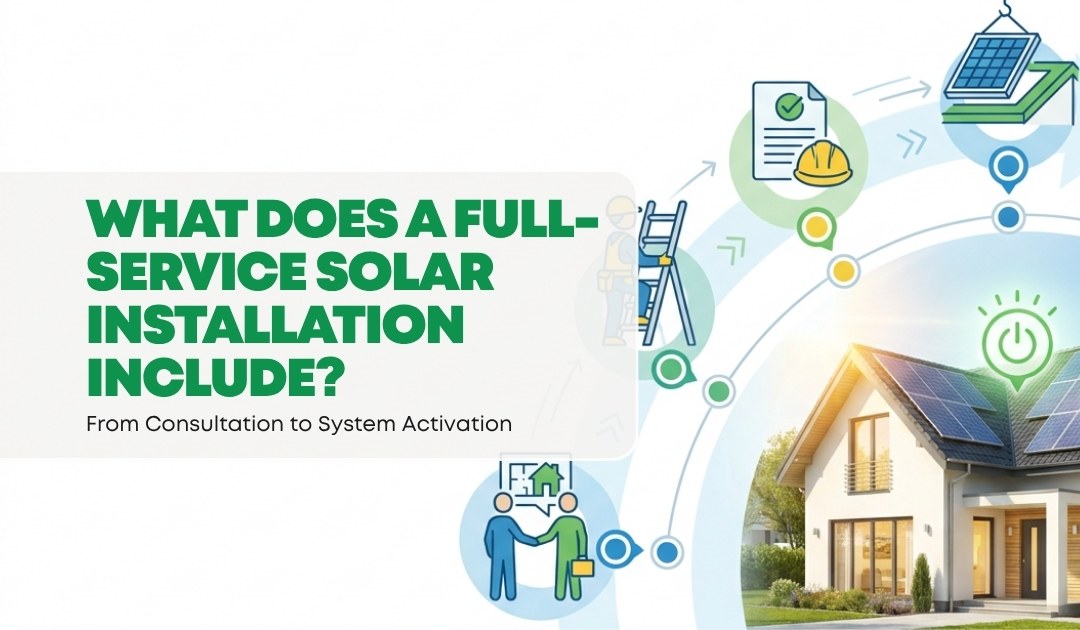
The Full-Service Installation Process, Step by Step
1. Initial Consultation and Energy Assessment
The process starts with a review of your household’s electricity usage, typically your past 12 months of billing history. This is what determines how large a system you need.
2. Roof Inspection and Site Evaluation
A site-specific assessment evaluates roof orientation, shading, structural condition, and roof age. Convert Solar performs a drone roof assessment before issuing a proposal, so the design reflects your roof.
Is my roof suitable for a full-service solar installation?
Most roofs are. South- or west-facing sections with minimal shading, sufficient structural capacity, and enough remaining lifespan to outlast the mounting hardware are ideal, but a proper site assessment is the only reliable way to know for your home specifically.
3. Custom Solar System Design
Using the usage data and site assessment, your installer finalizes system size, panel placement, and equipment selection, the panels, inverter, and (if applicable) battery storage.
4. Permitting and Documentation
Who pulls the permits? In a genuinely full-service installation, the installer does. This stage includes building and electrical permit applications, structural engineering documentation where required, and, for homes in a community with an association, coordinating any required design approval before installation is scheduled.
5. Utility Interconnection Coordination
Before installation can be scheduled, your installer submits interconnection paperwork to your electricity provider and secures approval to connect the system to the grid, the step that ultimately enables Net Metering credits once your system is active.
6. Equipment Procurement
Your installer sources the approved equipment specified in your design, panels, inverter, and battery storage if included.
7. Professional Solar Panel Installation
Physical mounting, racking, and panel installation on your roof, following manufacturer-approved methods to protect your existing roof warranty (more on that below).
8. Electrical Work and System Integration
Wiring the system into your home’s electrical panel and integrating the inverter (and battery, if applicable), work that should be performed by a Class A licensed electrical team.
9. Inspection and Quality Assurance
Does the installer handle inspections? It should. A full-service provider coordinates the local jurisdiction’s building and electrical inspection directly.
10. Permission to Operate (PTO)
What happens after installation? Your installer submits final documentation to your electricity provider, which issues Permission to Operate, the formal sign-off required before your system can be legally turned on and start generating credits.
11. System Monitoring and Performance Setup
Once PTO is granted, your installer activates your system and sets up a monitoring app or dashboard so you can track production going forward.
12. Warranty Coverage and Ongoing Support
A full-service provider’s responsibility doesn’t end at activation, see the warranty breakdown below for what should be covered afterward.
How Long Does the Entire Full-Service Installation Process Take?
| Stage | Typical Timeframe | What Happens |
| Sale to installation | 6–8 weeks | Design finalization, permitting, and utility interconnection approval |
| Installation to Permission to Operate | 8–10 weeks | Final documentation submitted, jurisdiction inspection scheduled and completed, utility issues PTO |
How long does installation take?
The physical installation itself is typically completed in a single day to a few days, depending on system size, it’s the permitting and utility approval on either side of it that account for most of the overall timeline above.
What “Full-Service” Removes From the Homeowner’s Plate
Without a full-service provider, a homeowner would otherwise need to:
- Independently source and vet a licensed contractor to handle permitting
- Personally file utility interconnection paperwork
- Schedule and be present for their own building/electrical inspections
- Track down separate vendors if something needs warranty service later
What Maintenance Does an Installed System Require?
Do I have to clean or maintain the solar panels?
Not much. Solar panels have no moving parts, so maintenance is minimal, periodic visual inspection and occasional cleaning are the main recommendations. If you finance through a lease, routine maintenance responsibilities are often bundled into the agreement; if you purchase, that responsibility (beyond what’s covered by warranty) generally sits with the homeowner.
What Kind of Warranties Come With a Full-Service Installation?
Ask specifically what’s covered, for how long, and by whom. Two separate protections are worth understanding:
| Warranty | Length | Covers |
| System warranty | 25 years | Materials and workmanship on the solar system itself |
| Roof penetration warranty | 10 years | The mounting points where the system attaches to your roof |
Convert Solar’s system warranty is a 25-year bumper-to-bumper warranty covering materials and workmanship, handled by its own in-house service team. The roof penetration warranty is a separate, shorter 10-year warranty specifically for the mounting points, don’t assume one number covers both.
Do solar panels protect my roof, and what happens to the warranty?
Two different warranties are in play here. When working with a solar installation company in Richmond, make sure the solar system is installed following the roofing manufacturer’s approved methods, including proper flashing and approved mounting points. This generally helps keep your existing roof warranty intact, as the roof manufacturer’s own guidance typically confirms.
On top of that, a reputable full-service installer adds its own roof-penetration warranty specifically covering the areas where the system attaches. For the full breakdown of what a strong solar warranty should include, see our guide to solar warranties in Virginia.
What Happens to My Solar Panels During a Power Outage?
Standard grid-tied solar systems automatically shut off during a utility outage for safety reasons, this is called anti-islanding, and it protects utility workers repairing the lines. Backup power during an outage requires battery storage paired with your system.
One battery is typically sufficient for essential or critical-load backup; whole-home backup generally requires at least two batteries, depending on household energy use. For more on whether backup is worth adding to your system.
What Incentives Factor Into the Cost of a Full-Service Installation in Virginia?
- Net Metering — excess electricity your system sends back to the grid earns a credit against your usage, generally at the full retail rate under Virginia’s Net Metering program.
- Property tax exemption — under Virginia law (Va. Code § 58.1-3661, as amended by SB 686, effective January 1, 2023), the added value of a residential solar system of 25kW or less is exempt from your local property tax assessment. Larger systems may qualify for a separate, locality-specific exemption.
- Sales tax exemption — solar equipment is exempt from Virginia state sales tax under Va. Code § 58.1-609.10.
- SRECs — an ongoing revenue stream tied to your system’s production (see below).
- The federal residential solar tax credit (Section 25D, 30%) expired December 31, 2025, and is not currently available for new installations.
How Do Virginia SRECs Work, and How Much Money Do They Make?
An SREC (Solar Renewable Energy Certificate) is generated for every megawatt-hour (MWh) your system produces and sold on the open market to utilities that need to meet Virginia’s solar carve-out requirement.
As of May 2026, Virginia SREC spot prices ranged $22.25–$27.00, with prices projected to rise following HB 628’s increase to the state’s solar carve-out (from 1% toward 4.5% of sales by 2030).
For example, a 9kW residential system producing roughly 12 MWh per year would generate approximately 12 SRECs annually. At a spot price near $25/SREC, that’s roughly $300 in annual SREC revenue, production depends on your system size and site conditions, and SREC prices fluctuate with market demand.
SREC ownership depends on your system’s ownership structure. For a leased system, SREC rights remain with the system owner as outlined in the lease agreement. Convert Solar handles SREC registration in-house, within the calendar year a system receives PTO.
Purchase, Lease, or PPA: What’s the Difference?
| Purchase (Cash or Loan) | Lease | PPA (Power Purchase Agreement) | |
| Who owns the system | Homeowner | Financing company | Third-party owner |
| Upfront cost | Higher | Lower | Typically $0 down |
| What you pay | The system itself | A fixed monthly fee for the equipment | A rate per kWh produced |
| SREC rights | Homeowner | Remain with the system owner per the lease agreement | Remain with the third-party owner |
| Offered by Convert Solar in Virginia | Yes | Yes | No |
What is the difference between purchasing, leasing, and a PPA?
Purchasing transfers full ownership (and SREC rights) to you upfront. Leasing lowers the upfront cost with a fixed monthly payment while the leasing company retains ownership. A PPA is similar to a lease but structured around paying for the electricity produced, it’s a financing structure you may encounter while researching, though it isn’t one every installer offers. Ask any company you’re comparing which structures they provide.
How Much Does a Full-Service Solar Installation Cost in Virginia?
How much does a solar installation cost in Virginia?
As of July 2026, the average installed cost of residential solar in Virginia is approximately $2.65 per watt before financing or incentives, based on Virginia-specific EnergySage data. A full-service price should bundle design, permitting, utility interconnection, installation, inspection coordination, and monitoring setup, and ask specifically what’s included if a quote seems unusually low, since a lower price sometimes means one or more of those stages isn’t covered.
A 9kW system at $2.65/watt would run approximately $23,850 before financing or incentives, for reference only, since pricing depends on your home’s specific design and equipment selection.
What Is the Average Payback Period for Virginia Homeowners?
Payback period depends on system cost, your electricity usage, your rate, and how you finance the system, there’s no single number that applies to every home. Assuming a 9kW system at $2.65/watt ($23,850), a Virginia default electricity rate of $0.16/kWh, and a system sized to offset roughly 90% of a typical Dominion-territory household’s average electric bill (approximately $161/month, or about $1,932/year), estimated annual savings would be roughly $1,740, putting simple payback at approximately 13–14 years, before factoring in SREC income or the property tax exemption, which would shorten it further. Your numbers will vary based on your usage, roof, and financing choice.
Is Solar Power Worth It in Virginia?
Between Net Metering credits, the mandatory property tax exemption on qualifying systems, the sales tax exemption on equipment, and SREC income, Virginia has several ongoing mechanisms that support the long-term economics of solar even without the federal tax credit. Whether it’s worth it for your specific home depends on your roof, usage, and financing choice, the sections above give you the framework to run those numbers for your situation.
What Is Not Included by Every Solar Company?
Not every “full-service” claim holds up. Here’s what to check for:
| Process Stage | Included by a Genuinely Full-Service Provider | Sometimes Outsourced or Left to the Homeowner |
| Design & site assessment | In-house, site-specific | Generic satellite estimate |
| Permitting | Filed by the installer | Left for the homeowner to arrange |
| Utility interconnection | Managed in-house | Outsourced or delayed |
| Installation | In-house crew | Subcontracted crew |
| Inspection coordination | Scheduled by the installer | Homeowner schedules independently |
| PTO handling | Installer submits final documentation | Left for the homeowner to follow up on |
| Monitoring setup | Configured at activation | Not offered or self-service only |
| Post-install service | Dedicated in-house service team | Third-party service providers |
How to Choose a Full-Service Solar Installer
- Ask which stages above are handled in-house versus subcontracted
- Confirm licensing directly, a Virginia Class A contractor license with the Alternative Energy Systems specialty is what authorizes a company to contract for and permit a full residential system
- Get warranty terms in writing, including both the system warranty and the roof penetration warranty
- Ask what financing structures are offered
What is a good solar installation company in Virginia? One that can show, stage by stage, that it handles design through maintenance.
Get a Complete Solar Installation From One Trusted Team
A genuinely full-service solar installation means one accountable team from your first consultation through decades of ongoing support. Convert Solar has completed 8,500+ Virginia installations over 14 years of continuous operation in Hampton Roads, with NABCEP-certified installers and recognition as a Solar Power World Top Solar Contractor for six consecutive years (2021–2026), including #22 Top Residential Solar Contractor and #25 Top Solar Installer in the U.S. for 2026, rankings based on installed capacity. Visit our Residential Solar page or request a no-obligation quote to see the full-service process in action for your home.
FAQs
Who pulls the permits?
In a genuinely full-service installation, the installer files all building and electrical permits directly, you shouldn’t need to arrange this yourself.
Does the installer handle inspections?
Yes, in a full-service model. The installer coordinates the local jurisdiction’s building and electrical inspection.
What happens after installation?
Your installer submits final documentation to your electricity provider for Permission to Operate (PTO), typically an 8–10 week window, after which your system is activated and monitoring is set up.
How long does installation take?
The physical installation is usually completed within a few days. The full process from sale to installation averages 6–8 weeks, with an additional 8–10 weeks from installation to PTO.
What maintenance is required?
Very little. Solar panels have no moving parts, so periodic visual inspection and occasional cleaning are the main recommendations; inverters are the component most likely to need attention over the system’s lifetime.
Do solar panels protect my roof, and what happens to the warranty?
Properly installed solar generally doesn’t void your existing roof warranty. A reputable installer also adds its own roof-penetration warranty (commonly 10 years) covering the mounting points specifically, separate from the system’s own materials-and-workmanship warranty.
What happens to my solar panels during a power outage?
Standard grid-tied systems shut off automatically during an outage for utility-worker safety. Backup power during an outage requires battery storage installed alongside your solar system.
Will solar panels increase my property taxes in Virginia?
No, for a typical residential system. Virginia law exempts the added value of solar systems 25kW or less from local property tax assessment, effective since January 2023.
What is the difference between purchasing, leasing, and a PPA?
Purchasing gives you full ownership and SREC rights upfront. Leasing lowers your upfront cost with a fixed monthly payment while a financing company retains ownership. A PPA is similar to a lease but you pay per kWh produced.
Is my roof suitable for a full-service solar installation?
Most roofs are, particularly south- or west-facing sections with minimal shading and enough structural life remaining. A site-specific assessment is the only reliable way to confirm it for your home.