In 2023, more than 1.2 million homeowners claimed the solar investment tax credit (ITC). Back in 2022, the Biden administration passed the Inflation Reduction Act (IRA) which introduced various tax credits for the solar industry.
If you invested in solar energy, you can reduce the amount of taxes you owe by 30% of your net investment. If your residential solar system cost $30,000 and you owe $15,000 in taxes, you can apply your solar tax credit of $9,000 (30,000 x 0.3).
So the ITC made solar much more affordable. In fact, in 2023, those 1.2 million homeowners accumulated over $6 billion in clean energy tax credits.
However, the second Trump administration dropped the residential ITC as of 2026. However, Third-party-ownership (TPO) companies successfully lobbied Congress to keep their version of the ITC. The 48E ITC allows third-party owners to collect that tax credit until 2027.
Is third-party-ownership a viable, affordable way to go solar this year?
To own a residential solar system, you can buy one out of pocket, but that is a hefty upfront investment. Or you could get a solar loan from a solar company in Virginia Beach. For example, we offer $0 down, $0 out-of-pocket financing options to make solar more accessible.
Or someone else can own the solar system on your roof while you enjoy the cheaper electricity.
Over the years, higher interest rates have discouraged people away from solar loans. According to a report from EnergySage, as average loan rates increased, solar contractors saw a decrease in loan demand.
“Even as higher interest rates have made traditional loan financing less attractive, we’re seeing that demand for solar hasn’t gone away, it’s simply shifting… We expect attractive new financing models to emerge next year, which will keep residential solar adoption moving forward.”
~ Emily Walker, Director of Insights at EnergySage.
What third-party-ownership is available for residential solar projects?
There are two main types of third-party-ownership: Traditional leases and Power Purchase Agreements (PPA). There is also community solar which is a form of democratic ownership, which we will explore later on.
How do solar leases work?
A third-party financing company invests in the installation. Sometimes this third-party is part of a solar contractor. Other times, these are separate companies working with solar installers.
Either way, they foot the up-front cost of installing a solar system on your roof. You host the system but you do not own it. The third-party owns all the equipment including panels, inverters, and monitoring gear.
You pay a fixed monthly fee to “rent” the system over the course of the contract which can last around 10-25 years. This fixed rate is usually based on estimated annual production. Essentially, your electric bill becomes more stable and easier to budget for.
Many leases include annual rate increases of about 1-3%. Nationwide, utility rates are rising at an unprecedented rate. So TPO companies are expecting traditional utility rates to outpace their rates, preserving your savings.
Since a third party owns the system, they receive all the tax credits, rebates, and performance-based incentives like solar renewable energy certificates (SRECs). However, TPO companies claim that they pass on these savings to you at competitive prices. According to EnergySage, the average homeowner with a TPO system receives about 10-30% savings on their utility bill.
How do residential Power Purchase Agreements (PPAs) work?
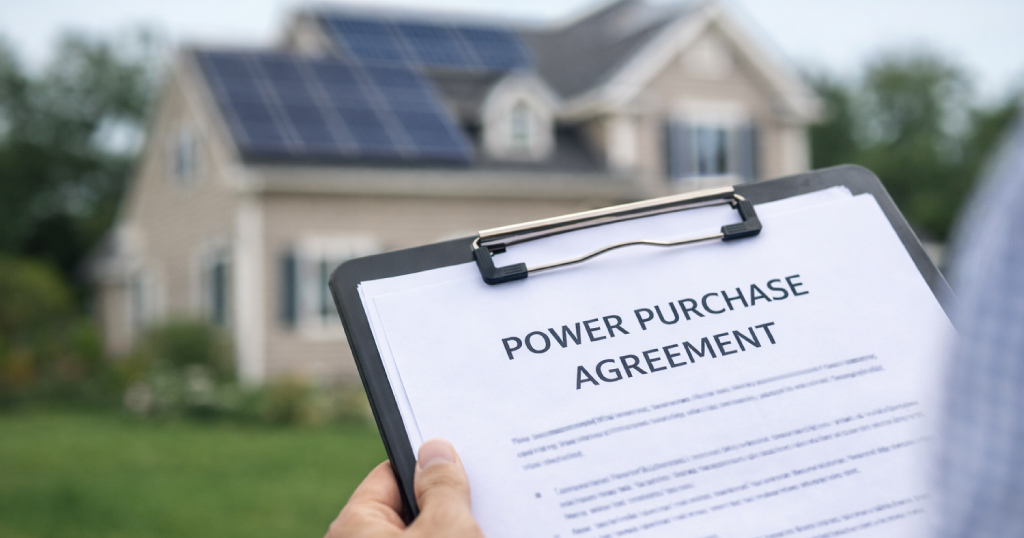
Power purchase agreements are very similar to solar leases. A third party pays for the system. They are responsible for the maintenance and performance. You host the solar system on your roof and pay for the electricity it produces.
Here is where PPAs and solar leases differ: Leases charge a fixed monthly rate regardless of how much power is being produced. PPAs charge you per kilowatt-hour of actual power generation.
Just like a traditional utility company, you will pay more in the summer when you are consuming more electricity.
However, that per kilowatt-hour rate is usually lower than the rate from a traditional utility company. Again, these kinds of TPO methods usually include annual rate increases of about 1-3%.
What are the pros of a solar lease/PPA?
- No upfront investment.
- You often pay less than you would from a traditional utility company.
- You are not responsible for insuring or maintaining your solar system. So if your solar system is experiencing a performance issue, your TPO company will come out and fix it. This can certainly take a load off your shoulders.
However, since the responsibility is on someone else, that TPO company better be reliable and responsive. If you have ever rented, then you might have experienced a bad landlord. Someone who isn’t in a rush to fix your heater even though it is the middle of winter. Not all landlords or TPO companies are like that, of course. Just make sure you’re working with someone you can trust.
What are the cons of a solar lease/PPA?
- Over the system’s lifespan, you might not save as much money as you would have if you had owned it. Of course, this cost-benefit analysis varies from person to person and from situation to situation.
- These kinds of things tend to come with 50+ page service agreements. So the actual contract can be confusing while ownership is pretty straight forward. Always read the fine print.
- Since you don’t own the system but your home hosts it, leases/PPAs can complicate selling your home. Normally, you can transfer the TPO to the new homeowners, but some buyers may be wary of such a complication. You can also buy the system outright if you don’t want to transfer the lease. Some may have termination fees. Always read the fine print!
What happens after a Solar lease or PPA ends?
Once the solar lease is over a few things can happen:
- You can renew the agreement.
- You can buy the system outright often at a discounted cost.
- Or you can have the company remove their system, effectively ending the lease.
What should I look for in TPO contracts?
- What’s the starting rate per kilowatt-hour?
- Is there an annual rate increase and for how much?
- What’s the term length?
- What are the end-of-term options?
- What happens if you sell your home? Can you transfer the lease or will you need to buy it outright?
- What is the buyout formula?
- Are there any production guarantees?
The goal of all these questions is to calculate the total cost of the TPO over its full term. That way you can compare your TPO options to ownership options like a loan. How much would you save with one financing structure compared to another? How much would you save if you didn’t go solar and just stuck with your utility company?
What is a solar co-op?
The secret third option is community solar. Community solar is when a community takes collective action to solarize their region. Basically, you and your neighbors are using collective bargaining to go solar at a group discount.
“Imagine walking into a solar company’s office with 50 or 100 of your neighbors and saying, ‘We all want to get community solar. What kind of deal can you give us?’”
~ Solar United Neighbors (SUN).
It is important to note that while co-ops use group purchasing power, the members enjoy individual ownership of their individual solar system.
However, it doesn’t have to be just your neighbors. It can also be small businesses, public institutions like libraries or schools, or shared spaces like parking lots. Every member of the co-op doesn’t even need to live in the same neighborhood. Co-ops can span multiple counties.

How do I start a solar co-op?
Our best recommendation for starting a solar co-op is to work with a nonprofit like Solar United Neighbors (SUN). They’ve helped dozens of communities go solar, so they can probably help you.
First, nonprofit organizers designate an area to focus on. Then, SUN holds informational community sessions where residents can ask questions. They explain how this whole co-op thing works, options for financing, and what to expect after going solar. SUN also posts seminars on its website.
SUN needs to get enough residents on board to reach their threshold (30-100 members). Once successful, SUN solicits proposals from reputable, trusted solar installers. The bidding is competitive, encouraging that group discount, but they are not looking for the cheapest. SUN tightly vets installers on everything from warranties to customer satisfaction.
The finalists are then presented to a board of co-op members. These are the residents who will actually receive the installations, so they get the final say. We actually won a proposal request from SUN for their Hampton Roads Co-op. Not to toot our own horn, but we are very proud of our work in that community. EnergySage has even recognized us as one of the best solar companies in Virginia.
The one major drawback to solar co-ops…
The one major drawback to solar co-ops is that state regulations can complicate an already intricate process. Because of this, there are only a few states seeing growth in community solar. For example, New York added an astonishing 145 Megawatts of community solar capacity in the third quarter of 2025. And this is largely thanks to systems like the Community Distributed Generation (CDG) program and the NY-Sun program.
Which TPO options should you choose for your residential solar project?
Well, it’s hard to say. Our best recommendation is to start with a free, zero-risk solar analysis. That will give you an idea of your property’s potential. From there, you’ll have the information you need to make a smart decision.