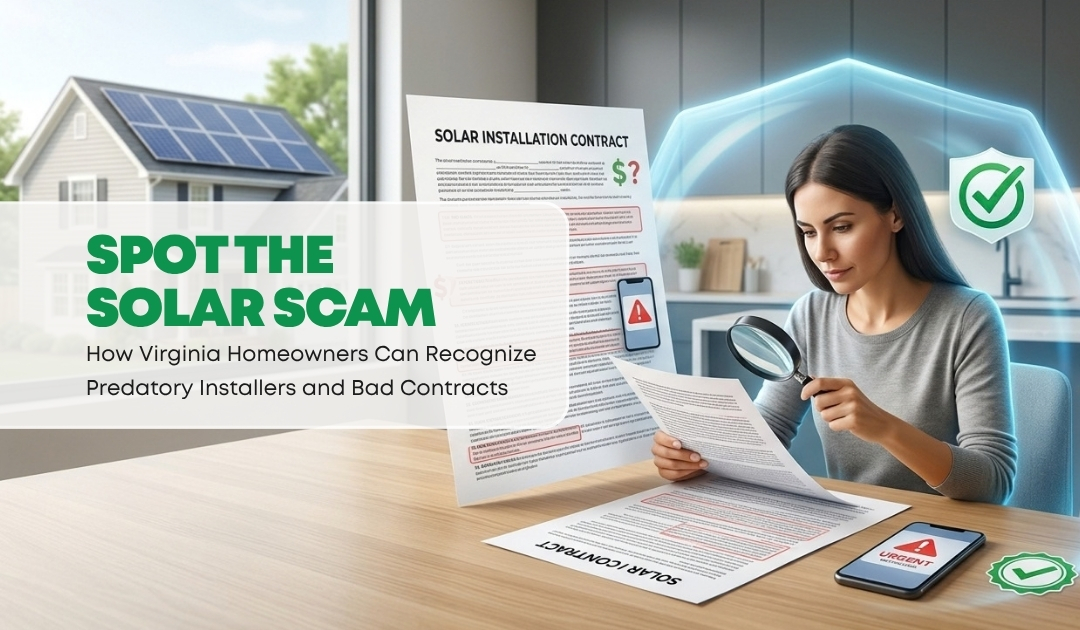
Quick Answer: Solar scams Virginia consumer protection starts with recognizing a few repeatable warning signs: false utility-affiliation claims, same-day signing pressure, and vague or inflated savings promises. Virginia gives homeowners concrete ways to verify a company before signing anything, including free contractor license lookups through the Department of Professional and Occupational Regulation (DPOR) and an incoming state Solar Consumer Protection Act.
This guide walks through the red flags to watch for and the exact steps to confirm you’re working with a legitimate, licensed installer.
What Are the Most Common Solar Scams in Virginia Right Now?
Most predatory solar sales tactics reported to Virginia consumer protection agencies fall into a handful of repeatable patterns:
- Fake utility-affiliation claims, a solicitor implies they’re calling on behalf of your electricity provider or need to “audit” your bill to qualify you for a special rebate
- “Free” or “$0-down” framing that omits the cost structure behind a long-term lease or loan
- High-pressure, same-day signing, usually paired with a claim that a rate or promotion expires in 24–48 hours
- Vague contract terms, no written system specs, no clear price, no firm financing terms
- An installer that cannot verify the contractor licenses and trade credentials required for the work.
| Red Flag | What It Really Means | What a Legitimate Installer Does |
| “We’re calling about your utility account” | No legitimate installer needs your account number or billing history to give an estimate | Explains why billing or usage information is needed and protects sensitive account details |
| “This rate expires today” | Manufactured urgency to prevent comparison shopping | Gives you time to compare multiple quotes |
| “Government will pay for your panels” | Misrepresents an expired or nonexistent program | Explains current incentive status accurately, in writing |
| No written contract before signing | Illegal under Virginia’s incoming consumer protection law | Provides full written disclosure of costs, specs, and financing terms |
| Sales rep can’t confirm license number | Company may be unlicensed or using unlicensed subcontractors | Discloses license number and uses an in-house, licensed crew |
Is “Free Solar” or a Government-Paid System Real?
No, there is no current federal program that pays for a homeowner’s solar system outright. The 30% federal residential solar tax credit expired December 31, 2025, so claims of “free solar,” federal rebates, or the state paying for your system should raise red flags. If you’re considering a Virginia solar installation company, make sure you understand the available financing, incentives, and actual costs before signing an agreement.
Virginia homeowners can still save through Switch Together, a group-buying program offering roughly 23% average installation discounts. It’s a legitimate purchasing discount.
Why Do Some Sales Reps Push You to Sign the Same Day?
Urgency is one of the clearest scam signals in door-to-door solar sales. Tactics include:
- Claiming a specific rate or incentive expires within 24–48 hours
- Asking you to sign on a tablet immediately, without leaving a physical copy of the contract
- Discouraging you from getting a second quote (“we’re the only ones who can offer this price”)
A legitimate installer expects, and encourages, you to compare quotes. Getting at least three quotes from licensed installers, and comparing them on a price-per-watt basis, is one of the simplest ways to catch an inflated offer before you sign anything.
What Solar Financing Scams Should I Watch For?
Financing is where a lot of the damage happens, because the issues often don’t show up until months after signing:
- Hidden loan escalators, a low introductory payment for the first 12–18 months that assumes you’ll apply a tax credit toward the loan principal; if you don’t, the payment jumps sharply
- Undisclosed dealer or origination fees built into the system price rather than itemized
- Vague lease or PPA terms with no clear escalator rate or end-of-term buyout terms in writing
To be clear on terminology, since “lease vs. PPA” comes up constantly in scam complaints filed with Virginia consumer protection offices:
| Financing Type | What It Means | Available in Virginia? |
| Cash purchase | You own the system outright from day one | Yes |
| Solar loan | You finance the purchase; you own the system | Yes, $0-down options available for qualified homeowners |
| Solar lease | You pay a fixed monthly fee to use a system owned by the installer | Yes |
| Power Purchase Agreement (PPA) | You pay per kWh produced, system owned by a third party | Not currently offered by every Virginia installer, confirm directly with any company that proposes one |
None of these structures is inherently a scam, leases and loans are both legitimate, common ways to go solar in Virginia. The scam risk shows up when the terms aren’t disclosed clearly in writing.
How Do I Verify a Solar Company’s License in Virginia?
- Search the company on the Virginia DPOR license lookup — confirm the license is active and matches the exact business name on your contract
- Check for complaint history — DPOR’s portal shows open and closed complaints against a licensed contractor
- Confirm the specific license class — residential solar installation requires a Class A contractor license in Virginia
- Ask for the license number directly — a legitimate sales rep or installer will provide it without hesitation
Solar Scams Virginia Consumer Protection Resources You Can Use Today
Two separate legal protections apply, and it’s worth knowing which is in effect right now:
- Federal 3-day cancellation right (in effect now): under FTC rules, most in-home sales contracts over $25 can be canceled within 3 business days, no penalty.
- Virginia’s Solar Consumer Protection Act (SB 823/HB 1439), effective January 1, 2027: this state-level law will require mandatory written contracts for residential solar sales, set a $2,500-per-violation penalty for noncompliance, and establish a state-specific 3-day cancellation right (Va. Code §54.1-1117.1 / §59.1-21.3). It is not yet in effect as of this writing, but it signals where Virginia enforcement is headed and gives homeowners signing today a preview of the disclosure standard to expect.
If you believe you’ve encountered a predatory solar company, a complaint can be filed with DPOR or the Virginia Attorney General’s Consumer Protection division, the same office that handles broader consumer protection cases across the state.
Never Show a Solicitor Your Electric Bill
A general estimate doesn’t require your account number or full billing history, just approximate usage. If someone going door-to-door asks to see your bill or account number before giving you any information, treat that as a red flag rather than a standard part of the process.
FAQ
What are the most common signs of a solar scam?
Fake utility-affiliation claims, same-day signing pressure, vague or missing written contract terms, and an inability to confirm a license number are the clearest warning signs.
Are solar panels “free” under state or federal programs?
No. The federal 30% residential solar tax credit expired December 31, 2025. Any pitch describing free government-funded panels is out of date or misleading.
How can I verify if a solar company is licensed in Virginia?
Search the company on Virginia’s DPOR license lookup, confirm the license is active under the exact business name, and check for any complaint history.
What should I do if a sales rep demands to see my utility bill?
Decline. A legitimate estimate only requires general usage information.
How do solar loan escalators work, and how do I avoid them?
Some loans offer a low introductory payment assuming you’ll apply a tax credit to the principal, if you don’t, payments increase. Ask for the full payment schedule in writing, including what happens if no credit is applied.
What are my cancellation rights if I already signed a contract?
Under federal law, most in-home solar contracts can be canceled within 3 business days at no penalty. Virginia’s own state-level cancellation right takes effect January 1, 2027.
How do I report a predatory solar company in Virginia?
File a complaint with DPOR or the Virginia Attorney General’s Consumer Protection division.
What’s the difference between buying, leasing, and a PPA?
A purchase (cash or loan) means you own the system; a lease means you pay a fixed monthly fee to use a system someone else owns; a PPA means you pay per kilowatt-hour produced by a third-party-owned system. All are legitimate structures, the scam risk is in undisclosed terms.
See our transparent, no-pressure quote process, Convert Solar has completed 8,500+ installations across Virginia and Maryland over 14 years in Hampton Roads, holds a Virginia Class A contractor license, and is NABCEP-certified, with every quote backed by a written proposal and no same-day signing pressure.