
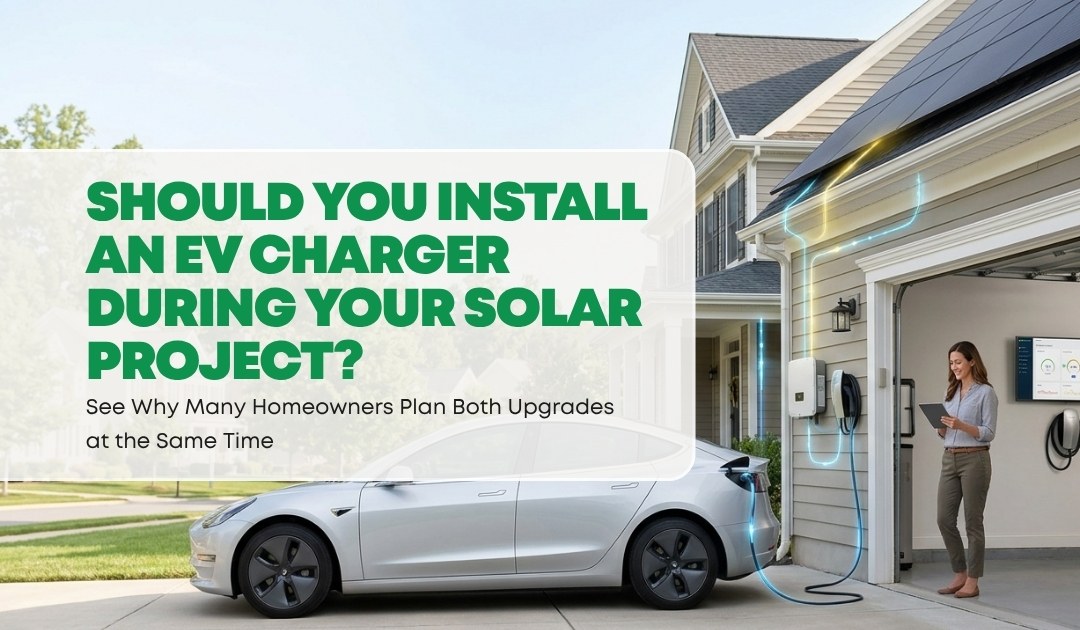
If you’re planning a solar installation and own, or expect to own, an electric vehicle, EV charger installation services are worth considering before your project begins. Bundling both installations is typically more cost-effective, avoids a second permit process, and gets your home ready for cleaner, lower-cost driving from day one.
This guide explains what Level 2 EV charger installation costs in Chesapeake, why bundling with solar saves money, how many solar panels can support your driving, and what to know about permits and available incentives.
Convert Solar provides EV charger installation services in Chesapeake through its in-house licensed electrical team, delivering one crew, one permit, and one streamlined installation from start to finish.
What Is a Level 2 EV Charger, and Why Does Every EV Owner Need One at Home?
A Level 2 home EV charger uses a 240-volt connection, similar to an oven or dryer, and adds about 15 to 60 miles of range per hour. A standard Level 1 outlet adds only 3 to 5 miles per hour, making Level 2 charging far more practical for a full overnight charge.
Level 1 vs. Level 2 EV Charging
| Level 1 | Level 2 | |
| Voltage | 120V | 240V |
| Miles added per hour | 3–5 miles | 15–60 miles |
| Full charge from empty | 24–40 hours | 4–10 hours |
| Installation required | Existing outlet | New dedicated circuit |
| Best for | Occasional short trips | Daily EV drivers |
What Level 2 Means for Chesapeake Homeowners
A Tesla Model Y driven 37 miles daily uses about 11 kWh. A Level 2 charger restores that in under two hours, compared with about five hours on Level 1. Level 2 chargers need a dedicated 40- or 50-amp, 240V circuit. In Chesapeake, installation requires a licensed electrician and permit.
How Much Do EV Charger Installation Services Cost in Chesapeake, VA?
Level 2 EV charger installation costs $500 to $4,000+ in 2026. Most Chesapeake homeowners pay $1,200 to $2,500 without a panel upgrade, depending on wiring distance, panel capacity, and permit fees.
EV Charger Installation Cost Breakdown
| Component | Cost Range |
| Charger hardware (Level 2 unit) | $300–$1,000 |
| Electrician labour and materials | $200–$3,000 |
| City of Chesapeake permit and inspection | $100–$349 |
| Panel upgrade (if needed) | $1,500–$4,000 additional |
| Conduit run for detached garage | $200–$1,500 additional |
Three Chesapeake Installation Scenarios
- Easy install ($500–$1,200 all-in): Post-2000 Chesapeake home, panel in or near garage, spare 240V capacity, short conduit run
- Standard install ($1,200–$2,500 all-in): Older home with adequate panel, moderate conduit run, standard Chesapeake permit
- Panel upgrade required ($3,000–$6,500+ all-in): Pre-1990 home with 100A or 125A panel, adding a 50A EV charger circuit can push the panel over capacity
The Panel Upgrade Question
Older homes with 100A or 125A panels may need a panel upgrade or load management device before installing a Level 2 charger. If you’re also installing solar, combining both projects avoids duplicate permits, inspections, and labor, often reducing overall electrical costs.
Should You Bundle EV Charger Installation With Solar?
For most Chesapeake homeowners, yes. Bundling EV charger installation services with solar reduces duplicate costs and helps size the system for future driving demand.
Five Reasons to Bundle
- One permit and inspection: Combining both projects consolidates permitting, inspections, and crew mobilisation.
- Lower electrical costs: Because electricians are already working near the main panel, adding the EV circuit costs less than a separate installation.
- Better solar sizing: Including your EV’s electricity use during design helps prevent an undersized solar system. Installing solar and an EV charger together can reduce permitting, electrical, and labour costs.
- Section 30C Federal Tax Credit: The federal Section 30C Alternative Fuel Vehicle Refueling Property Credit expired for EV charger installations placed in service after June 30, 2026. Qualifying residential and commercial installations placed in service on or before June 30, 2026, may have been eligible for a tax credit equal to 30% of eligible costs, up to $1,000, provided the property was located in a qualifying census tract.
- Lower driving costs: Charging with solar can reduce estimated driving costs from about $0.055 per mile on grid electricity to approximately $0.035 per mile.
How Much Does It Cost to Charge an EV With Solar Panels in Chesapeake?
Solar EV driving costs approximately $0.035 per mile, roughly 4x cheaper than gasoline and 35% cheaper than grid-charged EV driving at $0.055/mile.
These per-mile figures assume an EV efficiency of roughly 3.3 to 3.5 miles per kWh (consistent with the Tesla Model Y example used throughout this guide), a Virginia grid electricity rate in the $0.16 to $0.18/kWh range, and a levelized solar electricity cost of about $0.10/kWh based on a typical Virginia installed cost per watt amortized over a 25-year system life. Actual cost per mile depends on your vehicle’s efficiency, your local utility rate, and your system’s cost and production.
Cost Per Mile Comparison
| Charging Method | Cost per Mile | Annual Cost (13,500 miles) |
| Solar-generated electricity | ~$0.035/mile | ~$473/year |
| Home grid electricity (current VA rate) | ~$0.055/mile | ~$743/year |
| Gasoline (27 MPG, $3.50/gal) | ~$0.13/mile | ~$1,755/year |
| Public DC fast charger | ~$0.08–$0.15/mile | ~$1,080–$2,025/year |
Over 25 years, the average driver charging an EV with solar panels can save more than $14,000 compared to using grid energy and as much as $70,000 compared to fuelling a gas car.
These 25-year totals are directional estimates. They assume the per-mile cost gap shown above compounding over 25 years of driving at a consistent annual mileage, and they build in projected increases in utility and gasoline prices over that period rather than holding today’s rates flat. Actual lifetime savings will vary by household driving habits, future energy prices, and system performance.
How Solar Powers Your EV Even Without Real-Time Matching
During peak production, solar electricity can flow directly from your panels to your EV. At night, charging draws from the grid, while daytime solar production offsets that usage through net metering credits. Solar does not need to charge your EV in real time to reduce its monthly electricity use.
How Many Solar Panels Does It Take to Charge an EV in Chesapeake?
Most EVs need 6 to 9 solar panels (410W each) to offset the average American commute of 37 miles per day, in addition to whatever panels already cover your home electricity.
Additional Panels Needed by Vehicle Type
| Vehicle | Additional 410W Panels Needed |
| Efficient EV (Nissan Leaf, Tesla Model 3) | ~6 panels |
| Mid-size SUV (VW ID.4, Mustang Mach-E) | ~7 panels |
| Large truck (Ford F-150 Lightning, Cybertruck) | ~9 panels |
What This Means for Chesapeake System Sizing
A Tesla Model Y driven 13,500 miles annually uses about 4,050 kWh, roughly the output of six to seven additional solar panels in Chesapeake. Tell your installer about current or planned EV use before design begins. Convert Solar uses your 12-month electricity history and expected EV load to size the system correctly from the start.
Do EV Charger Installation Services in Chesapeake Require a Permit?
Yes. Level 2 EV charger installation typically requires a permit because it adds a dedicated 240V circuit. Permit fees generally range from $100 to $349.
Why a Permit Is Required
The charger uses a dedicated 40- or 50-amp circuit, making it new electrical work under code. Chesapeake requires this work to be permitted and inspected. Unpermitted installation may also create issues with insurance or a future home sale.
What the Permit Process Looks Like: Bundled vs. Standalone
| Bundled With Solar | Standalone | |
| Permit applications | One combined submission | Separate application |
| Inspections | One combined inspection | Separate inspection |
| Crew visits | One mobilisation | Second mobilisation |
| Permit fees | Consolidated | Additional filing fees |
| Who handles it | Convert Solar, no paperwork for homeowner | Whoever you hire |
When Convert Solar manages EV charger installation as part of a solar project, the charger circuit is included in the same permit application as the solar electrical work. The homeowner does not interact with the City of Chesapeake’s building department at any stage.
What to Look for in EV Charger Installation Services in Chesapeake
EV charger installation is electrical work. In Virginia, it must be performed by a licensed electrical contractor. Here is what to confirm before hiring:
Questions to Ask Any EV Charger Installer
- Are you licensed as a Class A or Class B electrical contractor in Virginia?
- Will you pull the electrical permit with the City of Chesapeake’s building department?
- Do you handle the inspection, or does the homeowner schedule it separately?
- If I am also installing solar, can the EV charger be included in the same project and permit?
What Convert Solar’s EV Charger Installation Services Include in Chesapeake
- City of Chesapeake permit filing, no paperwork reaches the homeowner
- GFCI protection and NEC-compliant 240V dedicated circuit
- Charger hardware selection guidance (smart vs. standard, amperage sizing)
- Inspection coordination and attendance
- Integration with solar system design when bundled
- In-house licensed electrical crew, no subcontractors
Convert Solar provides EV charger installation services through its in-house, Class A licensed electrical team. The same crew installs your solar system and Level 2 charger, giving you one contractor, one project, and one streamlined warranty.
EV Charger Installation Services From Convert Solar: One Crew, One Permit, One Project
If you’re installing solar in Chesapeake and own or plan to own an EV, adding the charger during your solar project can help reduce overall installation costs. As a trusted Virginia solar installation company, Convert Solar’s in-house electrical team can complete both installations under one project, permit, and inspection. The process begins with a no-obligation assessment of your home’s electricity usage and expected EV charging needs, ensuring your solar system is properly sized from day one.
Request a No-Obligation Quote →
Frequently Asked Questions
Should I install an EV charger with my solar project?
For most Chesapeake homeowners, yes. Bundling reduces duplicate permitting, electrical work, and crew visits while ensuring the solar system accounts for EV charging.
How much does Level 2 charger installation cost in Chesapeake?
A standard installation typically costs $1,200–$2,500. Projects requiring a panel upgrade may cost $3,000–$6,500 or more.
Do I need a permit for an EV charger?
Yes. A Level 2 charger requires a new dedicated 240V circuit and an electrical permit. Convert Solar handles the permitting process.
How many solar panels does it take to charge an EV?
Most EV owners need about six to nine additional 410W panels, depending on annual mileage, vehicle efficiency, and solar production.
How much does solar EV charging cost?
Solar-powered driving may cost about $0.035 per mile, compared with approximately $0.055 per mile using grid electricity.
What is the difference between Level 1 and Level 2 charging?
Level 1 adds about 3–5 miles of range per hour. Level 2 uses a 240V circuit and adds roughly 15–60 miles per hour.
Does Convert Solar provide EV charger installation services?
Yes. Convert Solar offers EV charger installation services in Chesapeake as part of a solar project or as a standalone installation.
What size EV charger do I need?
Most homeowners choose a 40- or 50-amp Level 2 charger. The right size depends on your vehicle, electrical panel, and daily mileage.