
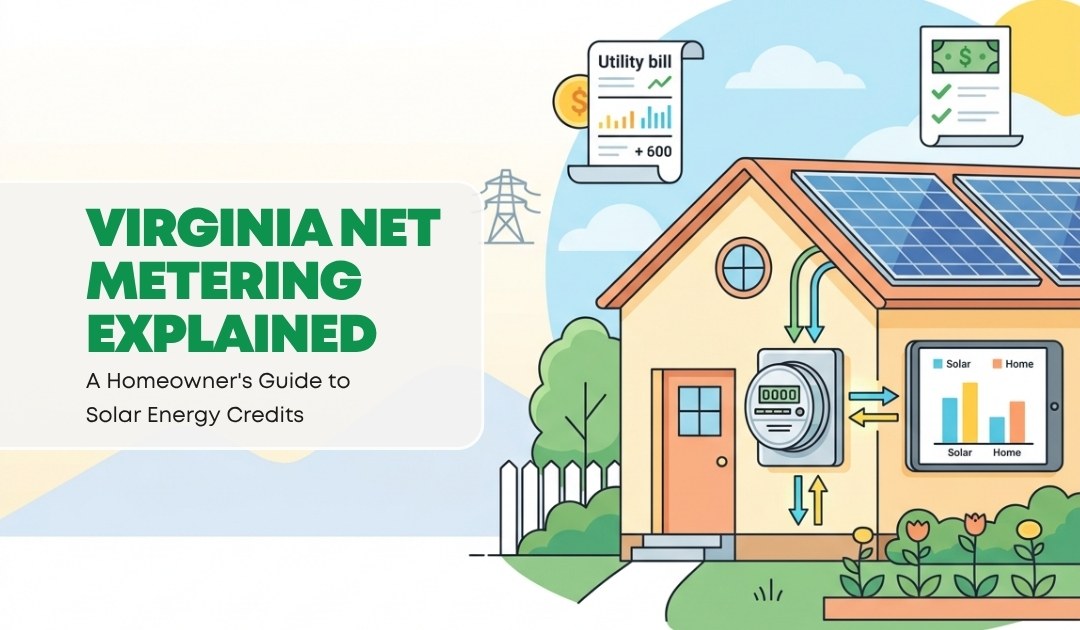
When homeowners search for Virginia net metering explained, what they usually want to know is simple: what happens to the extra electricity their solar panels produce? In most cases, that excess energy is sent to the grid and converted into bill credits that help offset electricity used at other times. Those credits are typically tied to the retail electricity rate and tracked across a 12-month period. The important catch is that net metering rules are not identical across Virginia, so the value and treatment of those credits can vary depending on your utility.
How Does Net Metering Work in Virginia?
Virginia net metering explained step by step, starting with the two directions the meter can run:
What happens when your solar panels produce more electricity than you use?
The excess flows back to the grid, and your utility credits that amount against your usage, generally at the full retail rate for the portion that offsets what you’d otherwise buy.
What happens when your home uses more electricity than your solar panels produce?
You draw from the grid as normal, same as before you had solar, offset by whatever credit balance you’ve banked.
How do net metering credits work in Virginia?
Credits accumulate over a 12-month netting period rather than being settled in real time, so a sunny month in June can offset a higher-usage month in January.
Are net metering credits the same as cash payments?
No. By default, they’re bill credits, not cash. Some utilities allow a customer to specifically request compensation for true excess generation instead of banking it forward, but that requires an explicit opt-in made before the 12-month period begins, it isn’t automatic, and it isn’t a “check in the mail” by default.
What happens to unused net metering credits?
They’re reconciled at an annual true-up. Virginia regulations require systems to be sized so they don’t produce significantly more than the customer can use, which is exactly why accurate system sizing (based on your actual usage, not a rule of thumb) matters for getting real value out of net metering.
Who Is Eligible for Net Metering in Virginia?
Virginia’s investor-owned utilities are required by state law to offer net metering to eligible residential and commercial customers. The residential program applies to systems up to 25 kW, the same size threshold used for the state’s residential solar property tax exemption.
Electric cooperatives generally set their own net metering terms through their own governing boards rather than following the same regulatory process; if you’re served by a cooperative, confirm your specific terms directly with them rather than assuming statewide rules apply.
Net Metering Rules for Virginia’s Largest Utility
Virginia’s largest investor-owned utility went through a State Corporation Commission (SCC) review of its net metering program, finalized April 30, 2026. The outcome:
- Full 1:1 retail-rate credit preserved for netting within your usage
- A $1/month administrative fee for new net-metering customers
- Any true annual excess beyond your usage is settled at a separate year-end rate of $0.05829/kWh
Electric Cooperative Net Metering Rules
If you’re served by an electric cooperative rather than an investor-owned utility, your net metering terms are typically set by your co-op’s own board rather than the same statewide proceedings described above. If you’re looking for a solar company in Henrico and Chester, VA, it’s also important to check with your specific cooperative for the current net metering terms that apply to your property.
How Does Your Electric Bill Change With Solar Net Metering?
What charges can remain on your electric bill?
Even with net metering, a minimum monthly customer/connection charge typically remains, and a standby charge may apply above a certain system size (see below).
Can I eliminate my electric bill entirely?
For most homeowners, no. Some individual months can hit close to $0, but the combination of a minimum customer charge and 12-month settlement (rather than real-time) means a fully and permanently eliminated bill isn’t the typical outcome, even with a well-sized system.
Do Net Metering Rules Change If Your System Is Over 15 kW?
Under HB 1255 (effective July 1, 2026), the size threshold at which a standby charge can apply was raised from 15 kW to 20 kW AC. A system between 15–20 kW that would have triggered a standby charge before that date may no longer, depending on your utility’s current implementation, be worth confirming directly if your system falls in that range.
What Is the Maximum Size Solar System I Can Install?
For residential net metering eligibility, Virginia’s threshold is 25 kW.
How Is a Solar System Sized for Net Metering?
Convert Solar sizes every system from a homeowner’s actual 12-month electricity usage since oversizing beyond what net metering can actually credit at full value doesn’t pay off proportionally.
What Happens to Net Metering When You Add Battery Storage?
Adding battery storage doesn’t change your net metering credit terms. It changes when you draw on your own stored production versus the grid, primarily a resilience and self-consumption factor, not a change to how your credits are calculated. See our Battery Storage guide for the full picture.
What Is the Difference Between Net Metering and SRECs in Virginia?
Net metering reduces what you pay for grid electricity by crediting your excess production. For homeowners considering a solar company in Richmond, SRECs are a separate, sellable certificate earned per megawatt-hour produced and sold on the open market. This is a different mechanism entirely, and your system can participate in both at the same time. See our guide to how much you can save for how SREC income factors into overall savings.
What Happens to Net Metering If You Move or Sell Your Home?
Net metering is tied to the account/meter at the property, so it typically transfers to a new owner along with the system, assuming the system stays with the home.
Can I Apply Net Metering Credits to Multiple Properties?
No, net metering applies per individual utility account/meter. Credits earned at one property can’t be applied to reduce a bill at a separate property.
What Happens to My Solar Panels During a Power Outage?
Standard grid-tied systems shut off automatically during a utility outage for safety reasons (anti-islanding), net metering credits don’t provide backup power. Battery storage is what enables backup during an outage; see the Battery Storage guide linked above.
Are Virginia’s Net Metering Rules Locked In Forever?
No, both proceedings described above were periodic SCC reviews, not permanent one-time settlements. Virginia law requires these programs to be periodically revisited. That said, both recent proceedings mostly preserved the core value proposition for solar owners, which is a meaningfully different outcome than net metering changes seen in some other states.
Is Net Metering Worth It for Virginia Homeowners?
What are the downsides of net metering? To be direct about the tradeoffs: it settles over a 12-month cycle rather than real time, true excess generation beyond your usage is compensated below full retail rate, terms can change through future SCC proceedings, and it doesn’t eliminate your bill entirely.
Weighed against the core benefit, a full 1:1 retail-rate credit for netting within your usage, currently preserved by both of Virginia’s major utility proceedings, most homeowners with a correctly sized system find it a meaningful part of the overall economics.
How to Enroll in Net Metering in Virginia
Enrollment generally involves a pre-approval application, licensed-electrician sign-off on the installation, a meter exchange, and an annual account review. Convert Solar manages utility interconnection paperwork in-house as part of a full-service installation, see What Does a Full-Service Solar Installation Include? for the complete process.
Can You Sell Excess Electricity Back?
Not by default, the standard mechanism is a bill credit rather than a sale. Under a Dominion Energy rate, some utilities may allow homeowners to specifically request compensation for true excess generation instead of banking it, but this requires an explicit request made in advance and is not an automatic payment.
Get Started With Solar and Net Metering in Virginia
With Virginia net metering explained clearly upfront, the biggest thing to remember is that the specific terms depend on your utility, and they’re worth understanding before you sign anything. Net metering is currently a genuinely favorable, well-tested policy in Virginia. Request a no-obligation assessment to see exactly how net metering would apply to your home.
FAQs
What is net metering?
Net metering is the policy that credits homeowners with solar for excess electricity their system sends back to the grid, generally at the full retail rate, reconciled over a 12-month cycle rather than in real time.
Does Virginia’s largest utility offer net metering?
Yes. Following an April 2026 SCC ruling, the 1:1 retail-rate credit remains in place for netting within your usage, with a $1/month administrative fee for new net-metering customers and a separate, lower rate for true annual excess.
Does Appalachian Power offer net metering?
Yes. A 2025 SCC ruling preserved the 1:1 retail-rate credit and the 12-month netting period, though true excess generation beyond your annual usage is now compensated at a reduced rate rather than full retail.
How do I enroll?
Enrollment involves a pre-approval application, licensed-electrician sign-off, and a meter exchange, followed by annual account reviews. A full-service installer typically handles the utility paperwork on your behalf.
Can I sell excess electricity?
Not by default, net metering pays out as a bill credit. Some utilities allow you to request compensation for true excess generation instead, but only if requested in advance, not automatically.