Virginia solar consumer protection laws are strengthening as residential solar grows and more homeowners encounter aggressive sales tactics, unclear financing terms, and inflated savings claims.
Beginning January 1, 2027, SB 823 and HB 1439 require solar companies to provide written contracts before a residential solar sale, lease, loan, or power purchase agreement is signed. These contracts must clearly explain system specifications, performance guarantees, and financing terms, with willful violations subject to civil penalties of up to $2,500 per violation. For homeowners asking are solar panels worth it in Virginia, these new consumer protection laws provide greater transparency and help ensure you have the information needed to make an informed decision before signing a contract.
Virginia homeowners also have protections under existing law that apply to solar contracts signed today. This guide explains your current rights, what changes in 2027, what a trustworthy solar contract should include, and what to do when an agreement raises concerns.
Convert Solar has completed more than 8,500 Virginia installations since 2012. We created this guide to help homeowners compare solar companies, review contracts carefully, and make informed decisions.
What Is Virginia’s New Solar Consumer Protection Law?
Virginia solar consumer protection rules taking effect January 1, 2027, require written disclosures and contracts before a residential solar sale, lease, loan, or power purchase agreement is signed. Willful violations may carry penalties of up to $2,500 per violation.
What the Law Requires: Starting January 1, 2027
The new consumer protections protect homeowners from predatory practices by requiring a consumer disclosure form with clearly laid out system specifications, costs, and financing options, signed prior to the contract.
Every residential solar contract in Virginia must include:
- Solar company information — the installer’s legal name and Virginia contractor licence number
- System design specifications — panel brand, model, number of panels, system size in kilowatts, and inverter type
- Performance or production guarantees — what the system is warranted to produce and over what period, stated clearly in writing
- Invoice and payment details — a complete breakdown of total installed cost, any down payment, financing terms, interest rate, and monthly payment amounts
- Financing disclosure — for leases, loans, and power purchase agreements, a clear statement of the total amount paid over the full term
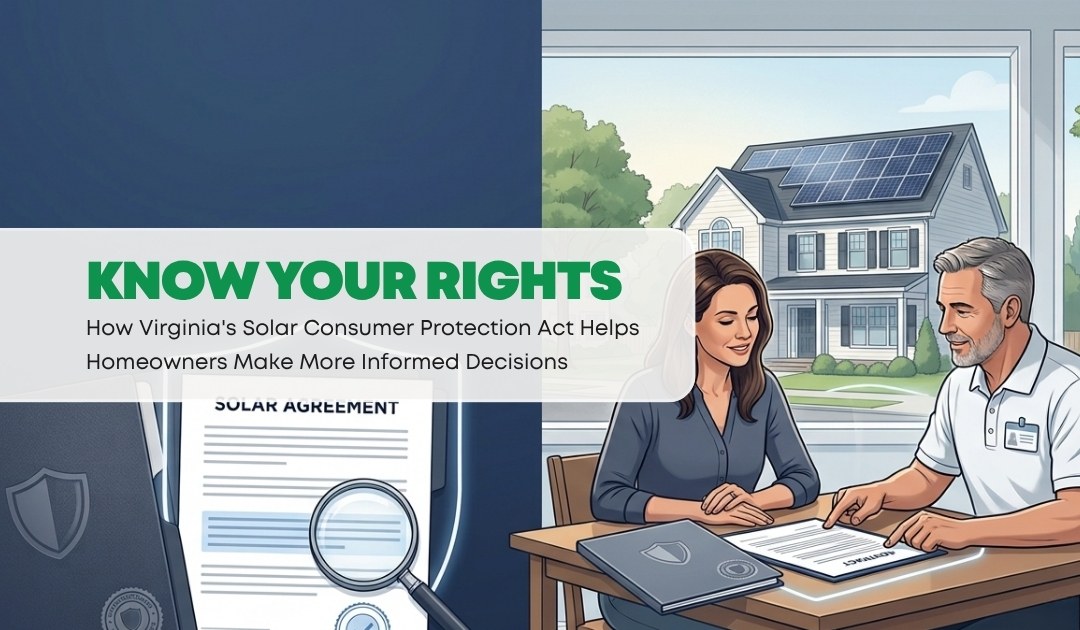
The law strengthens residential solar consumer protection by requiring a clear disclosure form that explains system specifications, costs, and financing terms before a contract is signed.
Civil Penalty
Willful violations may result in penalties of up to $2,500 per violation. Multiple missing disclosures or contract terms may be treated as separate violations.
Effective Date
The law takes effect January 1, 2027. By then, the Board for Contractors must issue the required disclosure form and update its regulations. Contracts signed before that date remain subject to existing Virginia consumer protection laws.
Virginia Solar Consumer Protection Rights You Have Right Now
The new law does not take effect until January 1, 2027. But Virginia homeowners have significant rights under existing law today, and those rights apply to every solar contract signed in 2026.
1. The Three-Day Cancellation Right
If you sign a solar contract at your home or anywhere outside the company’s permanent business location, Virginia law may give you until midnight of the third business day to cancel. This protection applies to qualifying home solicitation sales of $25 or more under Virginia Code § 59.1-21.3.
Key Cancellation Rules
- Cancel in writing using the address listed in the contract.
- Waivers are unenforceable. A seller cannot require you to give up your cancellation right.
- You may have up to 30 days to cancel if the seller misrepresented the transaction.
- The contract must clearly explain your rights and include instructions for submitting a cancellation.
- The FTC Cooling-Off Rule also provides three business days to cancel qualifying in-home sales over $25.
2. Virginia Consumer Protection Act
Virginia law prohibits false or misleading claims in consumer transactions. A solar company may violate the Act by overstating production or savings, hiding financing costs, or misrepresenting tax credit eligibility. Whether you’re exploring residential solar Suffolk VA or comparing installers elsewhere in the state, it’s important to work with a reputable company that provides accurate information, transparent pricing, and realistic performance expectations.
Consumers may recover actual damages or $1,000 per willful violation, whichever is greater, plus attorney’s fees.
3. Contractor Licensing
Virginia solar installers performing electrical work must hold a valid contractor license through the Board for Contractors. Homeowners should verify a company’s license with the Virginia Department of Professional and Occupational Regulation before signing.
What Should a Virginia Solar Contract Include?
Whether you are signing before or after January 1, 2027, a trustworthy Virginia solar contract should already include everything the new law will require. Any contract missing these elements warrants serious scrutiny.
Virginia Solar Contract Checklist
| What It Should Include | Why It Matters | Red Flag if Missing |
| Installer’s Virginia contractor licence number | Confirms the company is legally operating | Could mean unlicensed contractor |
| Panel brand, model, wattage, and panel count | Defines what you are actually buying | “Panels TBD” is not acceptable |
| System size in kilowatts (DC and AC) | Essential for evaluating the proposal | Cannot compare quotes without this |
| Inverter type and brand | Affects performance and warranty | Generic “inverter” language is vague |
| Written production guarantee (kWh per year) | Makes savings projections enforceable | Verbal only = unenforceable |
| Total installed cost — itemised | Full price transparency | One lump number is insufficient |
| Financing terms — APR, total cost over term, monthly payment | Prevents buried interest costs | Missing APR is a serious warning sign |
| Warranty terms — who services it and for how long | Determines real warranty value | Third-party servicer ≠ same protection |
| Permit handling — who files, who pays | Avoids surprises post-signing | Homeowner should not be filing permits |
| Three-day cancellation notice (door-to-door sales) | Required by Virginia law | Absence may extend your cancellation right |
Red Flags in Predatory Virginia Solar Contracts
Watch for these warning signs:
- Savings claims with no written production estimate or guarantee
- “$0 down” financing that hides the APR or total repayment cost
- System specifications marked “subject to change”
- No valid Virginia contractor license number
- Pressure to sign the same day
- Claims that new residential solar purchases still qualify for the 30% federal tax credit
The federal Residential Clean Energy Credit is unavailable for residential solar expenditures made after December 31, 2025. Even so, homeowners asking are solar panels worth it in Virginia should consider factors such as rising electricity rates, net metering, financing options, and long-term energy savings when evaluating solar. Before signing a contract, it’s also important to verify the installer’s license through Virginia’s DPOR license lookup to ensure you’re working with a qualified contractor.
How to Verify a Virginia Solar Installer
Virginia solar installers must hold the appropriate contractor license for the work they perform. Before signing:
- Search the company’s legal name through the DPOR License Lookup.
- Confirm the license is active and covers the proposed work.
- Review any disciplinary history.
- Make sure the company name matches the contract.
A company that cannot provide a valid license number should not perform the installation. Report suspected unlicensed activity to DPOR or the Virginia Attorney General’s Office. When researching the Cost of Solar Panels Chesapeake, VA, verifying that your installer is properly licensed and qualified is just as important as comparing prices, helping ensure your investment is protected and your system is installed safely and to code.
Beginning January 1, 2027, Virginia’s residential solar contract requirements will also require the installer’s contractor license number to appear in the agreement.
Can I Cancel a Solar Contract in Virginia?
It depends on when and how you signed. If a solar company came to your home or you signed anywhere that is not their permanent place of business, Virginia law gives you three business days to cancel in writing. If you’re considering residential solar Suffolk VA, understanding your cancellation rights can help you make a confident and informed decision before moving forward with your installation.
Your Three-Day Cancellation Window by Day Signed
| Day You Signed | Cancellation Deadline |
| Monday | Thursday midnight |
| Tuesday | Friday midnight |
| Wednesday | Monday midnight |
| Thursday | Tuesday midnight |
| Friday | Wednesday midnight |
| Saturday | Wednesday midnight |
| Sunday | Thursday midnight |
Business days exclude Sundays and federal holidays.
How to Cancel a Virginia Solar Contract
- Write a cancellation notice — state clearly you are cancelling the agreement, including the date you signed, your name, and your address. It does not need to be formal.
- Send it in writing — certified mail to the address in the contract is strongly recommended so you have proof of delivery and date
- Keep a copy of everything — the cancellation notice, the mailing receipt, and the original contract
What the Seller Must Do After Cancellation
- Within 10 days: Return any deposit or payment you made
- Within 20 days: Retrieve any equipment or goods left at your property
- You are not required to return goods until the seller comes to collect them
If More Than Three Days Have Passed
You may have up to 30 days to cancel if the solar company misrepresented the savings, financing costs, tax credit eligibility, or purpose of the transaction. Speak with a Virginia consumer protection attorney to determine whether this applies. This information is not legal advice. If you’re comparing providers, whether you’re working with a local installer or a solar company in Richmond VA, reviewing contract terms carefully before signing can help protect your investment.
What Door-to-Door Solar Companies Cannot Do in Virginia
Virginia and federal law set clear rules for how solar companies market and sell to homeowners. Many consumer complaints stem from violations of these requirements.
What Door-to-Door Solar Salespeople Cannot Do
Solar salespeople cannot:
- Pressure you to waive your cancellation rights
- Omit the required cancellation notice
- Use a contract written in a different language than the sales presentation
- Present estimated savings as guaranteed results
- Misrepresent tax credit eligibility
- Perform installation work without a valid Virginia contractor license
Urgent sales tactics do not eliminate your legal right to review or cancel a qualifying contract.
How to Report a Violation
| Agency | How to Report |
| Virginia Attorney General | oag.state.va.us — file a consumer complaint |
| DPOR (contractor issues) | DPOR.virginia.gov/complaints |
| Federal Trade Commission | ftc.gov/complaint |
| Better Business Bureau | bbb.org |
How Virginia Solar Consumer Protection Strengthens on January 1, 2027
Virginia’s new solar disclosure and contract rules do not take effect until January 1, 2027. For contracts signed in 2026, homeowners are still protected by:
- The Virginia Home Solicitation Sales Act
- The Virginia Consumer Protection Act
- DPOR contractor licensing requirements
- The FTC Cooling-Off Rule
These laws may provide cancellation rights, protection from misleading claims, and recourse against unlicensed contractors.
What Changes Starting January 1, 2027
| Requirement | Before January 1, 2027 | After January 1, 2027 |
| Mandatory consumer disclosure form | Not required | Required before signing |
| Written contract with system specs | Best practice only | Legally required |
| Performance guarantees in writing | Best practice only | Legally required |
| APR and total financing cost disclosed | Required under lending laws | Specifically required in solar contract |
| Contractor licence number in contract | Not mandated | Legally required |
| Civil penalty for violations | Not available | Up to $2,500 per willful violation |
Trustworthy solar installers already provide clear system specifications, financing terms, and written production commitments. The new law simply makes these practices the minimum standard for Virginia solar consumer protection beginning in 2027.
What to Do After Signing a Solar Contract
If the savings, payment terms, or sales process raise concerns, follow these Virginia solar consumer protection steps:
1. Check the Cancellation Window
If you signed at home or outside the company’s permanent office, you may have three business days to cancel. Send written notice promptly and keep proof of delivery.
2. Review the Contract
Check for the contractor license number, system specifications, production estimates, APR, and total financing cost. Missing or unclear terms deserve closer review.
3. Verify the Installer’s License
Search the company through Virginia’s DPOR License Lookup. Suspected unlicensed activity can be reported to DPOR.
4. Review the Financial Projections
Compare the proposed savings, net metering credits, system output, and financing costs with your actual energy use.
5. Request a Contract Review
Convert Solar can review your proposal at no cost and identify unclear assumptions, incomplete specifications, or unrealistic projections. There is no obligation to move forward.
Convert Solar is not a law firm and does not provide legal advice. For guidance on your rights or contract cancellation, consult a qualified Virginia consumer protection attorney.
Submit Your Contract for Review →
How Convert Solar Supports Virginia Solar Consumer Protection
Convert Solar has served Virginia homeowners since 2012. Every proposal includes:
- A valid Virginia Class A AES contractor license number
- Complete panel, inverter, system size, and design specifications
- Written production estimates with clear assumptions
- Full financing details, including cost, APR, payment, and term
- A 25-year warranty covering parts and workmanship
- Installation and service by our in-house team
- No door-to-door sales or high-pressure signing tactics
- Full respect for applicable cancellation rights
These practices reflect how a transparent solar company should operate. Beginning January 1, 2027, many will become minimum requirements under Virginia’s new consumer protection standards.
Have a Virginia Solar Contract You Are Not Sure About?
Convert Solar reviews Virginia solar proposals for realistic savings projections, complete system specifications, and alignment with the state’s 2027 consumer protection requirements. With 8,500+ Virginia installations since 2012, our team knows what a clear, complete solar proposal should include, and which terms deserve closer review. We can also help homeowners plan for future energy needs, including integrating ev car chargers for home with a properly sized residential solar system.
Submit Your Contract for Review — No Charge, No Obligation →
Frequently Asked Questions
What is Virginia’s new solar consumer protection law?
SB 823 and HB 1439 establish new disclosure and contract requirements for residential solar sales, leases, and power purchase agreements beginning January 1, 2027. Willful violations may carry a civil penalty of up to $2,500 per violation.
Can I cancel a solar contract in Virginia?
Qualifying home solicitation sales may be canceled in writing before midnight on the third business day after signing. Any waiver of this right is unenforceable.
What should a Virginia solar contract include?
Look for the installer’s license number, system size and equipment, production estimates or guarantees, total price, APR, financing terms, warranties, and project responsibilities. Reputable solar installers VA homeowners trust should clearly document all of these details before any contract is signed.
How do I verify a solar installer’s license?
Search the company’s legal name through Virginia’s DPOR License Lookup. Confirm that its license is active, appropriate for the work, and free of unresolved disciplinary issues.
What are common door-to-door solar red flags?
Watch for pressure to sign immediately, hidden financing costs, missing cancellation notices, unrealistic savings claims, unclear equipment specifications, or false tax-credit claims.
Does the new law apply to contracts signed in 2026?
No. The new requirements take effect January 1, 2027. Contracts signed in 2026 remain subject to existing consumer protection, home solicitation, and contractor licensing laws.
What is the $2,500 penalty?
A willful violation of the new solar contract or disclosure requirements may result in a civil penalty of up to $2,500 per violation.
What should I do if I signed a questionable contract?
Check your cancellation window, review the financing and system details, verify the installer’s license, and keep copies of all documents. Contact DPOR, the Virginia Attorney General, or a qualified attorney when legal guidance is needed.
What is the Virginia Home Solicitation Sales Act?
It provides cancellation protections for qualifying sales made through solicitation at a consumer’s home. Buyers generally have until midnight of the third business day after signing to cancel in writing.
How can I identify compliance in 2027?
Starting January 1, 2027, qualifying residential solar agreements should include the required Board-issued disclosure and specified contract information. Missing or unclear documents should be reviewed before signing.